Feeds:
Posts
Comments

Archive for October, 2024

A bit later to the party with reading (actually listening) to Jonathan Haidt’s latest book but I do think there is a lot for us in education.  It is interesting to think of  Haidt’s thesis in the context of the cell phone restrictions in schools that are sweeping North America (including British Columbia this fall).

Reflecting on Jonathan Haidt’s latest work, The Anxious Generation, I can’t help but connect its themes to the stories and experiences I’m encountering in my work as superintendent. Haidt’s exploration of the growing anxiety epidemic among today’s youth speaks deeply to those of us in education, as we’re on the frontlines of witnessing what seems like a  generational shift. For those of us who have been in the system for 20 or 30 years, what we see is telling us something is different with today’s students and their families. I want to unpack some of Haidt’s key ideas and consider what they mean for our schools, our students, and us as educators.  It is also important to note upfront that Haidt’s work has not been universally accepted, and critics have loudly raised concerns (some here) about the research used. In the TED Talks Daily podcast with Elise Hu I recently listened to interviewing Haidt she challenged him as to whether he we conflating correlation for causation when it comes to young people and the impacts of social media.


The Reality of Rising Anxiety

One of the central arguments of The Anxious Generation is that young people today are struggling with unprecedented levels of anxiety, and Haidt attributes much of this to environmental changes—particularly the rise of social media, the erosion of unstructured play, and the hyper-focus on safety and risk aversion. These ideas are not new to those who have followed Haidt’s previous work or the themes that often emerge in our schools.  For a number of years now I have heard some version of the criticism that we are bubble wrapping our kids.  There was a joke that went viral recently (TikTok link here) that you just don’t see kids with casts anymore – which plays on the same theme.

In our schools, we see the consequences firsthand of anxiety: students who are scared to fail, who hesitate to take risks, who struggle with resilience. It’s no longer about just teaching math or science; it’s about teaching coping strategies and emotional literacy. What’s particularly compelling about Haidt’s perspective is the way he links this anxiety to broader societal trends—less time outdoors, overprotective parenting, and of course, the omnipresent influence of social media.

The Social Media Dilemma

Haidt dedicates significant attention to social media and its impact on young minds. This is something we’ve been grappling with in our district for years—how to embrace the positive aspects of technology while safeguarding our students from its pitfalls. I was skeptical about the restrictions on cell phones in schools that went in place this fall, but I have heard first hand from students, it is calming to know nobody has access during class – there is no Fear of Missing Out.   I have also heard from school staff that our students using social media are constantly comparing, curating, and performing, and as a result, they’re often left feeling exhausted and, yes, anxious.

One point Haidt makes is that our role isn’t to demonize social media but to create spaces where young people can better understand and manage it. This resonates deeply with me. As educators and leaders, we need to be proactive about integrating digital literacy into our curriculum—not just how to use technology, but how to navigate the emotional landscape it creates.  I think we have done the right thing over the last 15 years to teach about social media use.  Schools are the best place to build thoughtful digital skills that they can take with them outside of school.

Reclaiming Unstructured Play

Another compelling aspect of Haidt’s book is his emphasis on the importance of unstructured play. He argues that the decline of unsupervised play and exploration has left kids ill-equipped to face challenges independently. When we overly supervise, we signal to our children that the world is inherently dangerous, and this message undermines their confidence.

This makes me think about the balance we try to achieve in our schools—balancing safety and freedom. It’s not about throwing caution to the wind, but about trusting our students enough to take risks, to make mistakes, and to solve problems on their own.  I do take it as a point of pride at how guests to our school district are often so impressed (and surprised) by all the rocks and trees we have for students to play on.  They always ask, “Aren’t you worried of kids getting hurt or you getting sued?” The short answer is no.

Haidt’s call for less structured environments isn’t just about playgrounds; it’s about our classrooms too. It’s about group work, inquiry projects, and letting students take the lead, even when it means they might stumble.  A lot in this that reminds me of the work in British Columbia over the last 20 years.

A Call for Resilience

Ultimately, what stands out to me in The Anxious Generation is a call for resilience—a reminder that we need to create conditions where young people can develop the skills they need to cope with an unpredictable world. It’s a reminder that education isn’t just about academics; it’s about shaping character. It makes me reflect on the initiatives we’ve put in place—self-regulation strategies, peer support systems, and counseling services—and the role of the entire community to support mental well being and resilience and how it should not be left just to schools.

As school leaders, we must also model this resilience. We need to show that while we acknowledge the challenges, we aren’t overwhelmed by them. Haidt’s work challenges us to rethink the environment we are building—not just for our students, but for our entire school community.

Moving Forward

The Anxious Generation offers no quick fixes, and perhaps that’s the most important lesson of all. Addressing youth anxiety is complex, and it requires us all—educators, parents, and community members—to play a role. We need to balance safety with freedom, acknowledge the pressures of social media, and create environments where students feel safe enough to take risks.

It’s a journey. And while Haidt offers a sobering look at the landscape of youth mental health today, he also provides hope—hope that by making thoughtful changes, we can help this generation not just survive, but thrive.

Curious for others who have read it – what do you think? What stood out for you?

The image at the top of this post was created by Chat GPT 4.  After drafting this post I used both Chat GPT  4 and Claude to get feedback and suggestions that I incorporated to improve the readability of the post.

Read Full Post »

Staying relevant is an ongoing journey.

This is ground I have in part, covered before. In 2018, relevance was actually my word for the year. As said in that post in January of 2018, “I am desperate to be relevant.” And this still holds true and is even maybe truer. The deeper I have got in my career, the more I have wondered if my thinking is still current. With AI dominating current education conversations, I feel an even greater need to stay relevant—not just as a leader but as someone who has always valued the balance between tradition and innovation.

Staying relevant is about balancing future demands while staying rooted in core values—a balance that has felt increasingly challenging lately. My recent writings on AI are part of this journey, reflecting my effort to understand how these technologies fit into our educational landscape. I want to be in the mix with important conversations for our profession. Whether navigating AI’s rise in classrooms or leading a school district, relevance means more than keeping up with trends—it’s knowing which to embrace and which to let pass by.


Rooted in Values, Evolving with Purpose
No matter the speed of change, certain principles—trust, empathy, and consistency—act as anchors. In education, our work isn’t just to adopt new practices whether it is literacy teachings or physical activity practices, it’s to assess how they enhance the learning experience while holding fast to the human connection that students need. Having worked in West Vancouver for 18 years now, for better or worse, my values and principles are very clear and public. And during this time, I have seen education become far more student-centric and personalized.


Adapting, Not Just Adopting
The key to relevance is thoughtful adaptation. Take AI, for instance: it can enhance lesson planning and save time, but how do we ensure it aligns with our broader goals? I’ve learned in both the classroom and through sports that not every innovation will fit, and it’s okay to be selective. Relevance comes from refining the tools that genuinely serve our values.


Consistency as the Foundation for Innovation
Consistency often gets a bad reputation in fast-moving industries. However, it’s precisely this stability that enables innovation. By creating an environment where trust thrives—whether in the classroom or on the court—we allow space for risks and experimentation. In my recent post Consistency is Often a Key to Positive Change I wrote about how our long-term relationship with Dean Shareski had been instrumental in some of the key innovations in our district.


Learning Across Contexts
One of the most powerful lessons in staying relevant is recognizing how different areas of life intersect. My experiences in education continually inform my approach to coaching, and vice versa. Whether it’s understanding how to motivate a student or an athlete, the principles remain: build trust, stay consistent, and be open to learning. Relevance is about seeing these connections and applying them across all aspects of our work.


Practical Tips for Staying Relevant

Learn Something New Every Year: Challenge yourself to master one new idea each year.

Stay Engaged with the Next Generation: Relevance is often about understanding younger voices and perspectives. Having younger leaders in key positions in our district has been healthy for everyone.

Adapt with Purpose: Don’t chase every trend; stay true to what works, and thoughtfully integrate what aligns with your core mission.  I have often said, “If you think everything in schools is important you really think nothing is important.”

Ultimately, relevance isn’t just about surviving change—it’s about thriving in it. When I wrote in 2018 and said, “It is easy to do this year just like last year.  I know that in the long run, that will not work.”  This sentiment sure hits home and even with more urgency knowing that the number of years I have to contribute and make a difference is shrinking (and seemingly faster than ever). By staying grounded in our values and embracing purposeful adaptation, we remain relevant in education and life.

How are others trying to stay relevant with how quickly things are moving in education?

The image at the top of this post was produced through Chat GPT 4.

Read Full Post »

Is anyone else feeling overwhelmed by how fast AI is evolving?

It is a sentiment I hear from a lot of school superintendents. The conversation about how fast things are moving and a resignation that it is impossible to keep up are commonplace.

We definitely have some of those same feelings in West Vancouver—whether it’s choosing the right tools or simply keeping up with the pace of change. We are trying to do some specific things to stay in the game, be AI relevant and not be so anxious.  What we have done and continue to do include:

Make leading AI part of people’s jobs – While declaring anyone ‘AI experts’ is silly, assigning someone AI leadership signals its importance and provides a go-to person for questions and coordination.

Build a cross-functional team – And the team looks different than with a curriculum implementation for example.  We have school and district administrators as well as IT personnel part of our core team around AI integration.

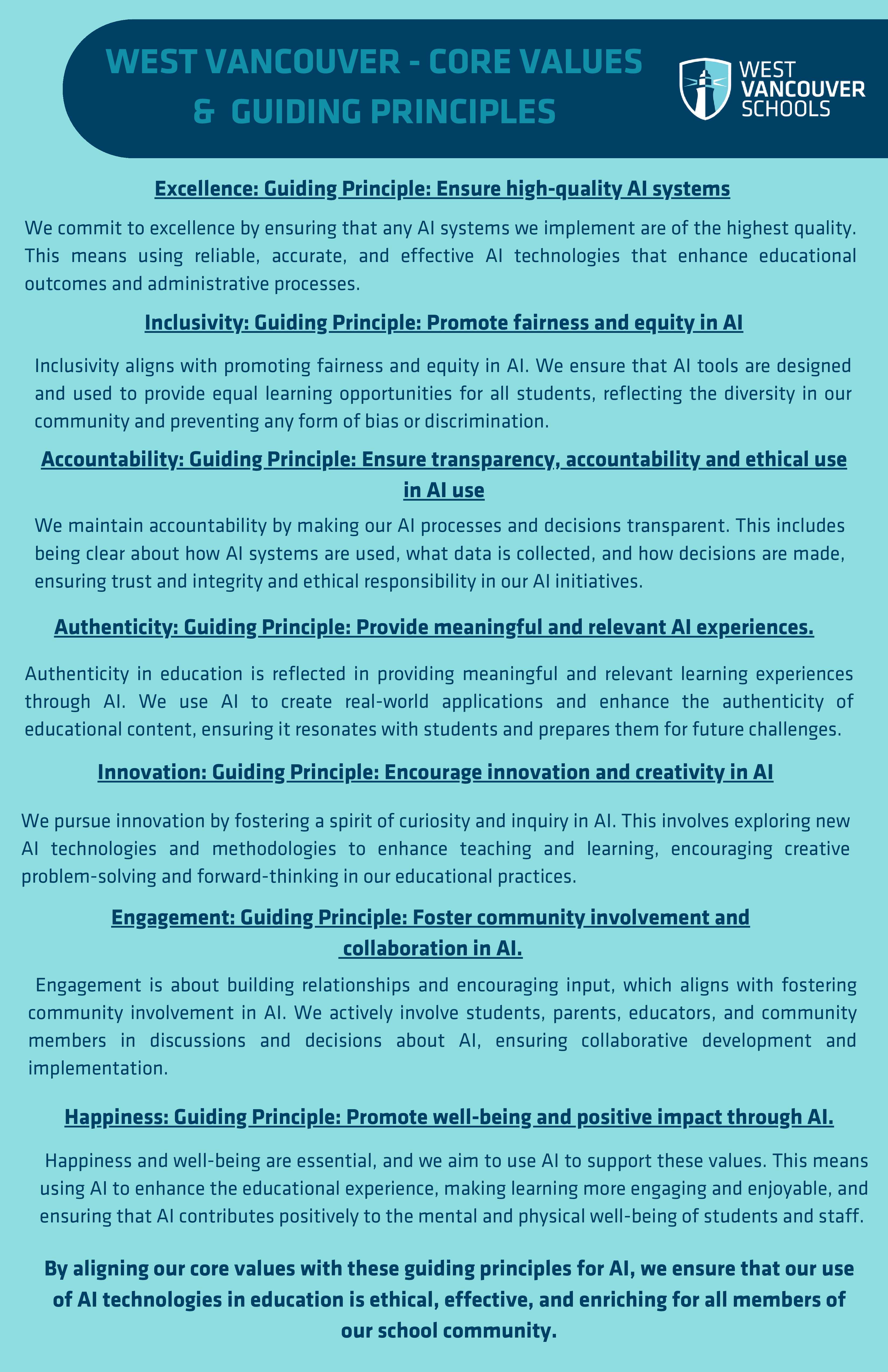
Creating and Revising Documentation – Setting clear guidelines and documentation ensures that everyone is on the same page as AI becomes more integrated into our work.  We started with our Core Values and Guiding Principles (HERE), Guidelines for the Use of AI (HERE) and When Do I Use AI visual (HERE). We also revised existing technology policies to ensure they were inclusive of AI.  

Focus on a few key AI apps – There are thousands of AI tools out there.  And it is easy to just talk about and debate which tools to use rather that just identifying a small number, supporting their use and getting on with better conversations around how AI can positively impact teaching and learning.  For us, Magic School has become a go-to tool for its ease of use and versatility in the classroom, helping both teachers and students adapt to AI technology

Engage the entire community – Often with new ideas or initiatives they apply unevenly to a school district.  One of the best things about AI is that it has uses throughout the system.  As I wrote recently there are great ways for trustees or senior leaders (HERE), or sports coaches (HERE), or parents (HERE), to use the tools to support their work and the work with students.  We have also leaned in to district-wide and school specific sessions specifically for parents.

Model AI in Action – Have you noticed this is the 5th AI related blog I have written in the last 2 months?  That is not coincidence.  My colleague Cari Wilson is also regularly blogging about it. And I have committed myself to spending a couple minutes at all meetings this year showing my learning with AI.  Over the last two weeks this has included meetings with Trustees, parents, principals, office staff and others.  

Leverage external experts – We have engaged with Alec Couros who worked with all district staff and then smaller groups in our district, and will be back this month to work with parents.  We have also spent five days with Dean Shareski and Adam Garry and are planning three more for the new year.  It is always a balance of using internal champions and outside experts. 

Join local and global AI networks – Locally we are working to network teachers inside our district and then network our schools around their AI work.  And then we have built a network of about 12 districts in Metro Vancouver that are working and sharing resources around AI. This is work that Shareski, Garry and ALP Learning are supporting.  We are also part of a network with Michael and Bailey Fullan and districts from across Canada and a network in partnership with C21 Canada, Mindshare Learning and Dell that is looking at AI practices across the country.

It is not fluke when you see things are moving fast, and you want to get out front what you need to do.  And it is never just one thing.  I am definitely bullish around the impact AI is going to have on schooling and want us to lead and guide what happens.  So we need to be doing things to look around the corner to what is coming next.

The speed of AI is exhilarating, and with so much possibility ahead, I’m excited to see where we can take it together.

The original blog post was posted into Chat GPT with the following prompt “Be a critic of this blog, what could be improved or clarified to make it more readable for the audience.” Feedback was incorporated into the final copy.  The image at the top was generated through the enterprise version of Magic School.  

Read Full Post »

How do you get everyone on board? It’s a universal question for so many initiatives. I remember when email was first introduced in schools about 30 years ago—there was skepticism, uncertainty, and hesitation. But just like email, generative AI is here, and the process of getting everyone on board feels familiar.

There’s often a desire for consistent training and understanding, so everyone feels equally equipped and confident in their use of the new tools.

I see generative AI use as a continuum for people.  Think of the continuum like learning to swim: First, you test the water with your toes (personal use), then you float (professional tasks), and finally, you dive in (working with students). Each step builds foundational confidence for the next.  We have been working through these stages as we work with colleagues.

  1. Staff  feel comfortable using it for personal use.

The first way to build comfort in generative AI tools is often in ways not directly connected to their work.  I find helping people use Chat GPT to help plan a trip, or make a recipe is a good opener. Many are nervous to use technology for something as important as work or as public as in the classroom until they feel comfortable with the tools in a more low stakes environment.  I do like some of the fun tools within Magic School (Magic School is the district wide AI tool we support in West Vancouver) like Song Creator or Teacher Jokes – which feel like ways to make AI accessible in an easy way.  For those of my generation this reminds me of how people would push email adoption by creating spaces for “Swap and Shop” or “Pet Talk” on the email platform.

For personal use, start with something fun. I’ve seen teachers use AI to generate jokes for their morning announcements or plan out their next family vacation. The low-stakes environment makes it less intimidating.

2.  Staff explore the benefits for using it for themselves professionally

Once people get comfortable within the tools personally, they can begin to use them to become more efficient professionally.  Some easy ways are creating lesson or unit plans, helping with report card comments or generating worksheets or assignments.  The value of the technology is when people to witness the efficiencies. They can then identify opportunities to reallocate time from previous tasks to focus on areas they find more valuable, such as direct engagement with students.

One teacher I spoke with recently started by using Magic School to help with lesson plans and emails. That saved her hours, and soon she was using it to generate adapted texts, which gave her more time to focus on her students.

3. Staff use the tools with students

Once adults are comfortable using it in their own practice, it is easier to use it with students.  Some of the first ways I am finding people using it with students includes adapting lessons to better allow students to move at different speeds.  Related, they are also using AI to adopt reading passages for different levels.  Teachers are also using it to create assignments that engage students with AI.  Here is a draft of a graphic that some of our staff are beginning to use around AI use with students:

In a classroom, students used generative AI to simulate historical debates, creating a dynamic learning experience that challenged them to think critically and defend their arguments using AI-generated counterpoints.

Beyond assignments and debates, students are using AI to explore different perspectives, co-create projects, and develop independent research skills. By encouraging students to build and use AI independently, we are helping them develop the critical thinking and digital literacy skills they’ll need in the future.

Ultimately, we want to ensure that the AI tools students use are not solely for passive consumption, but rather empower them to create their own AI projects and leverage AI for independent learning, without relying entirely on adult guidance.

One thing that is particularly helpful about generative AI is there is  opportunities for use across grades and subject areas and there are so many entry points whether you are just exploring or are fully integrating generative AI with your students.

The next step is simple: pick one AI tool this week and explore how it can save you time or engage your students in a new way. For me this past week, it has been Google – NotebookLM.  It is an easy (and feels a bit like it is out of a futuristic movie)  way to quickly convert documents into podcasts.  I could see some uses around uploading complicated texts in a class to share with students who may struggle with understanding the text.

Let’s continue the conversation—what are your recent experiences with AI in the classroom?

As per usual I want to be transparent with my AI use in my posts.  For this one I did post a complete draft to Chat GPT and ask for it to identify flaws in my logic.  I used this feedback in making revisions to my writing.

Read Full Post »