
Is anyone else feeling overwhelmed by how fast AI is evolving?
It is a sentiment I hear from a lot of school superintendents. The conversation about how fast things are moving and a resignation that it is impossible to keep up are commonplace.
We definitely have some of those same feelings in West Vancouver—whether it’s choosing the right tools or simply keeping up with the pace of change. We are trying to do some specific things to stay in the game, be AI relevant and not be so anxious. What we have done and continue to do include:
Make leading AI part of people’s jobs – While declaring anyone ‘AI experts’ is silly, assigning someone AI leadership signals its importance and provides a go-to person for questions and coordination.
Build a cross-functional team – And the team looks different than with a curriculum implementation for example. We have school and district administrators as well as IT personnel part of our core team around AI integration.
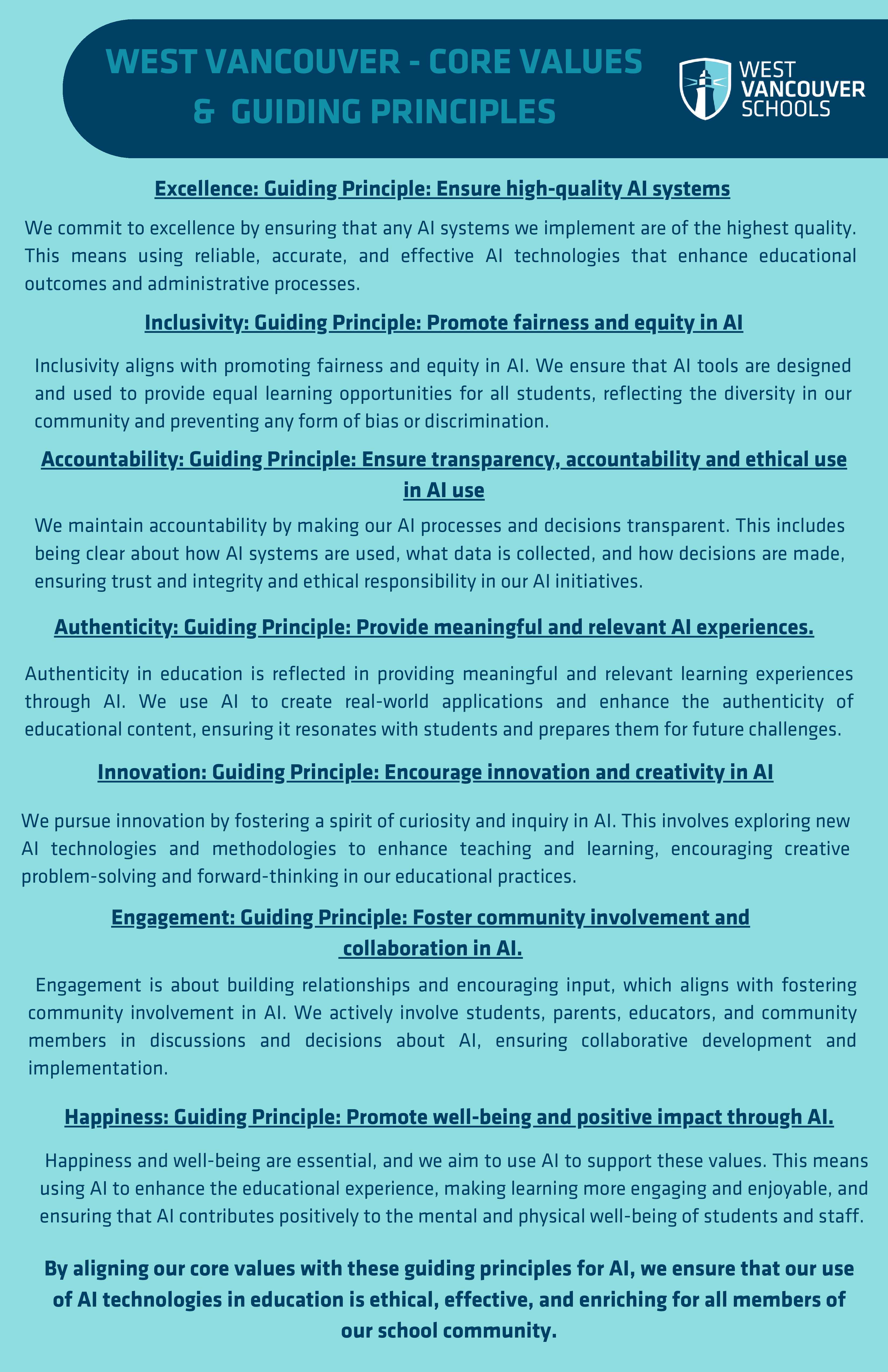
Creating and Revising Documentation – Setting clear guidelines and documentation ensures that everyone is on the same page as AI becomes more integrated into our work. We started with our Core Values and Guiding Principles (HERE), Guidelines for the Use of AI (HERE) and When Do I Use AI visual (HERE). We also revised existing technology policies to ensure they were inclusive of AI.


Focus on a few key AI apps – There are thousands of AI tools out there. And it is easy to just talk about and debate which tools to use rather that just identifying a small number, supporting their use and getting on with better conversations around how AI can positively impact teaching and learning. For us, Magic School has become a go-to tool for its ease of use and versatility in the classroom, helping both teachers and students adapt to AI technology
Engage the entire community – Often with new ideas or initiatives they apply unevenly to a school district. One of the best things about AI is that it has uses throughout the system. As I wrote recently there are great ways for trustees or senior leaders (HERE), or sports coaches (HERE), or parents (HERE), to use the tools to support their work and the work with students. We have also leaned in to district-wide and school specific sessions specifically for parents.
Model AI in Action – Have you noticed this is the 5th AI related blog I have written in the last 2 months? That is not coincidence. My colleague Cari Wilson is also regularly blogging about it. And I have committed myself to spending a couple minutes at all meetings this year showing my learning with AI. Over the last two weeks this has included meetings with Trustees, parents, principals, office staff and others.
Leverage external experts – We have engaged with Alec Couros who worked with all district staff and then smaller groups in our district, and will be back this month to work with parents. We have also spent five days with Dean Shareski and Adam Garry and are planning three more for the new year. It is always a balance of using internal champions and outside experts.
Join local and global AI networks – Locally we are working to network teachers inside our district and then network our schools around their AI work. And then we have built a network of about 12 districts in Metro Vancouver that are working and sharing resources around AI. This is work that Shareski, Garry and ALP Learning are supporting. We are also part of a network with Michael and Bailey Fullan and districts from across Canada and a network in partnership with C21 Canada, Mindshare Learning and Dell that is looking at AI practices across the country.
It is not fluke when you see things are moving fast, and you want to get out front what you need to do. And it is never just one thing. I am definitely bullish around the impact AI is going to have on schooling and want us to lead and guide what happens. So we need to be doing things to look around the corner to what is coming next.
The speed of AI is exhilarating, and with so much possibility ahead, I’m excited to see where we can take it together.
The original blog post was posted into Chat GPT with the following prompt “Be a critic of this blog, what could be improved or clarified to make it more readable for the audience.” Feedback was incorporated into the final copy. The image at the top was generated through the enterprise version of Magic School.