Feeds:
Posts
Comments

Posts Tagged ‘AI’

There’s a moment right now—an opening that Canada, and more specifically Canadian education, has an opportunity to seize.

As we watch political discourse in the United States grow increasingly polarized, with education often pulled backwards into culture wars and ideology-driven mandates, it’s hard not to reflect on the different tone we can set here in Canada. While we certainly have our challenges, we also have the chance to chart a distinctly Canadian path forward—especially when it comes to preparing our young people for the future they are entering.

To do this well, we must also recognize that any national conversation about education in Canada must begin with a commitment to truth, reconciliation, and partnership with Indigenous communities. Indigenous education—led by Indigenous voices—is not a “strand” of our system; it is foundational to the work of designing what comes next. It is through authentic collaboration that we can build a future that is not only innovative but also rooted in respect, reciprocity, and relationality.

And make no mistake: that future is arriving fast.

We are entering a world increasingly shaped by artificial intelligence, automation, shifting geopolitics, a changing climate and a labour market that demands not just knowledge, but adaptability, creativity and collaboration. For Canada to thrive, our education systems must evolve with intention—not reactively, but purposefully, and with our eyes wide open.

This isn’t about throwing out the basics. Literacy and numeracy are, and must remain, foundational. But how we teach them, and what we wrap around them, needs to shift. It’s not enough to equip students with the skills of the past. We need to prepare them to navigate complexity, to make ethical decisions in a data-driven world, and to work alongside technologies that didn’t exist when their own teachers graduated.

And here’s where the opportunity comes in.

We are also approaching a federal election—an event that always brings reflection, but this time, it feels different. Whomever forms the next government will inherit a country in need of fresh thinking about what unites us. Amid global uncertainty and domestic division, education can be a powerful force for cohesion. It can connect the regions, bridge generations, and build the kind of future we all want to live in.

Canada has long held that education is a provincial responsibility—and for good reason. Local control supports responsiveness, cultural relevance, and innovation at the grassroots. But maybe now is the time to consider how we add a layer of national vision—not control, but coherence. A Canadian strategy for educational innovation that aligns our strengths, helps us scale what works and positions us not just as followers of global trends, but as leaders.

Some may rightfully question whether a national approach risks undermining provincial jurisdiction or local responsiveness. This is a valid concern that deserves thoughtful consideration. The vision here is not about imposing federal standards or centralizing decision-making. It is about creating connective tissue between existing initiatives, facilitating knowledge sharing and identifying shared priorities where collective action makes sense. In a world where AI and technology are transforming education everywhere, we can maintain our provincial distinctiveness while also learning from each other’s successes and challenges.

Right now, every provincial ministry of education is grappling with similar questions about AI in classrooms. How do we teach students to work alongside AI tools? What ethical frameworks should guide AI use? How do we prepare young Canadians for a job market transformed by automation and for careers that don’t even exist yet? These shared challenges call for shared solutions.

A coordinated Canadian approach to AI education could become our international differentiator—setting us apart from the fractured approaches seen in the United States and elsewhere. We could develop a distinctly Canadian AI education model that balances innovation with equity, technological advancement with human values and economic opportunity with ethical responsibility. This isn’t just about educational coherence; it’s about economic competitiveness and social unity in a rapidly changing world.

Imagine a national commitment to AI literacy and digital citizenship that becomes our educational signature globally. A collaborative approach to  education that honours Indigenous knowledge alongside scientific understanding. A shared investment in modernizing curriculum and assessment—not to standardize, but to reimagine and humanize.

We have done it before. From peacekeeping to public healthcare, Canada has often been at its best when we have looked forward with bold humility and quiet confidence.

There is nothing more future-focused than education. If we get it right—rooted in the Canadian values of inclusion, equity, innovation and reconciliation—we give our young people the tools not just to survive what is coming, but to shape it.

Let’s not wait for someone else to show us the way. Let’s lead—together.

The image at the top of this post was generated through AI.  Various AI tools were used as feedback helpers (for our students this post would be a Yellow assignment – see link to explanation chart) as I edited and refined my thinking.

Read Full Post »

The phrase “all means all” sounds like common sense—after all, who would argue against it? But for it to be more than just a slogan, we must ask: What does it truly mean? And how do we ensure it becomes a guiding principle rather than an empty phrase?

In West Vancouver Schools, we are guided by three key commitments: fostering innovation, ensuring a strong foundation in essential skills, and embracing the principle that all means all. While innovation and foundational learning provide the structure, inclusion is the heart of our work. It is not a goal we reach but an ongoing responsibility—one that challenges us to continually adapt, reflect, and improve. Innovation connects to our work in AI and physical literacy. Our commitment to core skills is evident in our focus on literacy and numeracy. But inclusion—’all means all’—is broader. And if we don’t return to it with intention, it risks becoming just another phrase.

While inclusion is sometimes viewed narrowly as the work of Student Support Services, all means all extends to every student in every classroom. It is about ensuring that learning is personalized, responsive, and flexible enough to meet the specific needs of each learner. In West Vancouver, we have evolved from focusing narrowly on targeted interventions for specific groups—such as ELL learners or students with designations—to a broader recognition that, inclusive of priority populations and vulnerable learners, every student deserves personalized support, regardless of labels. Inclusion is not simply about bringing students into the same physical space—it is about ensuring they are truly seen, supported, and challenged in meaningful ways.

The Journey of Continuous Growth

The work of inclusion is never finished. There is no single program, policy, or initiative that will allow us to say, we have arrived. Instead, all means all is a mindset—one that requires us to ask difficult questions, recognize barriers, and continuously refine our practices.

We must ask ourselves:
– Are we designing learning experiences that reflect the needs, strengths, and interests of all students? For instance, when planning a project-based learning unit, are we providing multiple entry points and ways to demonstrate understanding?
– Do our structures, assessments, and teaching practices allow for different pathways to success? Consider how our assessment practices have evolved to include student voice and choice in demonstrating their learning.
– Are we leveraging all available tools—technology, data, and human insight—to support each student effectively? This might mean using learning analytics to identify patterns in student engagement or implementing flexible scheduling to accommodate different learning paces.


This is not about lowering expectations or making learning easier. It is about ensuring that all students have the support they need to succeed at the highest levels. In fact, we recognize that our parent community holds high expectations for their children’s success, and we are committed to partnering with families to extend learning beyond our classroom walls. All means all means ensuring that students who need more—more time, more flexibility, more challenge—get what they need without stigma. It means recognizing that inclusion is not about fitting students into existing systems but about adapting our systems to serve them better.

Innovation Enhancing Inclusion

Innovation is not just about technology but about mindset. However, emerging tools, including AI, have the potential to help us take our commitment to all means all further. I was recently in an elementary classroom and saw an educational assistant using AI to adapt a piece of writing in real-time, ensuring the content matched both the learning goals and the student’s current level. In another classroom, a new student to Canada was actively participating in complex class discussions through an AI translation tool, allowing them to share their insights while developing their English skills.

AI offers opportunities to personalize learning in ways that were previously unimaginable. It can provide immediate feedback that adapts to each student’s pace, offer multiple pathways to understanding complex concepts, and help teachers identify patterns in student learning that might otherwise go unnoticed. For families, these tools can bridge the school-home connection, providing ways to support learning in their first language and helping parents engage more deeply with their children’s education.

At the same time, we must approach AI with intention and equity at the forefront. This means ensuring all students have access to these tools, not just those with resources at home. It means carefully selecting and implementing AI tools that support our inclusive practices rather than creating new barriers. It means working closely with provincial outreach partners to expand and maximize access to technology for those who need additional specialized supports.  Most importantly, it means using AI to enhance—not replace—the human connections that make learning meaningful. When thoughtfully integrated, AI becomes another tool in our toolkit for ensuring that all truly means all.

Building Our Inclusive Future—Together

Our commitment to all means all is not about checking a box or meeting a target. It is about ongoing reflection and continuous improvement. It is about every student, in every classroom, feeling seen, supported, and challenged. And it is about using every tool at our disposal—our expertise, our creativity, and yes, even AI—to meet our most ambitious goal: ensuring that every student, no matter their starting point, has the opportunity to flourish.

There is no finish line. There is only the ongoing work of making all means all more real every day, supported by a community of educators, families, and partners who share this vision of true inclusion. By ensuring that every student belongs and thrives, we are not just shaping better schools, we are shaping a more inclusive society. This is how ‘all means all’ moves from words to action, from slogan to substance.

The image at the top of this post was generated through Magic School AI.  Various AI tools were used as feedback helpers (for our students this post would be a Yellow assignment – see link to explanation chart) as I edited and refined my thinking.

Read Full Post »

Ironically, by integrating generative AI tools in schools, we might empower ourselves to focus less on screens and more on human connection, simplifying tasks so that technology becomes a supporting player rather than the main act.

This idea has been rattling around in my head for a while now, partly because it feels so counterintuitive.  The image at the top of this post is a slide from presentations I have been giving lately on AI.   AI is often seen as another layer of technology that increases our dependence on devices, but what if it can actually do the opposite? What if AI’s ability to handle repetitive, time-consuming tasks allowed us to reallocate student time and focus on areas that emphasize creativity, connection, and collaboration?

Take the ubiquitous PowerPoint presentation as an example. Right now, students spend hours designing slides—choosing fonts, aligning images, and adjusting transitions—when the real value lies in the ideas they’re presenting. Imagine if AI could generate the slides for them in minutes, leaving more time for practicing their delivery, refining their arguments, or engaging in meaningful dialogue with peers and teachers about the topic. The focus shifts from the tool to the content, and from the screen to the human interaction.

Or consider note-taking. Today, students often type madly while their teacher is speaking, their eyes glued to their laptops or tablets, trying to capture every word. AI tools can now summarize lectures in real time or even generate notes automatically from audio recordings. With this burden lifted, students could engage more fully in discussions, ask thoughtful questions, or simply listen. This reallocation of attention—from typing to thinking—is where the potential lies.

And it doesn’t stop there. AI can analyze data for science projects, generate essay outlines, and create study guides tailored to individual needs. Each of these tasks, currently requiring significant screen time, could be offloaded to AI, allowing students to spend more time on hands-on experiments, peer reviews, or physical, collaborative activities like building prototypes or role-playing historical events.

 From Efficiency to Human Connection

Initially, it’s easy to think about these shifts in terms of efficiency—getting more done in less time. But I believe there’s a deeper opportunity here, one that’s more human. By removing some of the digital drudgery, we can refocus on the things that make education rich and meaningful: relationships, creativity, and shared experiences.

What if, instead of students individually creating digital flashcards for hours, they spent that time playing learning games together? What if the hours saved from not editing videos for a media project were spent brainstorming as a group or rehearsing for a live presentation? These shifts could bring back the human element that has sometimes felt crowded out by screens.

Even more intriguing is the potential for AI to free up teachers in similar ways. If AI can help with grading or lesson planning, teachers might have more time for one-on-one conversations with students or for designing experiential learning opportunities. The classroom could become less about sitting behind screens and more about shared exploration and growth.

Innovation in AI and Physical Literacy

In West Vancouver, we have been discussing innovation around two key areas: AI and physical literacy. This juxtaposition is intentional, as we begin to think about how these two seemingly opposite areas can work together. On one hand, AI has the potential to simplify and streamline tasks, freeing up time. On the other, physical literacy emphasizes movement, health, and engagement in the physical world. Together, they could create a more balanced and holistic approach to education, where technology supports human connection and physical activity rather than replacing it.

Earlier this month we did a session with school and parent leaders that looked at innovation in these areas and the linkages and it was met with a lot of interest.  My colleague, Assistant Superintendent Sandra-Lynn Shortall also wrote an excellent blog post on some of her thinking in this area earlier this month, Bots, Bodies & Balance: Embracing AI, Movement and Co-Regulation in Education.


A Work in Progress

Of course, I recognize that this vision might be naïve. Technology has a way of creeping into every corner of our lives, and the idea that AI will reduce overall screen time might be overly optimistic. It’s entirely possible that the efficiencies created by AI will simply lead to new tech-based activities filling the gaps, perpetuating the cycle rather than breaking it.

Moreover, this transition would require deliberate choices by educators and school leaders. AI won’t automatically shift the focus to human connection—we have to intentionally design learning environments that prioritize it. This involves rethinking instruction, supporting teachers, and ensuring that we use AI as a tool to enhance, not replace, the human elements of education.  

Embracing the Paradox

The idea that more advanced technology could lead to less reliance on technology feels paradoxical, but perhaps that’s where the real promise lies. If we can embrace AI as a means to simplify, streamline, and refocus, we might find ourselves in a world where technology truly supports learning rather than dominating it. It’s a shift from using tech for tech’s sake to using it as a tool to deepen our humanity.

This is still a work in progress for me—a mix of hope, curiosity, and skepticism. I’d love to hear from others: Do you think AI could lead to less technology use in schools? What would it take to make that happen? And how do we ensure that the efficiencies created by AI translate into richer, more connected learning experiences for our students?

For this post, I used several AI tools (Chat GPT, Claude, Magic School) as feedback helpers to refine my thinking and assist in the editing process.

Read Full Post »

This is not my last post of the year, but as we move through the middle December I wanted to pull together various threads and posts from this year on AI, and a few thoughts about what comes next. I find myself reflecting on what has been a transformative year for me as an educator, leader, and writer. Few technologies in my career have reshaped the way I think, work, and innovate as rapidly as AI has over the past twelve months.

This year, I have explored the opportunities and challenges of AI in education in a series of blog posts. It has been a journey of enthusiasm, curiosity, and learning, punctuated by moments of skepticism and concern. Now, as we approach 2025, I sense that we may be entering what the Gartner Hype Cycle calls the Trough of Disillusionment. And yet, I believe this is where the real work begins.

Here is my best effort at pulling together various posts I have written, presentations I have participated in and other learnings from this year:

Blog Posts

Gen AI – Governments, Districts, and Schools (May) Examining how British Columbia’s education system addresses generative AI, detailing the roles of the provincial government in providing guidance and resources, and individual school districts in implementing specific tools and fostering community engagement.

Leveraging Generative AI for Elementary Learners at Home (Sept) Offering parents practical advice on integrating generative AI into their children’s home learning, suggesting activities like using AI for writing assistance, personalized learning paths, and creative projects, while emphasizing the importance of safety and balance.

Exploring the Role of Generative AI in Supporting Governance (Sept) Exploring how generative AI can enhance school district governance by aiding in communication, professional development, policy drafting, strategic planning, and scenario analysis, advocating for a learning mindset among leaders.

Gen AI and the High School Sports Coach (Oct) This piece discusses the potential of generative AI to support high school sports coaches in areas such as creating training plans, simulating game strategies, preventing injuries, providing performance feedback, and developing skills, while acknowledging the importance of human judgment.

The Stages of Gen AI Adoption in Schools (Oct) Outlining a three-stage process for integrating generative AI in education: personal use by staff, professional use for tasks like lesson planning, and direct application with students, emphasizing gradual adoption to build confidence.

Leading the AI Charge:  Strategies for Forward Thinking Districts (Oct) Sharing strategies for school districts to effectively integrate AI, including designating leadership roles, forming cross-functional teams, creating clear guidelines, focusing on key applications, engaging the community, modeling AI use, consulting external experts, and participating in networks.

When AI Meets Education:  The Power of Diffusion Over Replication (Nov) A reflection  on the organic adoption of AI in education, advocating for trust in educators to adapt AI tools to their unique contexts, and promoting the diffusion of innovation through professional dialogue and shared experiences.

Video Presentations

The West Vancouver Story (Sept) – Cari Wilson, Megan Roughley and I share perspectives from our different vantage points on the use of AI in West Vancouver.  

AI Unlocked (Oct) – Presentation specifically for support staff in West Vancouver with an overview of AI and ways it could be incorporated into work that support staff do.  

Generative AI in K-12 (Oct) – Cari Wilson and I along with grade 12 student Jadyn Mithani shared our current work in AI and advice as part of a UBC speakers series.

Alec Couros Presentation (Oct) – West Vancouver has worked with Alec Couros from the University of Regina as we grow AI understanding in our community.  This video is a presentation he did for parents in the community.

Where I am Learning

On social media, I am finding LinkedIn to be my go to place for AI learning.  If I identified a couple people to add to your network they would be Adam Garry and Leon Furze.  Adam works with school districts across North American, including West Vancouver, as we look to thoughtfully plan for AI use in our systems and Leon is out of Australia and digs deep into both practical and ethical considerations around AI.

I also find podcasts super helpful.  There are lots of good ones, but the one I listen to every week is the TED AI Show with Bilawal Sidhu.

Of course, much of AI is just about playing.  I find myself going to AI first before Google, and regularly thinking if AI could add value – either efficiency or quality to the work I am doing.  


Reflections on the Year

As I look back, I’m struck by how much my thinking has evolved. At the start of the year, AI felt like an exciting frontier—a tool to experiment with and explore. By mid-year, it became clear that AI is no longer optional for educators. It’s a fundamental shift that requires us to rethink everything from pedagogy to policy.

Now, I see the cracks emerging—the Trough of Disillusionment. Educators are grappling with questions about bias, misinformation, and the ethical use of AI. Some are even questioning whether the promises of AI can be fulfilled. These doubts are natural. They are a sign that we’re moving beyond the initial hype and beginning to confront the complexities and possible outcomes.

Moving Forward with Hope

What gives me hope is that education has always been about people, not technology. AI is a powerful agent—but it’s our creativity, empathy, and leadership that will determine its impact. As we move into 2025, I am committed to continuing to push this dialogue and think about the impact of AI on our system today and into the future.

I am so appreciative of my network –  thank you for engaging with these ideas this year.  As I have regularly noted, it is the power of the network that is crucial in our AI work. Whether you’ve agreed, challenged, or simply reflected, widespread engagement has made the conversation richer and is crucial as we look ahead.

My “Top 3” Post will come next week, but for all wrapping up in schools this week before the break – Happy Holidays!

Ironically, I did not use a lot of AI in this week’s post.  The image at the top is generated in Magic School AI.

Read Full Post »

A decade ago, while contemplating innovation I wrote (HERE) about how meaningful change in education spreads through diffusion rather than replication. This is an idea that David Albury has written and spoken about regularly and been very influential in my thinking.

As we navigate the integration of generative AI in our schools today, this principle resonates more strongly than ever.

The early waves of AI adoption in education brought familiar pressures – the rush to replicate successful models, the search for universal “best practices,” and the desire for quick implementation.  If we only purchase the “right tool” amazing experiences will be happening similarly in all classrooms. But just as we learned with previous innovations, the most impactful changes come when we allow ideas to diffuse naturally, adapting to each teacher’s unique talents and each school’s and district’s unique context.  And then those of us in district positions try to network this work together.

Every School Tells Its Own AI Story

Walk into any school in our district, and you’ll see how AI tools are being embraced in distinctly different ways. In one class, teachers are exploring AI as a tool for differentiated instruction, helping students who need additional support while challenging those ready to dive deeper. In another, AI is supporting timely feedback as the teacher looks to see how it can help students in their writing process. And in many schools, AI is being used to support the completion of the administrative tasks of teaching.

This organic adoption isn’t chaos – it’s exactly how innovation should spread in education. When we trust educators to experiment and adapt AI tools to their specific needs, we see more authentic and sustainable integration.

The Heart of Diffusion is Trust

The key to successful diffusion lies in trusting our educators’ professional judgment.  I was speaking about this last week, and got the good question, “OK, so if this happens how do you respond to the parent of a child in one grade 3 class where no AI is being used when it is being richly used in the grade 3 class next door.”  This of course is not an AI issue, teachers have always found their own ways to adapt new tools in their classroom.  And what I have seen over 30 years is that when teacher A sees teacher B using something that is creating efficiencies and improving engagement and learning, they will want to be on the journey as well.

Rather than mandating specific AI applications or setting rigid implementation timelines, we’re creating spaces for teachers to explore, question, innovate and network together. We provide district-supported AI tools not to enforce uniform classroom usage but to support teachers and assure them that the tools they are exploring are safe to use with students. This approach acknowledges that our educators know their students best and are uniquely positioned to determine how AI can enhance their teaching practice.

Some teachers find AI to be a powerful tool for providing immediate feedback on student writing. Others are using it to generate personalized practice problems in mathematics. The common thread isn’t the specific application – it’s the thoughtful consideration of how these tools can serve their students’ needs.

Growing Together, Learning Together

As we continue this journey, we are seeing the power of organic networks forming among educators. Teachers are sharing their discoveries, challenges, and successes with AI integration, not as a blueprint to be copied, but as inspiration for others to adapt and build upon. This professional dialogue enriches our collective understanding and helps us navigate the ethical considerations that come with AI in education.

The future of AI in our schools won’t be determined by a single master plan or universal implementation strategy. Instead, it will emerge from thousands of small experiments, adjustments, and innovations happening in classrooms across our district and beyond. This is diffusion at its finest – messy, organic, and ultimately more transformative than any top-down initiative could be.

As we move forward, let’s remember that the goal isn’t to replicate success stories but to create the conditions where each teacher, school and district can write its own story of AI integration – one that reflects its unique community, challenges, and aspirations.

Interested in hearing 4 of these teacher stories?  Here is a video from a project we are doing with Dell and C21 Canada, supported in our district by Advanced Learning Partnerships and Dean Shareski. Such exciting times!


The image at the top of this post was created in Chat GPT.  Before publishing I used Claude as a grammar / spell check and to identify any statements that needed additional clarification or examples.

Read Full Post »

Is anyone else feeling overwhelmed by how fast AI is evolving?

It is a sentiment I hear from a lot of school superintendents. The conversation about how fast things are moving and a resignation that it is impossible to keep up are commonplace.

We definitely have some of those same feelings in West Vancouver—whether it’s choosing the right tools or simply keeping up with the pace of change. We are trying to do some specific things to stay in the game, be AI relevant and not be so anxious.  What we have done and continue to do include:

Make leading AI part of people’s jobs – While declaring anyone ‘AI experts’ is silly, assigning someone AI leadership signals its importance and provides a go-to person for questions and coordination.

Build a cross-functional team – And the team looks different than with a curriculum implementation for example.  We have school and district administrators as well as IT personnel part of our core team around AI integration.

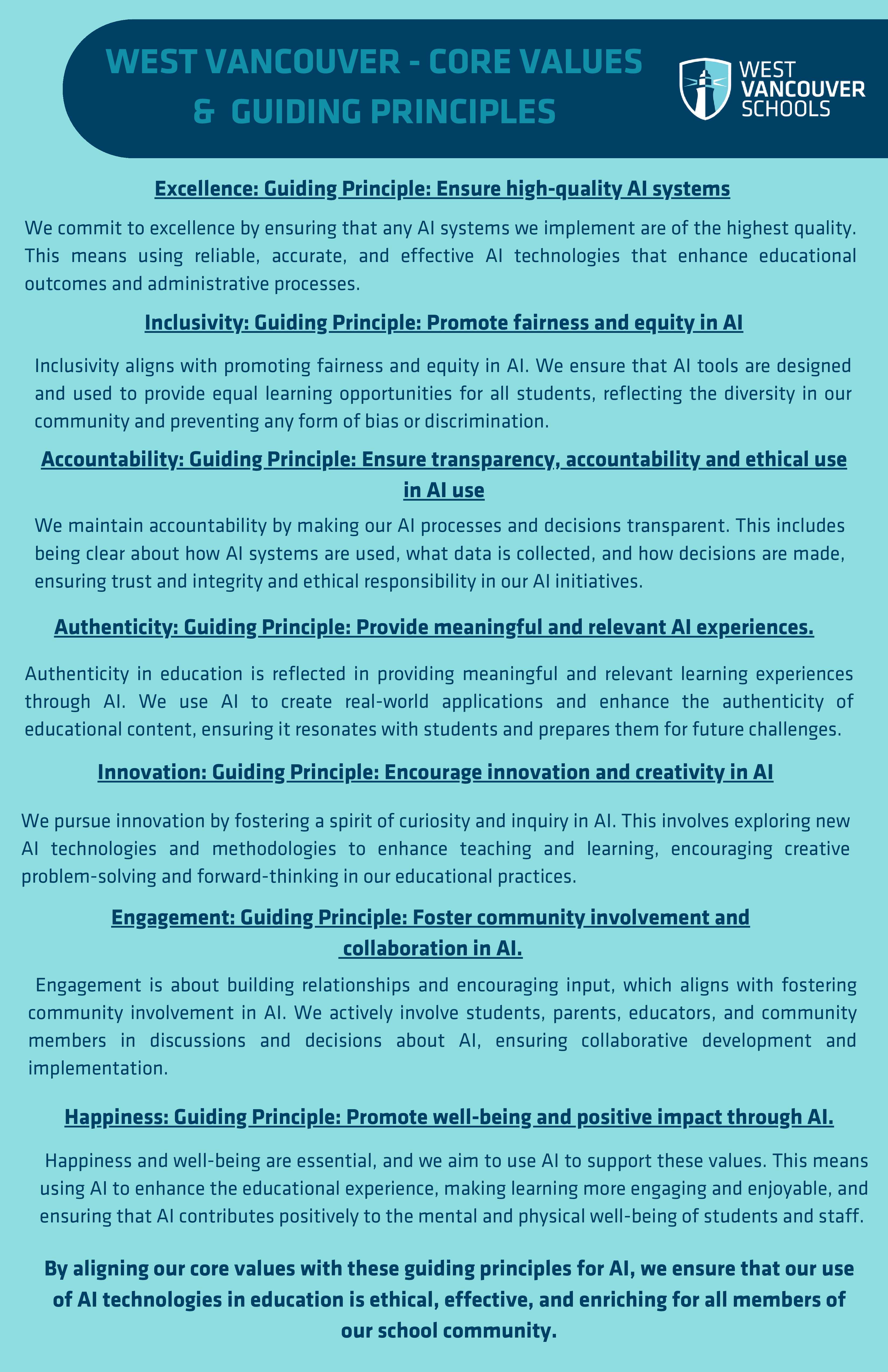
Creating and Revising Documentation – Setting clear guidelines and documentation ensures that everyone is on the same page as AI becomes more integrated into our work.  We started with our Core Values and Guiding Principles (HERE), Guidelines for the Use of AI (HERE) and When Do I Use AI visual (HERE). We also revised existing technology policies to ensure they were inclusive of AI.  

Focus on a few key AI apps – There are thousands of AI tools out there.  And it is easy to just talk about and debate which tools to use rather that just identifying a small number, supporting their use and getting on with better conversations around how AI can positively impact teaching and learning.  For us, Magic School has become a go-to tool for its ease of use and versatility in the classroom, helping both teachers and students adapt to AI technology

Engage the entire community – Often with new ideas or initiatives they apply unevenly to a school district.  One of the best things about AI is that it has uses throughout the system.  As I wrote recently there are great ways for trustees or senior leaders (HERE), or sports coaches (HERE), or parents (HERE), to use the tools to support their work and the work with students.  We have also leaned in to district-wide and school specific sessions specifically for parents.

Model AI in Action – Have you noticed this is the 5th AI related blog I have written in the last 2 months?  That is not coincidence.  My colleague Cari Wilson is also regularly blogging about it. And I have committed myself to spending a couple minutes at all meetings this year showing my learning with AI.  Over the last two weeks this has included meetings with Trustees, parents, principals, office staff and others.  

Leverage external experts – We have engaged with Alec Couros who worked with all district staff and then smaller groups in our district, and will be back this month to work with parents.  We have also spent five days with Dean Shareski and Adam Garry and are planning three more for the new year.  It is always a balance of using internal champions and outside experts. 

Join local and global AI networks – Locally we are working to network teachers inside our district and then network our schools around their AI work.  And then we have built a network of about 12 districts in Metro Vancouver that are working and sharing resources around AI. This is work that Shareski, Garry and ALP Learning are supporting.  We are also part of a network with Michael and Bailey Fullan and districts from across Canada and a network in partnership with C21 Canada, Mindshare Learning and Dell that is looking at AI practices across the country.

It is not fluke when you see things are moving fast, and you want to get out front what you need to do.  And it is never just one thing.  I am definitely bullish around the impact AI is going to have on schooling and want us to lead and guide what happens.  So we need to be doing things to look around the corner to what is coming next.

The speed of AI is exhilarating, and with so much possibility ahead, I’m excited to see where we can take it together.

The original blog post was posted into Chat GPT with the following prompt “Be a critic of this blog, what could be improved or clarified to make it more readable for the audience.” Feedback was incorporated into the final copy.  The image at the top was generated through the enterprise version of Magic School.  

Read Full Post »

How do you get everyone on board? It’s a universal question for so many initiatives. I remember when email was first introduced in schools about 30 years ago—there was skepticism, uncertainty, and hesitation. But just like email, generative AI is here, and the process of getting everyone on board feels familiar.

There’s often a desire for consistent training and understanding, so everyone feels equally equipped and confident in their use of the new tools.

I see generative AI use as a continuum for people.  Think of the continuum like learning to swim: First, you test the water with your toes (personal use), then you float (professional tasks), and finally, you dive in (working with students). Each step builds foundational confidence for the next.  We have been working through these stages as we work with colleagues.

  1. Staff  feel comfortable using it for personal use.

The first way to build comfort in generative AI tools is often in ways not directly connected to their work.  I find helping people use Chat GPT to help plan a trip, or make a recipe is a good opener. Many are nervous to use technology for something as important as work or as public as in the classroom until they feel comfortable with the tools in a more low stakes environment.  I do like some of the fun tools within Magic School (Magic School is the district wide AI tool we support in West Vancouver) like Song Creator or Teacher Jokes – which feel like ways to make AI accessible in an easy way.  For those of my generation this reminds me of how people would push email adoption by creating spaces for “Swap and Shop” or “Pet Talk” on the email platform.

For personal use, start with something fun. I’ve seen teachers use AI to generate jokes for their morning announcements or plan out their next family vacation. The low-stakes environment makes it less intimidating.

2.  Staff explore the benefits for using it for themselves professionally

Once people get comfortable within the tools personally, they can begin to use them to become more efficient professionally.  Some easy ways are creating lesson or unit plans, helping with report card comments or generating worksheets or assignments.  The value of the technology is when people to witness the efficiencies. They can then identify opportunities to reallocate time from previous tasks to focus on areas they find more valuable, such as direct engagement with students.

One teacher I spoke with recently started by using Magic School to help with lesson plans and emails. That saved her hours, and soon she was using it to generate adapted texts, which gave her more time to focus on her students.

3. Staff use the tools with students

Once adults are comfortable using it in their own practice, it is easier to use it with students.  Some of the first ways I am finding people using it with students includes adapting lessons to better allow students to move at different speeds.  Related, they are also using AI to adopt reading passages for different levels.  Teachers are also using it to create assignments that engage students with AI.  Here is a draft of a graphic that some of our staff are beginning to use around AI use with students:

In a classroom, students used generative AI to simulate historical debates, creating a dynamic learning experience that challenged them to think critically and defend their arguments using AI-generated counterpoints.

Beyond assignments and debates, students are using AI to explore different perspectives, co-create projects, and develop independent research skills. By encouraging students to build and use AI independently, we are helping them develop the critical thinking and digital literacy skills they’ll need in the future.

Ultimately, we want to ensure that the AI tools students use are not solely for passive consumption, but rather empower them to create their own AI projects and leverage AI for independent learning, without relying entirely on adult guidance.

One thing that is particularly helpful about generative AI is there is  opportunities for use across grades and subject areas and there are so many entry points whether you are just exploring or are fully integrating generative AI with your students.

The next step is simple: pick one AI tool this week and explore how it can save you time or engage your students in a new way. For me this past week, it has been Google – NotebookLM.  It is an easy (and feels a bit like it is out of a futuristic movie)  way to quickly convert documents into podcasts.  I could see some uses around uploading complicated texts in a class to share with students who may struggle with understanding the text.

Let’s continue the conversation—what are your recent experiences with AI in the classroom?

As per usual I want to be transparent with my AI use in my posts.  For this one I did post a complete draft to Chat GPT and ask for it to identify flaws in my logic.  I used this feedback in making revisions to my writing.

Read Full Post »

Anyone coaching high school sports this year should be considering how they could use generative AI to support their work.

Of course, I am a bit biased as this combines my love of technology in an education setting with school sports – two of my favourite things!

In British Columbia, like many jurisdictions across North America, there are a range of skills when it comes to those who are coaching school sports from well meaning parents or community members without a lot of history with the particular sport to former players to highly experienced teachers and community members who have coached at the national or international level.

What is true about all of them, is there is an entry point to improve their coaching this year using generative AI.  Just as we are finding ways to improve experiences in our classrooms in school using AI, the same should be true for our extra curricular sports whether on the court, field, track or pool.

So, just where should you get started?

The most common tool many are using is Chat GPT.

Some things you can use it for include:

Customized Training Plans and Practice Plans – Whether not knowing where to start or being too busy oftentimes coaches do not have clear practice plans.  AI can take a series of skills you want to cover and turn them into a practice plan.  It can also help design individual plans for athletes – whether it is individual work outside team practices or for more individualized sports.  

Game Strategy Simulation – Ask AI to develop 5, 10 or 20 scenarios that you can play out at practice. I used a simple prompt: Give me 20 different last minute basketball scenarios I could use with my team at practice during a scrimmage. You could give additional details and create more complex situations including giving details or tactics for different opponents.

Injury Prevention – Most newer coaches know little about injury prevention. Here is a simple prompt I recently used:  I want to spend the first 10 minutes of my high school cross country practice focused on activities that help with injury prevention what could I do?

Performance Feedback – Many coaches collect data from games or practices – whether it is fitness data, scoring data or any sport specific data depending on the activity.  This can be uploaded into Chat GPT and you can ask it to find trends, or suggest teaching points to focus on.

Skill Development Resources – Athletes are often asking how they can get better at A, B or C.  AI can provide access to drills, exercises and skill development linked to individual sports and specific skills within a sport.  

And Much More – Coaches can use AI to generate motivational messages or help craft pre-game talks, as a source of professional development, as a place to get advice around handling team dynamics or creating social media content to promote the team.  It also can be a source for mental health resources to support athletes and help with organizing team schedules and calendars – and I am sure much more!

Coaching is often a lonely job in high school, but generative AI (I used Chat GPT as an example here but there are definitely other alternatives) can be an assistant coach freeing up time to spend directly connecting with your athletes.

And what about going beyond Chat GPT?

There are a number of apps using AI to do higher level work (most of these have fees attached to them).

Some I have dabbled in a bit include:

Coach Logic – Provides video analysis and performance review, enabling coaches to visualize different tactics.

DribbleUp – An AI-driven tool for soccer and basketball that offers personalized drills and feedback (we have this one at home but never caught on much with our kids).

Fitbod – An app that uses AI to create personalized workout routines based on user input and progress.

Hudi – A video analysis and coaching platform that allows coaches to review game footage and simulate different game strategies.  Hudi has bought up numerous other companies in this space in recent years and often a huge range of tools.

It is a good reminder that the quality of AI to improve sports coaching will never be as bad as it is today.  The tools will only get better.  I am excited to see greater abilities with video to be analyzed and suggest drills. The future will see real-time game analysis, AI-driven recruitment tools, and the opportunity for virtual reality training sessions.

Like with all uses of AI, it is important to acknowledge concerns that some have that AI will replace human judgment, the learning curve associated with new tools may be too great, and data privacy issues must be at the forefront – especially when working with young people.  AI is meant to augment, not replace, the human element of coaching, hopefully shifting how coaches spend their time.

To rework the well worn phrase, AI will not take your job, but somebody using AI will take your job;  high school sports coaches will not be replaced by AI, but those who use it will be on the front edge of finding new ways to work with student athletes.  

High school coaches out there – how are you using AI?  What tools are you using?

At the end of each blog post I indicate how generative AI supported my writing:  The image at the top of this post was created in Chat GPT4 after a series of prompts and by uploading the post and asking for suggested images to accompany it.  After writing the post – I asked Chat GPT to find flaws in my logic, identify topics I had not covered and list topics I should have included but didn’t – I used some of this feedback to revise my post.

Read Full Post »

While the applications of generative AI in operational tasks are quickly becoming well-recognized, its potential to transform governance within school districts is equally significant. I am doing a couple workshops on this later this fall, and thinking about the governance work of Boards and how they might consider using AI to help with these important tasks.

Some specific examples include:

Supporting Communication

Whether it is email responses or graduation speeches, AI can be a support.  You may have given a version of the same speech at grad for the last 10 years; you can upload these speeches and ask for a revised modern version and suggest some new content to keep some of your key themes but make it newly relevant again.  It can also serve in the assistance of email responses with structure and build drafts that can be a starting point of revision before they are sent.

Professional Development and Knowledge Enhancement

AI can be used to summarize and recommend resources such as articles, reports, and research relevant to govenance roles, helping you stay informed on educational trends and best practices.  There might be a new provincial health report and a local one for your region. You could upload both documents and ask to have a list of similarities and differences identified between the reports and have suggested actions suggested.

Drafting and Refining Board Policies

Generative AI can assist in drafting board policy proposals or reports by producing initial drafts, summarizing legal or regulatory documents, and refining language based on specific goals or criteria. Similar policies from multiple districts can also be uploaded to identify areas that other districts have included in their policies that you may want to include in your policies.

Strategic Planning Support

AI can help during the strategic planning process by generating drafts, helping with specific wording of goals and objectives, and providing suggestions for long-term goals based on data trends. The ability of generative AI to look at large data sets and identify key aspects can be very helpful to help move away from “gut-feel” that can often take over strategic planning conversations.

Scenario Analysis

AI can simulate potential impacts of proposed policy changes (e.g., school closures or grade reconfigurations) by evaluating historical data and predicting outcomes. This can be another point of reference to the processes that lead to recommendations.

Be Good Models

Perhaps most importantly, those involved in governance can embrace a learning mindset when it comes to using generative AI, setting an example for the system by modeling the adoption of new technologies.  Political and administrative leaders in districts can also be open to how they can create policies and set directions along with staff that take important safeguards and privacy precautions but also are open to how these tools can support the work of everyone in the system.

We are at just the infancy of seeing the impact of these emerging tools.  It is crucial everyone in the system has awareness over how they will impact the system going forward.  By remaining adaptable to the evolving capabilities of AI, school districts can ensure these tools enhance our collective governance, support decision making and ultimately the overall mission of educational excellence.

At the end of my posts I explain how I used generative AI in their creation.  After drafting this post  I posted it to Chat GPT and I also posted the West Vancouver Schools Policy Book with the following prompt: Based on the policies and bylaws of West Vancouver Schools in the attached link, what are additional ways school districts could use generative AI to support their governance work beyond those I have already listed.  This prompt helped me revise and improve my post.

The image at the top of the post was generated in Chat GPT from a series of prompts related to this blog post.

Read Full Post »

Dean Shareski’s recent blog post about his time working with West Vancouver Schools (HERE) got me thinking. He is good at that.  His blog has been pushing my thinking for 20 years.

His recent blog post on his work with our district captures so much of what makes our partnership valuable. In his post, he is generous about the people and schools in our community and the exciting current work around generative AI. But what stands out to me isn’t just the highlights of the week—it’s the consistency of our work together over the years and how that consistency has fostered trust, which has become the foundation for innovation in our district.

 Trust Through Consistency

One of the most underrated factors in educational progress is the value of steady, consistent leadership and support. Dean isn’t just a consultant who drops in and out; he’s become a trusted partner who fully understands our vision and works with us to help move it forward. His ongoing presence has allowed us to build a relationship rooted in trust, which, in turn, has given us the confidence to take risks and innovate in meaningful ways. We have done this with others as well.  You can bring in someone for an hour or a day and you will get some initial enthusiasm – but it is the ongoing connections that move the work.

When you think about innovation, it’s easy to assume that change is the driving force. In reality, constant change without a strong foundation can lead to instability and confusion. What we’ve found in our district is that consistency—having the same voices, the same leaders, and the same trusted advisors—creates the conditions for genuine, thoughtful change. Of course, as a superintendent about to hit 15 years in the position, I am biased towards consistency.  When our team knows that the support they’ve relied on is there year after year, they can focus on pushing boundaries and exploring new ideas, knowing that their foundation is secure.  

In our classrooms, this foundation of trust and consistency has allowed our teachers to embrace innovative practices confidently. For example, our recent work around generative AI is not just a theoretical exercise but one that is being thoughtfully integrated into learning experiences. Teachers, secure in the knowledge that they have ongoing support and guidance, will be able to experiment and refine new methods in a way that directly benefits students. This steady approach ensures that our educators aren’t overwhelmed by constant change but can focus on delivering powerful, meaningful lessons.

This emphasizes the direct impact of innovation and leadership on daily teaching and learning, aligning the broader themes of trust and consistency with the tangible outcomes in the classroom.

Innovation Through Stability

Dean’s work with us around generative AI is a perfect example of how innovation flourishes in stable environments. We didn’t jump into AI because it was the trendy thing to do. Instead, we are laying the groundwork, with thoughtful conversations, professional development, and collaboration. This steady, deliberate approach is what allows us to dive deeper into AI in a way that feels sustainable and aligned with our broader educational goals.  In the end our goal isn’t AI, it is the creation of powerful learning experiences.  

When leadership and external partnerships are constantly shifting, it can be hard to build momentum. But in West Vancouver, we’ve been fortunate to have consistency in our leadership and in those who support us. This has allowed us to move forward faster and more effectively than if we were constantly changing course. With Dean’s ongoing guidance, we are able to focus on refining our work with AI, rather than starting from scratch each time we introduce a new initiative.  

Moving Forward With Confidence

There’s a lesson here about the power of consistency in all aspects of education. While we often hear that change is necessary for growth—and it is—it’s also true that change for the sake of change can slow progress. The real magic happens when consistent leadership and support create an environment where trust thrives and innovation can happen organically.

As we continue our work with AI and other innovative practices, I am grateful for the steady partnership we’ve built with Dean Shareski and others like him. It’s this consistency that has allowed us to push the boundaries of what’s possible in our classrooms while maintaining a clear sense of direction and purpose.

In West Vancouver, we are committed to continuing this approach: building on the foundations we’ve set, nurturing the trust we’ve established, and embracing innovation at a pace that feels both exciting and sustainable.

Thank you, Dean, for your ongoing support and for helping us model a culture of yes—one that is widely shared in its commitment to trust, consistency, and  moving forward together.


Read Full Post »

« Newer Posts - Older Posts »