Feeds:
Posts
Comments

Posts Tagged ‘West Bay’

selfreg

Two of my most popular posts have been about Dr. Stuart Shanker and his work; each post has received well over 10,000 views.  To recap, the first post in November 2010 is here and the second one here  was written in April 2012.

West Vancouver is part of the first wave of school districts in British Columbia, along with Bulkley Valley, Coquitlam, Greater Victoria, Nanaimo and Surrey, who are working together on a project to implement and monitor the impact of self-regulated instructional models.  One of the greatest contributions to date has been a one-stop shop for resources on Self-Regulation (here).

Dr. Shanker’s work is clearly providing inspiration around the province, and we are seeing that in each of our schools in West Vancouver.  While the work models may look slightly different in each school, the impetus of having students in their zone for learning is district-wide.  A number of recent blog posts by some of our district educational leaders support this influence:

Westcot Principal, Liz Hill describes her school’s work with The Zones of Regulation:

We often make the assumption that children know how to identify their emotions, but akin to teaching reading, writing and math, emotional  literacy is a skill that needs to be taught to our children.  The Zones of Regulation framework teaches the language of emotions.  This helps children understand how one’s state of regulation impacts one’s ability to be calm, alert and ready to learn.  Using this framework, students develop  their own personal toolkit of strategies and learn when, how and why to use  strategies to help them  be “good to go” or “ready to do their best learning.”  These self-regulation tools may include breathing techniques, stretching, exercising, reading or simply getting a drink of water.

West Bay Principal, Judy Duncan, describes her school’s efforts to look through a lens of self-regulation:

Self-regulation spans all five domains (biological, cognitive, emotional, social, pro-social) and is really about the burning and recovering of energy.  As Shanker states, “optimal self-regulation requires a child to match his or her energy levels to meet the demands of a situation in a maximally efficient manner.”  More and more research is linking how well students do in school to their ability to self-regulate.  We are seeing this firsthand at West Bay, thus the excitement to improve our practice.

Our school’s Self-Regulation Team meets regularly to discuss how teachers and students can be supported in the quest to maintain self-regulation in the classroom. The team shares its work at staff meetings and in informal conversations; our teachers are keen on deepening their understanding of self-regulation and are open to trying new strategies to support their students. If you were to wander into our Grade Two classroom, you might see some students wearing noiseless headphones, some using cardboard study carrels (they call these “force fields”), others sitting on wiggle cushions, while others may be perched on stools at the side of the classroom.  These seven-year olds are beginning to figure out what they need to help them learn.  This metacognition piece is key.  As one little girl blurted out the other day, “I need to self-regulate!” Being aware of your own emotions and what you need to achieve a state of calm is very powerful!

Lions Bay Vice-Principal, Jody Billingsley, describes a number of ways they are fostering self-regulation including a series of classroom management techniques:

Classroom management techniques that have the children thinking about their levels of arousal when in a lesson.  We have “check ins” where the student self-assesses as to whether she is calmly focused and alert.  We call this level 4 – directly stemming from Shanker’s stages of arousal.  If they are at the level 3 stage (hypoalert) of arousal, they may be daydreaming, whereas at level 5 students may be over-stimulated and not able to focus (hyperalert).  If we see a child that is not at level 4, we give a friendly reminder to “check in” with themselves, or “give themselves a hug” as a way to think about where they are with being calmly focused and alert.  The idea is to have them see when this is occurring, reinforce behaviour with a verbal or non-verbal cue, and eventually watch how the students do this independently.

Irwin Park Principal, Cathie Ratz, has her school focussed on MindUP™ to help students be calm, alert and ready to learn:

It is a family of social, emotional, and attentional self-regulatory strategies and skills developed to cultivate well-being and emotional balance. Based on the notion that intellect does not exist in isolation from emotions,  connections to others or the rest of their bodies, the MindUP™  program is designed to address these components of learning for all students.

By teaching our students about the brain we make them more aware of their own thoughts and emotions. It can also help them to develop the ability to think about thinking, or metacognition. That awareness would then give them better control over their own mind—directing their attention more appropriate, or calming themselves down—in ways that could improve learning.

These are only four stories, but there are stories like these in every school in West Vancouver.  It is often a lament that schools and those who work in them, are slow to change.  Where, three years ago, there was hardly a person in our district who could describe the power and importance of self-regulation, this research now influences how we teach, organize our classes, and how we think about our buildings in every corner of the district.

Finally, I encourage you to spend some time with the wonderful resources being collected as part of the newly revamped website in support of the  Canadian Self-Regulation Initiative.

Read Full Post »

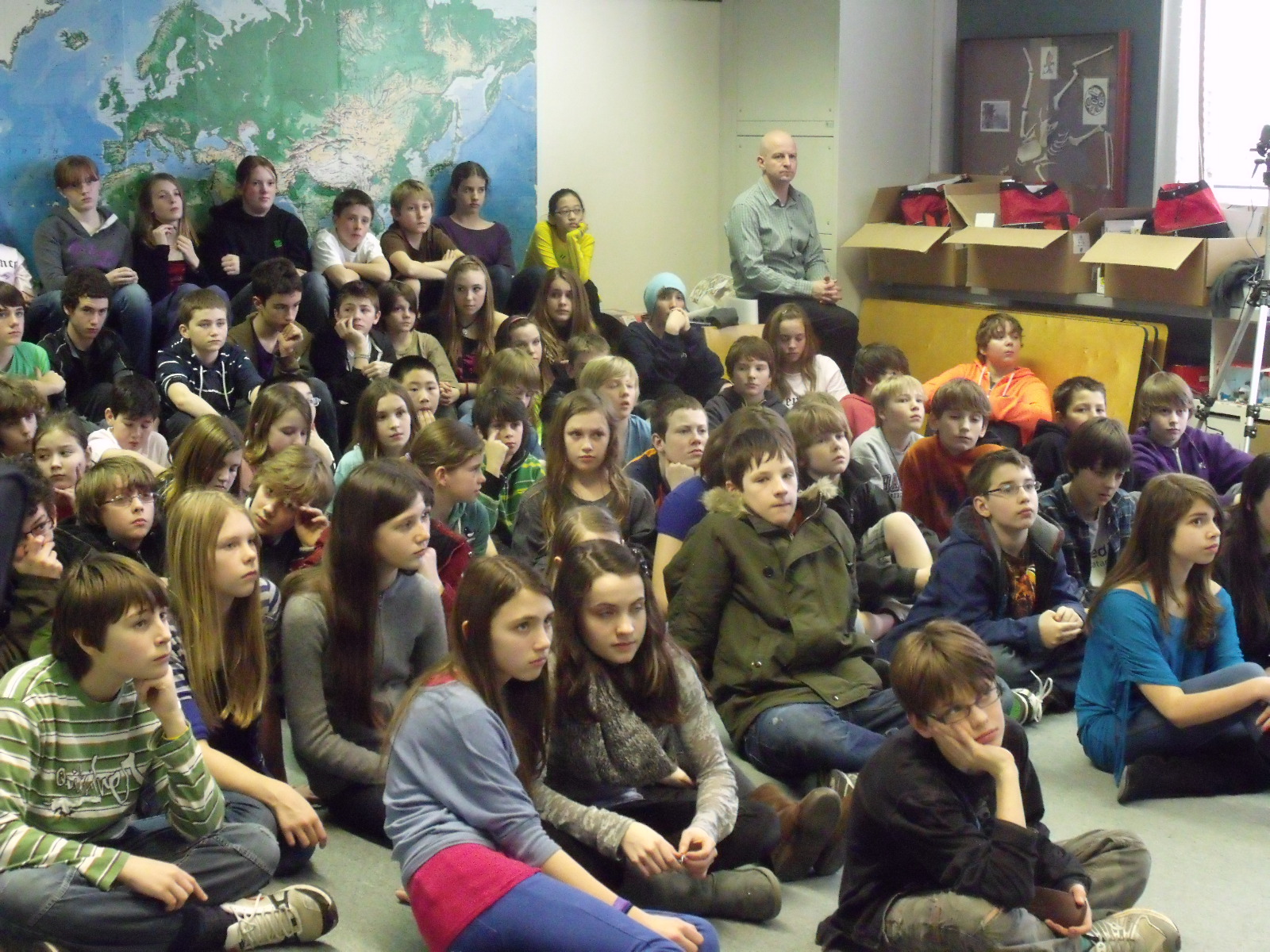
Trying  to do something new or different can be a real challenge sometimes.  Last week I had the opportunity to teach a class to students at Gleneagles Elementary School and West Bay Elementary School, and to share my story about how I started blogging. I also had the opportunity to learn about their work and their own digital writing.  The work at Gleneagles is part of a teacher inquiry project that focussed on the following question:

Will students include more meaningful detail and perspective in their weBlogs by focusing on social issues as their ‘purpose for writing’ and will continuous feedback, in the form of threads, lead to deeper understanding of a given issue?

The classroom was both face-to-face and virtual, and teaching students I couldn’t see was new and challenging.  Teachers are accustomed to reading a student’s body language, and receiving cues from the class.  Half of the students were in front of me at Gleneagles, but the other half were viewing the class on-screen at West Bay via Lync, and it was a one-way video.  The students could ask questions, but I didn’t feel the same connection as when they are in front of me, in a room, or at least when I can see them on video.

Of course, the whole topic was quite new for the students as well.  We all agreed that even two years ago, there would have been no way we would be having a conversation about digital writing and blogs; what it meant to have a personal brand, and what kind of topics we would write about if we were going to share our ideas with classmates, or the world.  Out of the presentation came a number of excellent questions:

  • Why do you blog versus using an alternative platform to share your message/knowledge?
  • Where do you get your ideas/inspiration for your many blogs?
  • How do you create an effective blog?
  • Where/how do you find the time to blog so frequently?
  • When you started blogging, were you inspired by anyone/anything in particular?  Do they continue to influence your thinking?  If so, by what/whom?
  • Do you follow other bloggers and use their techniques/messages as a model for your own?
  • How do you decide on the graphics, pictures, and links you embed when there seems to be so many to choose from?
  • How often do you post?  Why?
  • Do you believe the good connection with your readers is because of your transparency as a writer?

It is a different way to think about writing, and I often say that I think in blog posts.  When I sit in a meeting, I write my notes around themes that may later become posts; I can think of the visuals that might go with the words, and this is so different from only a few years ago.  I have started dozens of posts, which may or may not become a blog at some point, but they have helped me organize my thinking.  While I write about one post a week, I think about hundreds. It was great to hear students discussing the stories they would like to tell, because we all have stories; we all have our own powerful narratives to share.

Toward the end of the session, one of the excellent discussions was about commenting. I offered that when I comment on other blogs I try to expand on an idea raised by the writer, perhaps give a different point-of-view, or add additional information the writer, or other readers, may find interesting or valuable.  I am hopeful some of the students who participated in our session last week will do just that with this post — extend and reach out with all of your learning.  So, what did you find interesting/valuable? What are you going to do next?  What questions do you still have?

Thanks again to the students of Gleneagles and West Bay for your engagement.

Thanks also to Colleen Denman for session photos, and all of the teachers and administrators who were involved in organizing and setting up the session.

Read Full Post »

This past week the Honourable George Abbott, B.C.’s Minister of Education, spent a day in our district. It was another great opportunity to share a slice of West Vancouver’s public education story, and while I do cover many of our schools’  initiatives and learning directions through my blog posts, this time, I would like to share it through photos of the day spent with the Minister connecting with students, teachers, administrators, parents and others in our schools. I would also like to share what Dean Shareski described as “narrative champions”, telling our exciting, ongoing and ever emerging story.

At Eagle Harbour Montessori School, although there was a room full of adult visitors, students remained focussed and intent on their work:

All groups working together at Caulfeild — administrators, teachers and parents discussed with the Minister the work the school has undertaken with its iDEC Program:

Also at Caulfeild, students demonstrated some of their work with self-regulation and how they are more easily able to answer the question, “how fast is their engine running — too slow, too fast, or just right”:

An opportunity for students to share how inquiry and digital technology are coming together using their student dashboards:

At West Bay, we heard firsthand from students about choice and ownership of their learning:

As part of the school’s work in inquiry, outstanding interaction and questions between teachers and students as part of this work:

At the Premier Sports Academies (with Rockridge and Sentinel students) we watched as students pursued their passions:

Albeit a small slice, it was a very representative slice of learning in West Vancouver. Different examples, often fulfilling the same narrative, could be found in all of the schools. The West Vancouver District has had a long tradition of choice  — in programs, and in learning opportunities within the programs.  What has become increasingly important are inquiry, digital technology and self-regulation, and elements of all three can be found in all schools.

We also know that a large part of our great story can be attributed to our outstanding teachers, supportive and engaged parents, and passionate students. But the most gratifying element of the visit was the outside voice reassuring us we are on the right track.  Call it “21st century learning”, or “personalized learning” or “the West Van way” it can be seen in all of our schools.

Read Full Post »

« Newer Posts