I shared my “Word for 2025” last week, but I am still thinking about the year ahead. I know in school-life the real new year starts in September, but January is a good time to reset and reassess. And just as we do that in school, I know it is happening in homes as well.
As we step into a new calendar year, it’s the perfect time for a refresh—a moment to reflect, reset, and renew our family routines. For parents navigating the complexities of raising children in today’s digital age, this moment feels particularly significant. And with the added layer of AI, this navigation is only getting more complex.
We live in a world where technology is seamlessly woven into the fabric of daily life. Devices offer connection, knowledge, and opportunities that previous generations could only dream of. Yet, they also pose challenges—especially for families trying to strike a balance between purposeful technology use and the very human need for physical activity, meaningful connections, and mindful living.
At school, we have been working hard to foster that balance. We’ve set limits on cell phone usage in schools across BC, not because we are anti-technology, but because we believe in purposeful use (Here is an infographic we have shared out this week in schools). What does this look like in practice? Students using computers to create digital portfolios of their work, collaborating on shared documents for group projects through Google Classroom, or using educational apps to practice math skills—all while maintaining dedicated time for physical activity, face-to-face discussions, and hands-on learning. These boundaries ensure our students’ well-being and physical literacy remain priorities. But this is not a task schools can do alone. As I have written before, physical literacy and AI are side by side as key areas for innovation in West Vancouver.
Parents play a crucial role in shaping how their children navigate technology. As we rethink routines this January, let’s remember that our children are always watching. They notice when we set aside our phones during dinner, when we prioritize outdoor family activities, and when we engage in face-to-face conversations. Modeling thoughtful technology habits isn’t just important—it’s transformational. At school events, it is often adults who demonstrate the poorest cell phone etiquette.
Over the break a colleague of mine showed me an interesting iPhone feature. Go to Settings, tap Screen Time>See All Activity. Scroll down to the area titled “pickups”. This number is how many times you have picked up your phone that day. It’s not just the kids who might be a little too attached to their screens. Give it a try and be ready for a reality check!
This January reset calls for thoughtful conversations. Rather than banning or blindly embracing tech, engage your children with questions that promote intentional use: How does this app support your learning goals? What boundaries would help you balance screen time with other activities you enjoy? When do you feel most creative and focused while using technology? These conversations can help children develop critical thinking about their digital habits.
As a parent, this isn’t about perfection. It’s about progress—a commitment to staying engaged and aware as technology evolves. It’s about setting expectations that align with your family values, being open to learning from your kids, and creating a culture where tech is a tool, not a master. I know I used to HATE my kids playing video games, but now I realize they can often be a point of connection with friends out of school time.
In schools, we’ll continue to champion purposeful technology use while ensuring students’ physical and emotional development is front and centre. But as we know, what happens at home matters just as much. Together, we can guide our kids to be confident, capable, and thoughtful digital citizens.
Around our office, we have a walking club once a week at lunch and staff have started a run club to train for a race in March. We are keenly aware that we need to model getting outside and modeling good practices with our own health.
Here’s your January challenge: Choose one area of family technology use to reset. Maybe it’s establishing device-free dinner times, setting up a family charging station outside bedrooms, or planning weekly outdoor activities. Start small, stay consistent, and celebrate progress. This is the year to refresh, reset, and reimagine what it means to parent in the digital age.
I used both Chat GPT and Claude in the editing process and the image at the top of the post is also AI generated.
As change accelerates at an unprecedented pace, particularly with AI, 2025 calls for something deeper than speed—it calls for thriving. After a year devoted to acceleration in 2024, I find myself drawn to a word that represents not just progress, but flourishing in every aspect of leadership and life. Whether it’s coaching youth sports, lacing up my shoes for morning running, or leading groundbreaking AI initiatives in our district, “thrive” captures the essence of what I aim to achieve in 2025. Thrive also more broadly speaks to me as not just a professional goal, but one that hits my personal goals as well.
This marks the 10th year of my “One Word” tradition. Looking back at 2024 and “accelerate,” it was a year of urgency and innovation. We embraced the challenge of supporting AI across our district and networking with jurisdictions around BC, Canada and the world. We advanced literacy and numeracy initiatives and focused on mental and physical health. The pace was intense but rewarding. While acceleration was about building momentum, thriving is about sustaining and flourishing with that momentum.
Why Thrive for 2025?
Sustainable Innovation
Thriving means not just keeping pace with change, but shaping it thoughtfully. In the fast-evolving AI landscape, it’s about balancing innovation with educational fundamentals. We’ll approach AI integration like I approach basketball coaching – start with the fundamentals (critical thinking, collaboration, creativity) and then layer in innovative tools that enhance these core skills. Just as a strong defensive foundation enables more dynamic offensive plays, strong teaching fundamentals will ensure our AI efforts enhance learning rather than overshadow it.
Collective Growth
True thriving isn’t just about individual success; it’s about collective achievement. Watching young athletes develop skills, seeing educators embrace new technologies, and spending meaningful time with family all contribute to a sense of shared growth. Thriving lifts us all.
Depth and Breadth
Like training for a marathon, thriving requires both speed work and endurance. It’s about growing deeper in our initiatives while broadening their reach. Whether it’s making new learning approaches and tools accessible for all educators or deepening relationships within my community, thriving ensures our progress is impactful and lasting. For example, this year, I am focusing on spending more time in classrooms learning with and from teachers using AI in their classes.
Balance
Thriving captures the delicate harmony between pushing boundaries and maintaining well-being. Balancing district leadership, being involved in youth sports, running, blogging, and family time demands intentionality. For me, this means protecting my early morning runs as devotedly as I guard time for family dinners and summer basketball trips, and approaching my district leadership with equal enthusiasm and presence.
Resilience
To thrive means to grow stronger through challenges. Whether it’s navigating the complexities of educational transformation or powering through the final stretch of a long run, thriving requires adaptability and the ability to turn obstacles into opportunities. My run streak is never boring – I plan to run at least 5 km everyday this year, just like I have for almost 4 years.
Impact
At its core, thriving is about making a meaningful difference. In our district, it’s about fostering environments where students flourish. In sports, it’s about shaping not just skilled players but well-rounded individuals. At home, it’s about nurturing relationships that energize and sustain us.
Moving Forward
As I look ahead to 2025, I’m excited to transform the momentum of acceleration into a year of thriving. Whether it’s crafting my next blog post, leading an AI initiative, coaching a game, or stepping out for an early morning run, my goal isn’t just to participate or succeed—it’s to embrace every opportunity fully and flourish in all I do.
I’m curious – what word will guide your journey in 2025? How does it reflect your hopes and aspirations for the year ahead? Share your word, and together, let’s inspire each other to thrive.
I used Chat GPT to create the image at the top of the post. I also used both Chat GPT and Claude in the brainstorming phase of my word selection. I described what I was hoping to accomplish in 2025 and used AI to help generate potential words from which to choose.
Here we are – a final post for year 15 on Culture of yes.
As another year comes to a close, I find myself looking back at 2024 and all the moments that made it memorable. It’s become a tradition for me to reflect on the year and put together a “Top 3” list—just a quick way to highlight the ideas, experiences, and surprises that stood out the most.
If you are wondering what you might have missed, here are the previous years Top 3 lists: 2023 (here) 2022 (here) 2021 (here) 2020 (here) 2019 (here) 2018 (here) 2017 (here) 2016 (here) 2015 (here) 2014 (here) 2013 (here) 2012 (here), 2011 (here) and 2010 (here)
This isn’t about covering everything or being overly formal; it’s more like sharing a few of my favorite highlights from the year. So, grab a Booster Juice or settle in to a White Spot Pirate Pak and join me as I look back on what made 2024 special.
Top 3 “Culture of Yes” Blog Posts which have generated the most traffic this year:
Taylor Swift’s popularity is everywhere. If I take a look at this year’s most read posts in a couple of months, the recent post about her will probably be number one. It is just much newer than the others ahead of it. The 28 Reasons post was probably my favourite post to write, so nice to see it connect so well with people. How people find this blog continues to be interesting. For many years Twitter drove much of the traffic, now LinkedIn is a far more common place for people to find it. And then certain posts, like when I write about parenting or sports, or Taylor Swift, are well shared through Facebook. Overall the metrics show readership up about 25% year-over-year and numbers are the highest they have been in about a decade. Still not at the numbers of 2011 – 2014 (the glory days of the edu blogosphere) but great to see that I can still connect with such a strong network. Interestingly, the least read post this year was The Art of Staying Relevant.
Top 3 Shifts in BC Education in 2024:
Limiting Phones in Schools
The growth of AI
Focus on literacy and numeracy
Looking more broadly, like many jurisdictions across North America, British Columbia put in rules to limit the use of technology, and in particular cellphones, during school time. A couple takeaways from this change for me, 1) It went over very well with not a lot of challenges. Students quickly adapting to new procedures, and the limits were flexible enough to recognize different rules for different ages and circumstances is important and 2) The fear of some that these changes would push back the thoughtful use of technology in schools did not come to fruition. Students and staff are still using technology as appropriate, but are in most cases being more intentional.
I have covered AI a lot, including a full post (HERE), just last week. BC has had a big advantage because of forward thinking work from the Ministry of Education. The resources are available HERE.
And the refocusing on core learning skills of numeracy and literacy is an important focus, again in BC and beyond. In part as a result of dipping results in international assessments, in part because of a sense that COVID had a negative impact in these areas, and a reevaluation of the topics that have dominated education conversations, these key areas are being given additional attention.
Top 3 Things I was Wrong About:
Cell phones
In-person meetings
AI resistance
Always good to think about areas where you have changed your thinking. And sometimes you just have a hunch that proves to be wrong.
When it comes to cell phones, as I noted above, I expected the limitations on students to be met with more resistance from students (and also parents trying to get ahold of their children). What happened was it really went smoothly. Students knowing that other students also didn’t have access during class time seemed to have a positive impact for everyone. And the flexibility (at least with the rules in BC) to allow technology still for purposeful class use meant digital efforts continued to move forward.
I finally relented and moved a series of our administrator meetings back to in-person. I had been a hold out thinking they should continue online. I liked the idea of our staff not having to travel from their schools – the chance to save travel time and also lessen time out of buildings seemed like a win. What I was missing was that these meetings were an important connection point for people, and the informal meetings that often occur at these sessions are actually crucial.
And I was sure parents were going to want AI banned in schools. Not that it is possible, I was just expecting a repeat of the social media conversation from 15 years ago. It has been completely different. I think parents see that AI is changing their lives and actually they are often looking to the schools to upskill themselves. I think our parent education sessions on AI are so well attended in part because parents know they need these skills for themselves.
Top 3 AI Tools for education I have used (not counting ChatGPT):
Brisk
Magic School
Claude
OK, full disclosure. I had a very similar category last year, and I am using none of the tools now that I wrote about then. This speaks to the fluidity in the space and how quickly things are moving and new AI tools are emerging. I am also not calling these free tools, as although they all have free versions, they also have paid versions. It is dangerous to get hooked on the free version of any of these products, and often features might start as free and move to the paid version or vice versa. In looking at these 3 tools, I like Brisk particularly for secondary schools and for its integration with Google. It is really easy to get started with for teachers. Magic School is our core AI tool in West Vancouver, and it has a simple interface and I like it particularly for younger students as you can turn off and on specific parts of it. And Claude is one I use more and more with writing. It is a competitor to Chat GPT and I find they offer a good contrast when looking for feedback. I often use them in tandem with my writing. Before publishing this post, both Claude and Chat GPT were used to get feedback.
Top 3 TED Talks I watched this year that pushed my thinking:
What is AI Anyway?
2. How the US is Destroying Young People’s Future
3. Sport Leadership: Are We Lost?
Top 3 artists for me according to Spotify this year:
Paul Simon
Simon and Garfunkel
The Beatles
Not much to see here – other than for all the things that change in the world, my music tastes are not one of them. The Beatles snuck in the bronze medal spot this year over James Taylor. I am still my parents musical tastes.
Top 3 Concerts I Saw This Year:
Taylor Swift
Bruce Springsteen
Pearl Jam
OK, so my concert list is a little more modern than my regular musical listens (Of course I would trade all the concerts I see in any given year for one more Simon and Garfunkel reunion concert). I have already referenced the Taylor Swift concert earlier as it led to one of my most read posts. It was also a particularly nice event for me as I was treated to the ticket by my older daughter who was lucky to get some of the last minute tickets that were released. Another artist who went for more than 3 hours, Bruce Springsteen, put on an amazing show. And Pearl Jam was on my concert bucket-list and it was great to see them in-person. I am always so impressed with how Springsteen and Pearl Jam make every show different.
Top daily 3 streaks I still have going:
10,000 Steps
Running 5 km a day
Photo posting to Instagram
Yup – I can just cut and past my top 3 here from last year, and many years now. It will be a bigger deal when any of these come to an end. These streaks are all about discipline and consistency, qualities that I think are so important, and often in short supply today. The steps streak in now at every day for 11 years. I wrote about the running streak HERE when I crossed the 1000 day mark in October 2023, the streak is now over 1400 days, and I continue to post a photo every day – something that will hit 10 years or just over 3650 days of posting. photos on January 1st.
Top 3 photos from this past year that make me smile:
A great West Vancouver leadership team tradition – Adult Pirate Pak Day!
I can vividly remember the story this young learner was telling me with his loose parts he was using.
One of many fun family traditions – strawberry picking day on Father’s Day Weekend.
I could have easily picked so many other photos. I love going through my photos from each day to look back on the year – a great collection of work, family and friends. I stopped making them public a few years ago, but I still post them to Instagram and archive them. Scrolling through them will always make me smile.
Final Thoughts
As I wrap up my reflections on 2024, I am once again struck by the power of traditions, both big and small, to anchor us through the whirlwind of change. This blog, my streaks, the music, the moments with family and colleagues—they remind me that even in a world reshaped by technology and shifting priorities, the things that truly matter remain steady.
This year has been one of growth and learning, filled with new challenges and exciting opportunities. Whether through conversations about AI, embracing the evolving landscape of education, or simply finding joy in a Pirate Pak, I’m reminded of the importance of staying curious, connected, and optimistic about what’s ahead.
To all of you who’ve read, shared, and engaged with these posts throughout the year—thank you. Your reflections, challenges, and encouragement fuel my writing and inspire my thinking. Here’s to stepping into 2025 with the same energy, passion, and hope that have carried us through this transformative year.
Happy holidays, and see you in the new year!
The image at the top of this post was created using Chat GPT. I also used Chat GPT and Claude in my review and editing process for this post.
This is not my last post of the year, but as we move through the middle December I wanted to pull together various threads and posts from this year on AI, and a few thoughts about what comes next. I find myself reflecting on what has been a transformative year for me as an educator, leader, and writer. Few technologies in my career have reshaped the way I think, work, and innovate as rapidly as AI has over the past twelve months.
This year, I have explored the opportunities and challenges of AI in education in a series of blog posts. It has been a journey of enthusiasm, curiosity, and learning, punctuated by moments of skepticism and concern. Now, as we approach 2025, I sense that we may be entering what the Gartner Hype Cycle calls the Trough of Disillusionment. And yet, I believe this is where the real work begins.
Here is my best effort at pulling together various posts I have written, presentations I have participated in and other learnings from this year:
Blog Posts
Gen AI – Governments, Districts, and Schools (May) Examining how British Columbia’s education system addresses generative AI, detailing the roles of the provincial government in providing guidance and resources, and individual school districts in implementing specific tools and fostering community engagement.
Leveraging Generative AI for Elementary Learners at Home (Sept) Offering parents practical advice on integrating generative AI into their children’s home learning, suggesting activities like using AI for writing assistance, personalized learning paths, and creative projects, while emphasizing the importance of safety and balance.
Exploring the Role of Generative AI in Supporting Governance (Sept) Exploring how generative AI can enhance school district governance by aiding in communication, professional development, policy drafting, strategic planning, and scenario analysis, advocating for a learning mindset among leaders.
Gen AI and the High School Sports Coach (Oct) This piece discusses the potential of generative AI to support high school sports coaches in areas such as creating training plans, simulating game strategies, preventing injuries, providing performance feedback, and developing skills, while acknowledging the importance of human judgment.
The Stages of Gen AI Adoption in Schools (Oct) Outlining a three-stage process for integrating generative AI in education: personal use by staff, professional use for tasks like lesson planning, and direct application with students, emphasizing gradual adoption to build confidence.
Leading the AI Charge: Strategies for Forward Thinking Districts (Oct) Sharing strategies for school districts to effectively integrate AI, including designating leadership roles, forming cross-functional teams, creating clear guidelines, focusing on key applications, engaging the community, modeling AI use, consulting external experts, and participating in networks.
When AI Meets Education: The Power of Diffusion Over Replication (Nov) A reflection on the organic adoption of AI in education, advocating for trust in educators to adapt AI tools to their unique contexts, and promoting the diffusion of innovation through professional dialogue and shared experiences.
Video Presentations
The West Vancouver Story (Sept) – Cari Wilson, Megan Roughley and I share perspectives from our different vantage points on the use of AI in West Vancouver.
AI Unlocked (Oct) – Presentation specifically for support staff in West Vancouver with an overview of AI and ways it could be incorporated into work that support staff do.
Generative AI in K-12 (Oct) – Cari Wilson and I along with grade 12 student Jadyn Mithani shared our current work in AI and advice as part of a UBC speakers series.
Alec Couros Presentation (Oct) – West Vancouver has worked with Alec Couros from the University of Regina as we grow AI understanding in our community. This video is a presentation he did for parents in the community.
Where I am Learning
On social media, I am finding LinkedIn to be my go to place for AI learning. If I identified a couple people to add to your network they would be Adam Garry and Leon Furze. Adam works with school districts across North American, including West Vancouver, as we look to thoughtfully plan for AI use in our systems and Leon is out of Australia and digs deep into both practical and ethical considerations around AI.
I also find podcasts super helpful. There are lots of good ones, but the one I listen to every week is the TED AI Show with Bilawal Sidhu.
Of course, much of AI is just about playing. I find myself going to AI first before Google, and regularly thinking if AI could add value – either efficiency or quality to the work I am doing.
Reflections on the Year
As I look back, I’m struck by how much my thinking has evolved. At the start of the year, AI felt like an exciting frontier—a tool to experiment with and explore. By mid-year, it became clear that AI is no longer optional for educators. It’s a fundamental shift that requires us to rethink everything from pedagogy to policy.
Now, I see the cracks emerging—the Trough of Disillusionment. Educators are grappling with questions about bias, misinformation, and the ethical use of AI. Some are even questioning whether the promises of AI can be fulfilled. These doubts are natural. They are a sign that we’re moving beyond the initial hype and beginning to confront the complexities and possible outcomes.
Moving Forward with Hope
What gives me hope is that education has always been about people, not technology. AI is a powerful agent—but it’s our creativity, empathy, and leadership that will determine its impact. As we move into 2025, I am committed to continuing to push this dialogue and think about the impact of AI on our system today and into the future.
I am so appreciative of my network – thank you for engaging with these ideas this year. As I have regularly noted, it is the power of the network that is crucial in our AI work. Whether you’ve agreed, challenged, or simply reflected, widespread engagement has made the conversation richer and is crucial as we look ahead.
My “Top 3” Post will come next week, but for all wrapping up in schools this week before the break – Happy Holidays!
Ironically, I did not use a lot of AI in this week’s post. The image at the top is generated in Magic School AI.
When the 2-minute countdown clock appeared on the jumbotron, the crowd was already in a frenzy. Our bracelets, which would soon flash in unison, hadn’t even activated yet. A 3+ hour phenomenon ensued—a concert that was part live music, part immersive storytelling.
This past weekend I joined more than 150,000 “Swifties” for the final 3 nights of The Eras Tour in Vancouver. While I felt like one of the few in the crowd who didn’t know the words to all the songs, nor did I have any bracelets to trade, I was taken by the amazing event that is a Taylor Swift concert—like nothing I had ever seen. Swift isn’t just an artist—she’s a master of connection, reinvention, and community building.
So, like any educator in the crowd who never truly clocks out, I was left wondering: What can teachers and leaders learn from her? What lessons do her concerts hold for us?
Reinventing Relevance
Taylor Swift has transitioned seamlessly from country music to pop and now to genres blending indie, rock, and even cinematic storytelling. She evolves not just to stay relevant but to stay true to where she is in life. In schools, reinvention isn’t just important, it is essential. The world is changing rapidly—students’ needs, societal expectations, and technology are all evolving. Like Swift, we need to find ways to stay relevant while staying true to our core values. Embracing change doesn’t mean abandoning the past—it means using it as a foundation to innovate and stay relevant.
Storytelling That Sticks
Swift’s songs resonate deeply with fans because they tell authentic, relatable stories. Her music isn’t just entertainment; it’s a connection. At the concert, the crowd became a single voice, shouting every lyric in unison – quite the testament to the power of a shared experience. In schools, our stories—both as educators and as a community—matter. One of the greatest powers of schools lies in the human connections we make with colleagues and students. Sharing the successes, challenges, and dreams of our schools can build trust and engagement with students, parents, and staff. Schools are at their best when they transcend the transactional and become spaces of genuine connection and shared purpose.
Building Belonging
When you look at Taylor Swift’s fans, the “Swifties,” you see more than just an audience—you see a community. Swift has created a space where every fan feels seen and valued. Schools can learn from this by building strong communities where students, staff, and families feel part of something bigger. Whether through shared values, celebrations, or collaborative projects, the power of belonging cannot be underestimated. Swift’s concert was a celebration of community, like all our events in schools where we come together face-to-face. For example, our high schools hold Grade 8 retreats each fall to make students feel they are part of their new school community – mirroring Swift’s ability to foster inclusion.
The Power of Details
If you’ve ever attended a Taylor Swift concert, you know the level of detail she brings to every performance—from the stage design to the secret songs in her setlist. Everyone was buzzing in Vancouver about what the secret songs would be the night we were there and they are a great example of both the personalization and commitment to every single detail. The 3 hours are tightly scripted but also made to feel completely real and authentic. These details create a memorable experience. In schools, details matter too. Whether it’s a well-planned field trip, thoughtful lesson design, or personalized feedback for a student, the little things add up to make a big impact. I recently visited a science class with a masterfully designed experiment. The students were completely engaged, and the real effort had been in the careful setup, not just the execution.
Lifelong Learning in Action
Swift’s career is a testament to growth. She’s learned from challenges, such as disputes over her music rights, and she’s used those lessons to become stronger. She was great when I saw her concert in 2015, but she is completely different today—an ongoing reinvention. Schools are the epicentre of lifelong learning. We teach students that growth isn’t just for the classroom—it’s for life. As educators, modeling this growth mindset in our work is essential. Using the Swift analogy of growth in the 9 years between her concerts in Vancouver in 2015 and 2024, schools could have been great in 2015. But if they haven’t changed in the last nine years, they may still be fine, but it’s a missed opportunity to evolve as the world has changed.
Leading with Influence
Swift isn’t just an artist; she’s a leader in her industry, using her platform to advocate for change and inspire her fans. Similarly, those of us in schools have the opportunity to influence our communities in positive ways. By setting an example, standing up for what matters, and leading with conviction, we can inspire students and staff to strive for their best. Teachers are the adults children spend the most time with after their immediate family, and this is an amazing opportunity to lead and inspire.
Empathy Is Everything
What sets Swift apart is her ability to make fans feel like she truly understands them. She is known for choosing the empathetic path, whether through small gestures at concerts or interactions with fans and this resonates with her supporters. The crowd in Vancouver was the nicest I have ever been part of – a testament to the culture of kindness Swift fosters. This empathy is something schools should all embrace. Whether it’s understanding a struggling student’s needs or supporting a staff member, empathy builds trust, encourages resilience, and strengthens relationships.
Participation Breeds Engagement
Swift engages with her fans in ways that make them feel involved, from dropping Easter eggs in her social media posts to acknowledging fan-made bracelets. Schools can do the same by amplifying student voice and encouraging participation. When students feel heard and seen, they become active participants in their education, not just passive recipients.
Final Thoughts
Taylor Swift’s concert was more than a spectacle—it was a masterclass in connection, relevance, and leadership. As educators, we can draw inspiration from her ability to engage and uplift, to adapt and evolve, and to create a sense of belonging for everyone she touches.
Perhaps the biggest takeaway is this: in both music and education, it’s not just about what we deliver—it’s about how we make people feel. Swift understands this instinctively, and it’s a lesson we need to live everyday in our schools.
When we approach our schools with Taylor Swift’s energy, heart, and attention to connection, we create not just learning spaces, but thriving communities where everyone feels they belong. Because, like a Taylor Swift concert, schools should leave everyone feeling they were part of something extraordinary.
I have previously written about other musicians connecting them to education including Paul Simon and The Tragically Hip.
I used both Chat GPT 4 and Claude to give me feedback on various drafts of this post.
In education, we navigate a world full of challenges, each one demanding creativity and perseverance. But some challenges are different – those that don’t fit neatly into categories or yield simple solutions. They’re not necessarily problems, crises, or opportunities—they’re just… tricky. You know the kind: situations with too many layers to unravel in one sitting or questions that don’t have a single right answer. When I hear someone describe something as “tricky,” my mind instantly goes to the iconic Run-D.M.C. song, It’s Tricky. If you’re already humming the chorus—“This beat is my recital, I think it’s very vital…”—you get it. Just like in the song, tricky moments require rhythm, effort, and a little bit of creativity to navigate.
So, what makes something tricky? It’s the layers. A tricky situation might involve balancing the needs of different students, navigating new technologies, or implementing a well-meaning procedure that not everyone fully supports. It’s the kind of challenge where the answers aren’t obvious, and sometimes you don’t even know the right questions to ask. Think about the first time we had to move to virtual learning overnight or tried to introduce equity-focused changes to deeply rooted and ingrained systems—tricky.
The beauty of the word “tricky” is that it reframes our mindset. Unlike heavier terms like “problem” or “crisis,” which can feel overwhelming, or even “opportunity,” which might feel overly optimistic, “tricky” sits in the middle. It’s a word that invites curiosity. It says, “This isn’t easy, but we’ll figure it out.” It’s nonjudgmental, leaving space for exploration, experimentation, and, yes, even failure.
Facing trickies in education requires us to lean on a few key strategies. First, curiosity over control. The best way to approach a tricky situation is with a willingness to learn. Instead of trying to force a solution, we can step back and ask, “What is this moment teaching us?” Second, collaboration over solitude. The best ideas don’t happen in isolation. When we come together, our collective creativity can turn the trickiest of challenges into manageable tasks. Finally, reflection over reaction. Trickies often tempt us to act quickly to resolve discomfort, but taking time to understand the complexity can lead to better, longer-lasting outcomes.
I’ve seen these strategies in action in my own work. A few years ago, we faced a particularly tricky challenge: how do we balance the populations at various elementary and secondary schools with minimal disruptions. We didn’t solve it overnight, but by involving students, families, and educators in the conversation, we started to chip away at it. The solution wasn’t perfect, but the process taught us how to listen, adapt, and build trust.
Trickies are part of the terrain in education—they’re not detours from the work but central to it. They stretch us, challenge us, and, when we embrace them, make us better at what we do. The trickies push us to innovate, to think more deeply, and to grow as a community.
So, the next time you encounter a tricky, channel your inner Run-D.M.C. Remember that it’s not just about surviving the challenge but finding the rhythm, leaning into the process, and maybe even enjoying the ride. “It’s tricky to rock a rhyme,” but as the song reminds us, tricky doesn’t mean impossible. Let’s embrace the trickies.
Thanks to my colleague Ian Kennedy, a seasoned educator and district leader for modeling how to embrace trickies with curiosity and resilience, and to the Roy Group for guiding our administrators in managing these complexities.
Of course, now Ian knows I have Run DMC running through my head every time he talks about the trickies.
The image at the top of the blog was created in Chat GPT 4. Some of the research around Run DMC and their song “It’s Tricky” was based on a series of prompts in both Chat GPT 4 and Claude.
Recently, two insightful blog posts from my former West Vancouver colleagues and now superintendent colleagues Dave Eberwein in Saanich (his post here) and Sean Nosek from Abbotsford (his post here) have sparked fresh dialogue about our curriculum—specifically, what’s missing from it. Dave’s post, Why Don’t Schools Teach X?, and Sean’s, Beyond the Classroom: Preparing for Tomorrow, both tackle the growing calls for “adulting” skills in our K-12 system. While the desire for practical education in areas like budgeting, cooking, and basic repairs resonates with many, we must ask: Is K-12 education truly the right venue for these skills?
The push for “adulting” skills often surfaces as a critique of modern education. “If only schools taught more life skills,” the argument goes, “students would be better prepared for the real world.” Yet this perspective overlooks a fundamental truth: K-12 education isn’t merely about immediate functionality—it’s about building a foundation for lifelong learning and adaptability. And yes, the truth is that schools should really be about both – preparing students with the immediate skills for the world and preparing them to be participants in shaping the changing world.
Our curriculum centers on core competencies: communication, thinking, personal awareness, and social responsibility. These aren’t just academic abstractions; they’re versatile tools that students can apply across all aspects of life. The thinking that helps decode complex literature can also untangle a confusing lease agreement. The collaboration skills honed in group projects translate directly to managing household responsibilities with your college roommates or family members.
Could we weave “adulting” skills more deliberately into existing subjects? Certainly. Mathematics classes already tackle financial literacy through real-world applications. Home economics programs teach food preparation and could expand more often to cover meal planning on a budget. Language arts and social studies naturally prompt discussions about housing, health, and personal responsibility through diverse texts and historical contexts.
However, we face real constraints. Each school day has limited hours, and every new addition to the curriculum means something else must give way. We’re constantly balancing depth against breadth, trying to cover an ever-expanding range of essential knowledge while maintaining meaningful engagement with each topic.
I am pitched dozens of topics each year by well meaning, passionate people with ideas on what should be included as part of the package of school. And it is not that all these things aren’t important – should students know how to change a tire – yes, should they be able to do their taxes – yes, should they know first aid – of course, what about basic table manners – absolutely! There is no shortage of great things that it would be awesome if younger people knew – but when you come with an idea for school, also come with the item that you take out. This is the challenge. And moreover, we want to give students more choice in schools so a key goal of the last 20 years has been to make school more flexible and less restrictive.
I do think there are opportunities in community partnerships. Many “adulting” skills—from understanding taxes to maintaining a car—are best learned through direct experience, often outside the classroom. Parents, community organizations, and local businesses can offer practical learning opportunities that complement, rather than compete with, core academic instruction.
The calls for “adulting” education, as both Dave and Sean note, reflect legitimate concerns about relevance. But perhaps the solution isn’t a dedicated “Adulting 101” course. Instead, we might focus on creating an education system that equips students with the foundational skills and confidence to master practical challenges as they arise.
As educators, our mission extends beyond preparing students for immediate practical challenges. We aim to nurture curiosity, resilience, and adaptability—qualities that serve students not just in managing daily tasks, but in navigating life’s broader journey. The key lies not in cramming more content into our curriculum, but in fostering a mindset that empowers students to tackle new challenges, seek out knowledge, and grow throughout their lives.
All that said, if my kids’ teachers could start teaching the recycling process that includes putting the refundable cans in one bag and not just the blue box with other cans, and that cardboard boxes do not magically find their way to the yellow bag when they are thrown into the garage – that would be appreciated!
What are your thoughts on this balance between practical skills and foundational learning? How do you see the role of K-12 education evolving to meet future needs while staying true to its core mission?
A decade ago, while contemplating innovation I wrote (HERE) about how meaningful change in education spreads through diffusion rather than replication. This is an idea that David Albury has written and spoken about regularly and been very influential in my thinking.
As we navigate the integration of generative AI in our schools today, this principle resonates more strongly than ever.
The early waves of AI adoption in education brought familiar pressures – the rush to replicate successful models, the search for universal “best practices,” and the desire for quick implementation. If we only purchase the “right tool” amazing experiences will be happening similarly in all classrooms. But just as we learned with previous innovations, the most impactful changes come when we allow ideas to diffuse naturally, adapting to each teacher’s unique talents and each school’s and district’s unique context. And then those of us in district positions try to network this work together.
Every School Tells Its Own AI Story
Walk into any school in our district, and you’ll see how AI tools are being embraced in distinctly different ways. In one class, teachers are exploring AI as a tool for differentiated instruction, helping students who need additional support while challenging those ready to dive deeper. In another, AI is supporting timely feedback as the teacher looks to see how it can help students in their writing process. And in many schools, AI is being used to support the completion of the administrative tasks of teaching.
This organic adoption isn’t chaos – it’s exactly how innovation should spread in education. When we trust educators to experiment and adapt AI tools to their specific needs, we see more authentic and sustainable integration.
The Heart of Diffusion is Trust
The key to successful diffusion lies in trusting our educators’ professional judgment. I was speaking about this last week, and got the good question, “OK, so if this happens how do you respond to the parent of a child in one grade 3 class where no AI is being used when it is being richly used in the grade 3 class next door.” This of course is not an AI issue, teachers have always found their own ways to adapt new tools in their classroom. And what I have seen over 30 years is that when teacher A sees teacher B using something that is creating efficiencies and improving engagement and learning, they will want to be on the journey as well.
Rather than mandating specific AI applications or setting rigid implementation timelines, we’re creating spaces for teachers to explore, question, innovate and network together. We provide district-supported AI tools not to enforce uniform classroom usage but to support teachers and assure them that the tools they are exploring are safe to use with students. This approach acknowledges that our educators know their students best and are uniquely positioned to determine how AI can enhance their teaching practice.
Some teachers find AI to be a powerful tool for providing immediate feedback on student writing. Others are using it to generate personalized practice problems in mathematics. The common thread isn’t the specific application – it’s the thoughtful consideration of how these tools can serve their students’ needs.
Growing Together, Learning Together
As we continue this journey, we are seeing the power of organic networks forming among educators. Teachers are sharing their discoveries, challenges, and successes with AI integration, not as a blueprint to be copied, but as inspiration for others to adapt and build upon. This professional dialogue enriches our collective understanding and helps us navigate the ethical considerations that come with AI in education.
The future of AI in our schools won’t be determined by a single master plan or universal implementation strategy. Instead, it will emerge from thousands of small experiments, adjustments, and innovations happening in classrooms across our district and beyond. This is diffusion at its finest – messy, organic, and ultimately more transformative than any top-down initiative could be.
As we move forward, let’s remember that the goal isn’t to replicate success stories but to create the conditions where each teacher, school and district can write its own story of AI integration – one that reflects its unique community, challenges, and aspirations.
Interested in hearing 4 of these teacher stories? Here is a video from a project we are doing with Dell and C21 Canada, supported in our district by Advanced Learning Partnerships and Dean Shareski. Such exciting times!
The image at the top of this post was created in Chat GPT. Before publishing I used Claude as a grammar / spell check and to identify any statements that needed additional clarification or examples.
This is ground I have in part, covered before. In 2018, relevance was actually my word for the year. As said in that post in January of 2018, “I am desperate to be relevant.” And this still holds true and is even maybe truer. The deeper I have got in my career, the more I have wondered if my thinking is still current. With AI dominating current education conversations, I feel an even greater need to stay relevant—not just as a leader but as someone who has always valued the balance between tradition and innovation.
Staying relevant is about balancing future demands while staying rooted in core values—a balance that has felt increasingly challenging lately. My recent writings on AI are part of this journey, reflecting my effort to understand how these technologies fit into our educational landscape. I want to be in the mix with important conversations for our profession. Whether navigating AI’s rise in classrooms or leading a school district, relevance means more than keeping up with trends—it’s knowing which to embrace and which to let pass by.
Rooted in Values, Evolving with Purpose No matter the speed of change, certain principles—trust, empathy, and consistency—act as anchors. In education, our work isn’t just to adopt new practices whether it is literacy teachings or physical activity practices, it’s to assess how they enhance the learning experience while holding fast to the human connection that students need. Having worked in West Vancouver for 18 years now, for better or worse, my values and principles are very clear and public. And during this time, I have seen education become far more student-centric and personalized.
Adapting, Not Just Adopting The key to relevance is thoughtful adaptation. Take AI, for instance: it can enhance lesson planning and save time, but how do we ensure it aligns with our broader goals? I’ve learned in both the classroom and through sports that not every innovation will fit, and it’s okay to be selective. Relevance comes from refining the tools that genuinely serve our values.
Consistency as the Foundation for Innovation Consistency often gets a bad reputation in fast-moving industries. However, it’s precisely this stability that enables innovation. By creating an environment where trust thrives—whether in the classroom or on the court—we allow space for risks and experimentation. In my recent post Consistency is Often a Key to Positive Change I wrote about how our long-term relationship with Dean Shareski had been instrumental in some of the key innovations in our district.
Learning Across Contexts One of the most powerful lessons in staying relevant is recognizing how different areas of life intersect. My experiences in education continually inform my approach to coaching, and vice versa. Whether it’s understanding how to motivate a student or an athlete, the principles remain: build trust, stay consistent, and be open to learning. Relevance is about seeing these connections and applying them across all aspects of our work.
Practical Tips for Staying Relevant
Learn Something New Every Year: Challenge yourself to master one new idea each year.
Stay Engaged with the Next Generation: Relevance is often about understanding younger voices and perspectives. Having younger leaders in key positions in our district has been healthy for everyone.
Adapt with Purpose: Don’t chase every trend; stay true to what works, and thoughtfully integrate what aligns with your core mission. I have often said, “If you think everything in schools is important you really think nothing is important.”
Ultimately, relevance isn’t just about surviving change—it’s about thriving in it. When I wrote in 2018 and said, “It is easy to do this year just like last year. I know that in the long run, that will not work.” This sentiment sure hits home and even with more urgency knowing that the number of years I have to contribute and make a difference is shrinking (and seemingly faster than ever). By staying grounded in our values and embracing purposeful adaptation, we remain relevant in education and life.
How are others trying to stay relevant with how quickly things are moving in education?
The image at the top of this post was produced through Chat GPT 4.
Is anyone else feeling overwhelmed by how fast AI is evolving?
It is a sentiment I hear from a lot of school superintendents. The conversation about how fast things are moving and a resignation that it is impossible to keep up are commonplace.
We definitely have some of those same feelings in West Vancouver—whether it’s choosing the right tools or simply keeping up with the pace of change. We are trying to do some specific things to stay in the game, be AI relevant and not be so anxious. What we have done and continue to do include:
Make leading AI part of people’s jobs – While declaring anyone ‘AI experts’ is silly, assigning someone AI leadership signals its importance and provides a go-to person for questions and coordination.
Build a cross-functional team – And the team looks different than with a curriculum implementation for example. We have school and district administrators as well as IT personnel part of our core team around AI integration.
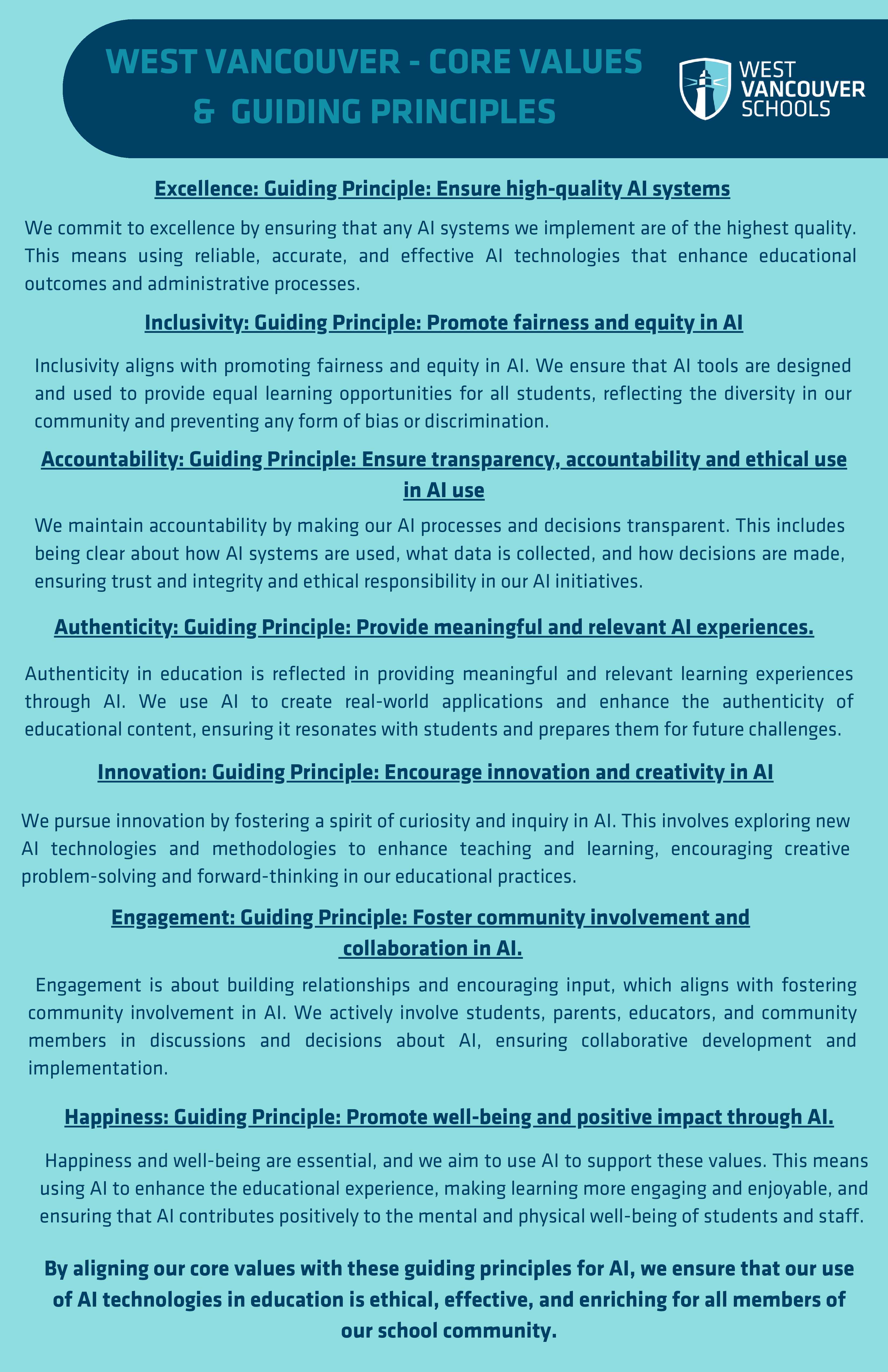
Creating and Revising Documentation – Setting clear guidelines and documentation ensures that everyone is on the same page as AI becomes more integrated into our work. We started with our Core Values and Guiding Principles (HERE), Guidelines for the Use of AI (HERE) and When Do I Use AI visual (HERE). We also revised existing technology policies to ensure they were inclusive of AI.
Focus on a few key AI apps – There are thousands of AI tools out there. And it is easy to just talk about and debate which tools to use rather that just identifying a small number, supporting their use and getting on with better conversations around how AI can positively impact teaching and learning. For us, Magic School has become a go-to tool for its ease of use and versatility in the classroom, helping both teachers and students adapt to AI technology
Engage the entire community – Often with new ideas or initiatives they apply unevenly to a school district. One of the best things about AI is that it has uses throughout the system. As I wrote recently there are great ways for trustees or senior leaders (HERE), or sports coaches (HERE), or parents (HERE), to use the tools to support their work and the work with students. We have also leaned in to district-wide and school specific sessions specifically for parents.
Model AI in Action – Have you noticed this is the 5th AI related blog I have written in the last 2 months? That is not coincidence. My colleague Cari Wilson is also regularly blogging about it. And I have committed myself to spending a couple minutes at all meetings this year showing my learning with AI. Over the last two weeks this has included meetings with Trustees, parents, principals, office staff and others.
Leverage external experts – We have engaged with Alec Couros who worked with all district staff and then smaller groups in our district, and will be back this month to work with parents. We have also spent five days with Dean Shareski and Adam Garry and are planning three more for the new year. It is always a balance of using internal champions and outside experts.
Join local and global AI networks – Locally we are working to network teachers inside our district and then network our schools around their AI work. And then we have built a network of about 12 districts in Metro Vancouver that are working and sharing resources around AI. This is work that Shareski, Garry and ALP Learning are supporting. We are also part of a network with Michael and Bailey Fullan and districts from across Canada and a network in partnership with C21 Canada, Mindshare Learning and Dell that is looking at AI practices across the country.
It is not fluke when you see things are moving fast, and you want to get out front what you need to do. And it is never just one thing. I am definitely bullish around the impact AI is going to have on schooling and want us to lead and guide what happens. So we need to be doing things to look around the corner to what is coming next.
The speed of AI is exhilarating, and with so much possibility ahead, I’m excited to see where we can take it together.
The original blog post was posted into Chat GPT with the following prompt “Be a critic of this blog, what could be improved or clarified to make it more readable for the audience.” Feedback was incorporated into the final copy. The image at the top was generated through the enterprise version of Magic School.
 I shared my “Word for 2025” last week, but I am still thinking about the year ahead. I know in school-life the real new year starts in September, but January is a good time to reset and reassess. And just as we do that in school, I know it is happening in homes as well.