Feeds:
Posts
Comments

Archive for the ‘Personalized Learning’ Category

We tried to stop them, but they just wouldn’t take “no” for an answer.

As a follow-up to my “real-real” learning post (here), last week I had the chance to spend some time with four Sentinel Secondary students, Adam Mitha, Justin Wong, Jun Jeagal and Sailesh Suri, to hear a story, firsthand, of what this kind of learning looks and feels like.

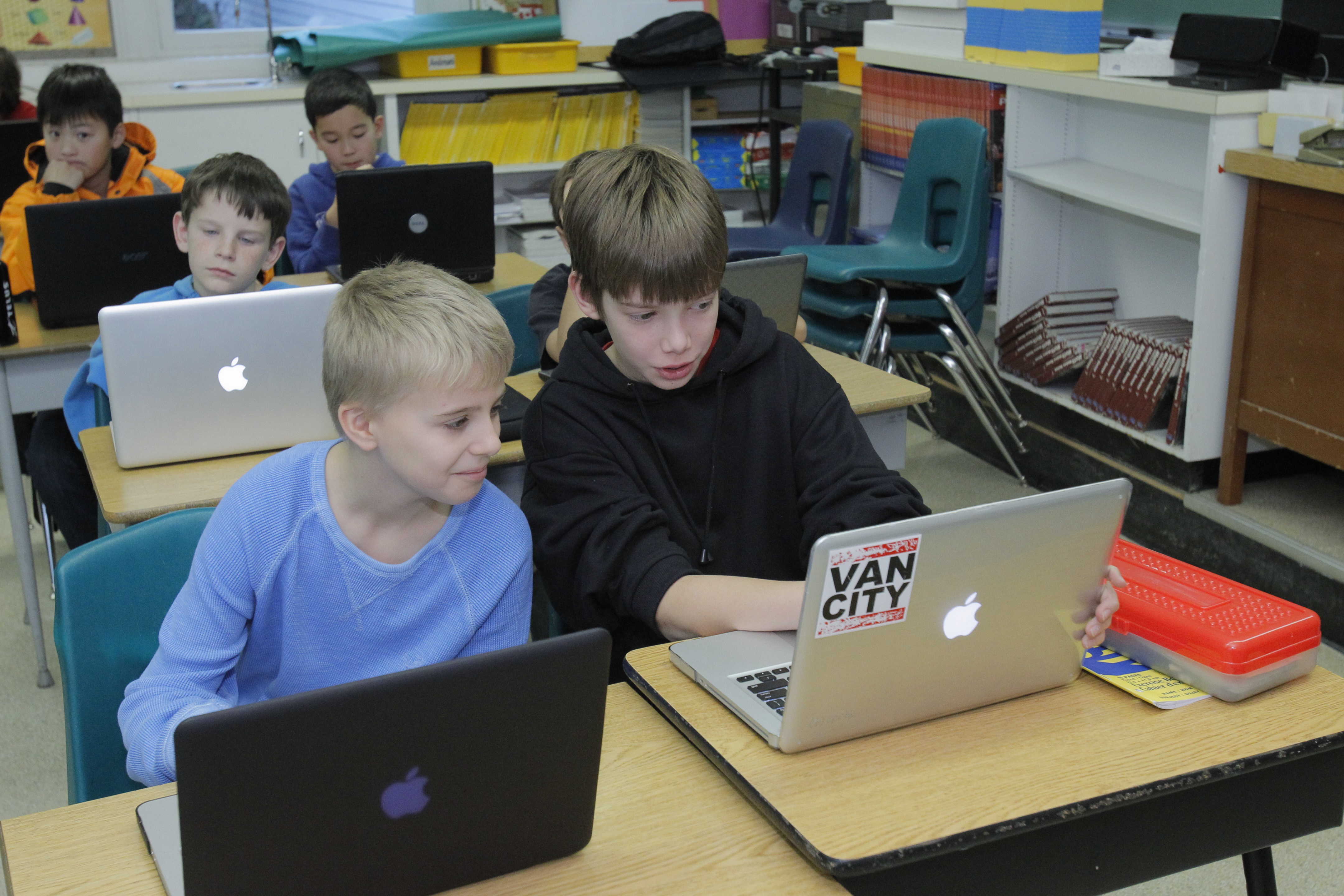
Supported by their teacher, Joel Gibson, the four young men, former classmates in Joel’s Information Technology class, were inspired to develop an “App” for the school that could easily match any created by experts in the field. They didn’t get paid, they didn’t get school credit, but it was some of the best learning they had ever experienced. In my conversation with them, they expounded about the 300 hours of coding, developing and designing that went into the finished product that has just been loaded to iTunes here (it is a free download).

So, just why did they do it?  They wanted to leave a legacy for the school. They described it as a mostly an out-of-school project, but they loved it because they were doing stuff they wanted to do and were interested in learning about. They emphasized the role of their teacher, Joel Gibson, “saying, I believe in you, is the best thing a teacher can do.”  When Joel saw the group needed to obtain more technical expertise for some parts of the project, he connected the students to experts from within and outside the system. Along the way, he connected them to the school PAC and others who could help.

Of course, as I stated at the beginning of this post, we didn’t make it easy for them. We (the system), limited some of their access to computers, were slow to support them technically, and made it challenging to move forward. They said that it was a good thing they had Mr. Gibson to mentor and guide them, but also, that they were part of the hacker culture. The hacker culture, as they described it, is “doing things over and over again. At school, the culture is that you do it right the first time.” One student remarked, “I had 30 failed projects before this one.”

I have been inspired by their inventiveness, determination and passion. How can we help students balance this kind of work with school, or better yet, how do we make this type of work systemic to the work of the school?  These four students were pursuing their passion, creating real work of value, and they were learning — for the benefit and reward of learning.

Often, this type of informal learning can be incredibly powerful. While our current structure does limit this “real world” opportunities, students like Adam, Justin, Jun and Sailesh, describe these as often the most exhilarating school experiences.

Be sure to download the fabulous Sentinel App:  HERE


Read Full Post »

It is easy to talk about what could be, what should be and what other people could do.  Instead, I would like to share what I have done, and what we are trying to do, as we engage in and embrace this learning evolution.

I began my career trying to emulate the teachers I remembered most, and through the stories I remembered from my school experiences.  The teacher was mixing content, stories and weaving a narrative. While hardly an actor, there was something about the performance of teaching I really did enjoy. I would organize the desks in a circle, and while this was great for students to engage with each other, it also gave me centre stage.  I was very focussed on the lesson plan and activities in the classroom.  I saw myself as the expert, and it was up to me and the textbook to help students understand the content. Now, here is a true confession — I loved being the ‘sage on the stage’. In my Social Studies and English classes I would often retell the stories my memorable teachers had told me.

As I became more comfortable, I tried to allow students more of an opportunity to tell their stories.  I worked to create situations where students could simulate the real world.  In History class this might have been a United Nations role-play lesson, or reviewing a series of case studies in Law class. Students loved the examples drawn from the “real world”.  In Law, we would study cases making headlines in the news, and other Social Studies’ classes leant themselves ideally to current events.  I loved the relevance that came from these lessons, as well as the engagement.  Combining my lectures with hands-on activities, like putting Louis Riel on trial, led to an even richer teaching and learning experience.

More recently, I have tried to not only simulate the real world, but give students opportunities in the real world. I often describe it in simple terms as moving to real-real, instead of fake-real (mock trials, case studies etc). My most concrete example of this is one I have shared previously (here) and presented at TEDxUBC:

Lately, I have seen many other wonderful examples of real world teaching. Delta District Principal, Neil Stephenson, shared a number of stories from his experience in Calgary, including this one (here) where Grade 9 students visited local universities in Calgary to convince young voters to go to the polls in their 2010 Civic Election. In our district, there are also many wonderful examples, like the Cypress Park students who participated in real world inquiry around clean water (link to video).  Another example is Larry Rosenstock, who presented twice  last month challenging the audience with the power of his work at High Tech High in San Diego (link to video).  And, although challenging, this push to real world inquiry is very exciting; when given the chance, learners love to engage in the world, and not only to be told about what’s going on in the world or through role simulation.

It is simplistic to think one method of teaching can replace another, and it is disrespectful to conclude there haven’t been wonderful real-real examples in our schools for hundreds of years.  But the move to personalized learning, the focus on “the 7 C’s”, and the power of technology to allow us to do things not possible before, have really changed the dynamics.

There is no doubt, when working with students or adults, all three experiences will come into play. There is a time for a teacher to be on stage, a time for learners to simulate the experiences of the world, and a time for learners to be part of the real world.  The irony is not lost on me that I often present a lecture in a teacher-centric approach to adults championing the value of teacher guided/facilitated learning.  And, if you saw the video attached to my last post, it was very much in the “sage on the stage” tradition.

I went into teaching, in part, to replicate the experience I had from the very best teachers in my school.  As our world changes, and notions of student engagement change, it is challenging to teach students and adults in ways that run counter to much of what I experienced growing up. This, for me,  is one of the great challenges of the profession today — adjusting the practices at the core of who I am as a teacher to better engage students for a world that is not the one of my youth.

Read Full Post »

Trying  to do something new or different can be a real challenge sometimes.  Last week I had the opportunity to teach a class to students at Gleneagles Elementary School and West Bay Elementary School, and to share my story about how I started blogging. I also had the opportunity to learn about their work and their own digital writing.  The work at Gleneagles is part of a teacher inquiry project that focussed on the following question:

Will students include more meaningful detail and perspective in their weBlogs by focusing on social issues as their ‘purpose for writing’ and will continuous feedback, in the form of threads, lead to deeper understanding of a given issue?

The classroom was both face-to-face and virtual, and teaching students I couldn’t see was new and challenging.  Teachers are accustomed to reading a student’s body language, and receiving cues from the class.  Half of the students were in front of me at Gleneagles, but the other half were viewing the class on-screen at West Bay via Lync, and it was a one-way video.  The students could ask questions, but I didn’t feel the same connection as when they are in front of me, in a room, or at least when I can see them on video.

Of course, the whole topic was quite new for the students as well.  We all agreed that even two years ago, there would have been no way we would be having a conversation about digital writing and blogs; what it meant to have a personal brand, and what kind of topics we would write about if we were going to share our ideas with classmates, or the world.  Out of the presentation came a number of excellent questions:

  • Why do you blog versus using an alternative platform to share your message/knowledge?
  • Where do you get your ideas/inspiration for your many blogs?
  • How do you create an effective blog?
  • Where/how do you find the time to blog so frequently?
  • When you started blogging, were you inspired by anyone/anything in particular?  Do they continue to influence your thinking?  If so, by what/whom?
  • Do you follow other bloggers and use their techniques/messages as a model for your own?
  • How do you decide on the graphics, pictures, and links you embed when there seems to be so many to choose from?
  • How often do you post?  Why?
  • Do you believe the good connection with your readers is because of your transparency as a writer?

It is a different way to think about writing, and I often say that I think in blog posts.  When I sit in a meeting, I write my notes around themes that may later become posts; I can think of the visuals that might go with the words, and this is so different from only a few years ago.  I have started dozens of posts, which may or may not become a blog at some point, but they have helped me organize my thinking.  While I write about one post a week, I think about hundreds. It was great to hear students discussing the stories they would like to tell, because we all have stories; we all have our own powerful narratives to share.

Toward the end of the session, one of the excellent discussions was about commenting. I offered that when I comment on other blogs I try to expand on an idea raised by the writer, perhaps give a different point-of-view, or add additional information the writer, or other readers, may find interesting or valuable.  I am hopeful some of the students who participated in our session last week will do just that with this post — extend and reach out with all of your learning.  So, what did you find interesting/valuable? What are you going to do next?  What questions do you still have?

Thanks again to the students of Gleneagles and West Bay for your engagement.

Thanks also to Colleen Denman for session photos, and all of the teachers and administrators who were involved in organizing and setting up the session.

Read Full Post »

IF YOU RECEIVE THIS POST VIA EMAIL YOU MAY HAVE TO OPEN THE WEBSITE TO ACCESS THE SLIDESHOW BELOW.

I have to give this post my usual preface that these slides are part of the presentation I am giving on innovation in K-12, but only one part of the story.  Today, I am part of an event hosted by Simon Fraser University, Targeting Technology for Maximum Student Benefit.  I won’t cover the ground I have covered before as the scenario and other background on the event is available (here), as well as from a substantial post I recently wrote on the appeal of one-to-one devices in the classroom and equity (here).

Beyond this and going forward, there are a few key points I would like to emphasize as we look at my assumptions and thinking on what we should and shouldn’t be doing:

Some assumptions for the next 5 years:

  • Teachers and schools are status quo (sense of community/social-emotional learning)
  • Learning, not technology, is the driver
  • Good writing (and what we often call “the core” curriculum) still matters
  • Complex problems often have a simple solution
  • External inventions (like the iPad) will continue to impact what we do, and we have no control over this!
  • Teachers need to know where to begin: “personalization” and “digital literacy” are broad and ambiguous terms, so we need to narrow the framework
  • We can’t wait for the decisions of others. It is “go” time. Now

What We Would Do:

  • Start at Grades 4–7 (if a middle model, maybe Grades 6-8), over time, the “sweet spot” will extend from Grades 4–10 depending upon school organization
  • Develop a personally owned devices strategy addressing equity
  • Focus on a web environment/space for learning/personalization with a common structure to change the norm of how we do business
  • Nurture great leadership with administrators and librarians
  • Have our learning leaders become digital learning leaders
  • While it may not be a popular decision to give teachers access to portable devices before students, it is often necessary in the case for change
  • Find the “simple thing” that challenges the norm, changes our thinking, and helps make technology “sticky”; it could be digital writing, or digital content, portfolio, or . . . .
  • Link technology to physical activity, and the visual and performing arts; it is not just about language arts – integrate, integrate, integrate!

What We Wouldn’t Do:

  • Distributive Learning, — we want all classes to be blended classes. There are others who are experts in Distributive Learning, so, let a few do it well for the students who need it, and we will focus on what we can do for all students
  • Allow technology to solely report to the business side of the organization
  • Go slate crazy. iPads do not lend themselves to creation and participation in our text-heavy world. They are more (at least, so far) about consuming information, and we want to create content creators
  • The ‘drill and kill’ and the ‘shiny new thing’ syndrome; instead, we would focus on good teaching and learning. If the technology isn’t good learning, don’t use it
  • Try to be something for everyone – because we need to truly focus on supporting student learning. While it is nice to say there is an interactive whiteboard in every classroom, to what education end?
  • Have a strategic plan; we would have a learning plan, and invest in infrastructure and pedagogy, but prescription with technology (particularly devices) is almost impossible

With that preamble and a very brief explanation, here is my slidedeck.  If you would like to use any of the slides, you can download the presentation from SlideShare.

If you are reading this in the presentation room, or from around the world, please feel free to join the conversation on Twitter at #bcedsfu.

Update:  You can download the Twitter conversation today (over 850 tweets) by clicking on this link:   BCEDSFU Chat

Read Full Post »

The beginning of February is generally seen as the midway point of the school year; it also marks the midway point of our first year in the West Vancouver School District, where our school and district leaders have turned to blogging to connect with their school communities.  At a recent principals’ meeting we took a look at some pretty amazing statistics, including about 250,000 page views on their blogs since September, emphasizing how powerful a tool this can be in connecting with a local and global audience.

And just what have some of  our educator leaders been writing about lately?

Director of Instruction, Lynne Tomlinson, recently wrote about Inquirydom in describing some of the challenges as we embrace inquiry and innovation:

There is a danger in overusing educational jargon and too often, good ideas and purposeful, relevant pedagogy are watered down to a shrink-wrapped version of their former selves.  As educators, we are well aware of the “pendulum swing” of learning models over time and it is important to think critically about the reasons why we may want to embrace any changes to our programs, large or small.

Kalen Marquis, teacher-librarian at Bowen Island Community School guest-blogged for Principal Jennifer Pardee and described the value of digital dialogues:

Used purposefully, Digital Dialogues may enhance the development of important skills and provide timely access to useful information and time-tested knowledge. Used wisely, they may facilitate ongoing inquiry and gradually develop the broadest awareness, deepest understanding, and most inspirational and transcendent wisdom.

Chantal Trudeau, Principal at Ecole Cedardale, wrote about the careful work that often happens at elementary school level to integrate curriculum, particularly when it comes to combined classes:

Teachers do not ‘cover’ a curriculum, they teach students. Teachers plan their instructional program meticulously to ensure that the Prescribed Learning Outcomes (PLO) from the Ministry of Education are taught to their students at their level of ability. . . . In the elementary years in particular, learning and instruction often take place in an integrated fashion and do not always stay within the boundaries of a particular subject area.

Darren Elves, IB Coordinator at Cypress Park Primary School, looked at how we teach learners to ask good questions, and the important value it plays:

At a time when our government is looking at better defining the parameters of 21st century learning and teaching, it is my belief that the students’ abilities to explore the key concepts by acquiring and practicing a range of questioning skills will further enable them ‘to be active participants in a lifelong journey of learning’.

Scott Wallace, Principal at Gleneagles Elementary, recently described play and its importance in school.  Reflecting on a recent workshop staff participated in, he shared five key concepts of the Play is the Way program:

  • Treat others as you would like them to treat you
  • Be brave — participate to progress
  • Pursue your personal best no matter who you work with
  • Have reasons for the things you say and do
  • It takes great strength to be sensible
Val Brady, Principal at Hollyburn Elementary, blogged about a topic that regularly comes up with parents — anxiety and how we can help.  Her post was informative, full of resources, and reassuring as a normal behaviour:
Anxiety is a normal emotional state that we all experience at various times in our lives. Anxiety serves as a means of protection and can often enhance our performance in stressful situations.  It is closely related to fear, which is another normal and necessary emotion that everyone experiences.
Rockridge Acting-Principal, John Crowley, linked the recent announcement on UBC shifting to a broad-based admission system to the important role of “The Other Part of  School Life.”:
I encourage you all to challenge your child to be involved outside of the classroom, to develop the perseverance and leadership skills that come from working with other students, and work on that essential skill called “finding balance”.
And Sentinel Secondary Principal, Jeannette Laursoo, highlighted the amazing experience a number of Sentinel students had at the recent Model UN Conference in New York:
At the conference, Sentinel students became members of a crisis committee and represented the viewpoint of their assigned country when faced with a pressing issue or event.   They discussed, debated, and solved the issue.  For example, Aeron Westeinde, was on the Modern Day Haiti Committee, which was responsible for rebuilding Haiti from the ground up.  They developed programs to improve security, education, agriculture and irrigation within the country.

These are just a few snapshots of what is being written, and how staff are being more transparent with their own learning, and the learning in their schools. Some themes emerge, ones we see elsewhere including the role of early learning and self-regulation, the power of digital learning and the interest in inquiry-based study.  What is also clear in so many of the posts, is the powerful experiences students are having — personalized learning is alive and well in West Vancouver.

The blogs are a great celebration of community — curious students, engaged and passionate teachers, thoughtful and visionary school and district leaders.

For a complete list of the West Vancouver School District blogs, please see (here).

Thanks to all who have engaged with us this year.  We appreciate being able to share, and to continue to share, our learning with our local and global communities.

Read Full Post »

In my previous post (here) I referenced an upcoming event at SFU, Targeting Technology for Maximum Student Benefit.  To think out loud a bit, as well as to garner some ideas, I want to take a look at a number of issues that need to be unpacked, and to create some models for comment, pushback and refinement. So, the idea is to engage in a larger conversation, but less about the case for change, and more about a tangible idea of what that change might look like.

One of the points raised in the BC Education Plan under Learning with Technology is “The Province will promote the use of technology for both students and educators.”  So, why does the BC Education Plan want to promote the use of technology?  Technology is only the device;  it is access to the benefits of a digitized world where everything is amplified that is the greater goal.  For many, this part of the education plan speaks to moving to one-to-one opportunities.  In the feedback I have seen around this, many have raised concerns over equity, and how one-to-one might further divide our students into have and have-nots, and while most believe technology can help overcome barriers of access and geography, we need to ensure there is some baseline. While it plays out as ‘technology’, what so many want for their children is the benefits of digital learning — relevant, connected, unlimited.

So, given that it seems unlikely that all students will be provided with a similar device (as was done in Maine and has been done in specific grades in BC at different times), what might a model look like that embraces personally owned devices, but would also tackle the  issue of equity for all?

Some underlying background assumptions:

1) If we believe technology is crucial for students moving forward, we need to find a way for all students to have a base level of access.

2)  Many still argue about the merits of technology; however, without question, the world is becoming increasingly digital. Accessing content, communicating, working, learning, and all facets of life are being shaped by the ‘digitization’ of the world.  For our students to thrive in this world, they need to have access AND direction.

3)  All efforts need to be learning efforts; the goal is to increase personalized learning that improves engagement, relevancy, achievement, and the technology is there to support this goal.

3)  Given that it is unlikely any grand plan will come together to support all students and staff with technology, implementation will be incremental.

4)  Simply encouraging students to bring their own devices is not enough, or an effective strategy.  The strategy must be purposeful, supported and unified for both teachers and students.  Failure to do this will leave us with pockets of innovation, and without a sustainable model.

5)  There will be teachers who continue to push the boundaries, who will do amazing and edgy stuff — teachers always have and always will.  But, while this should be encouraged, it shouldn’t be understood as a base expectation.  Not every class needs to be Skyping with students in Europe for their assignments, or producing videos to explain their work (but it’s great in classes that do).

6)  To be clear, one-to-one computing is not the solution to any challenge — it may, though, be part of the answer to going forward.  If we think by placing an Internet appliance in a student’s hands alone will create a more creative, innovative, or more intelligent student we are missing the point.  Like the paper and pen of the last generation, it is the ‘oxygen’ to breathe in a digital world.

So, what might a strategy look like:

1)  It is important to start with either one grade or one school.  While this post covers the technology, there is huge support needed for staff.  This is not a pilot project — this is the first step in a strategy.  The ‘sweet spot’  seems to be between Grades 4 -10. The elementary level is appealing as a starting point because it is one (or very few) teacher(s) interacting with each student, and easier for early success.  Grades 4-10 is also the area where learning strategies can be integrated and cross-curricular, supporting personalized learning strategies.

2)  Teachers need to have the technology in their hands early on to become comfortable with it and before students are using it on a regular basis.  There is also a lot of work to be done to support teachers in adopting pedagogy in this ‘new’ classroom environment.

3)  We need to identify what will make the digital learning ‘sticky’ for classes and schools to enable meaningful and powerful learning; it might be digital writing through a blog, student portfolios, or digital content (e-books/content). It will need to be supported for both teachers and students, and framed around an inquiry-based approach with student ownership and teachers as guides in learning.

4)  A standard about what technology works best is required.  Absolutely, bring what you have, but that strategy is far from perfect. Much can be done with a smartphone, but I am not convinced it is the best device for learning. I still think a small laptop that allows for work production is currently the best device, of course, this is changing with the growth of slates (iPads) and the potential of new devices like ultrabooks.

The really big question, how do we ensure equity?

  • Have students with their own devices bring them. There are more students who have them than we think, and if the case is made that students are benefiting from the learning, more families will invest in the mobile technology for school and home.  If parents can be assured that an investment in Grade 4 will carry their child through for four-to-six years with their learning, many will make this choice.  I am often stunned by families that buy their child a cell phone, but don’t have a computer.  I am also quite comfortable in saying that if they are investing in a cell phone and not a computer there are better options to support their child’s learning.  We need to help guide families with what technology will have the greatest impact in supporting their child’s learning.
  •  Of course, not all students will supply a computer up front, this could range from a few students to the entire class depending on the school or district.  The second option would be a lease-to-own option for students. There are a number of options available with price points around $20 per month.  This picks up on the cell phone argument, and a more affordable device with more value for student learning.  Families could be assured their child would be getting a device that would be ideal for learning for a number of years, and could be used at school and home.
  •  Finally, there are  students that, for many reasons (financial and otherwise) won’t embrace the first two options.  We need to find ways to supply these students with a comparable technology to use at school.  Many schools have class sets of laptops that could be repurposed for this project; in other cases investments will need to be made.  The challenge is that the investments will be uneven (and this is difficult to do) with some schools requiring a greater percentage of investment than others.

The uptake on the first two options will determine the speed at which the program could grow.  There is also a belief (as evidenced) that devices will continue to come down in price over the next few years and the $100 Internet device for schools is hopefully soon at hand.  We can take the approach that laptops may likely be what calculators were for me in senior math, something that I could bring, rent or borrow.

I realize that we are far from coming to terms on the question about whether the future is every student with a device, but I do think many see that as being part of schooling in the not-so-distant future.  If that is true, we need to begin test models.

If we believe this is what we want for all learners in public education, we need to find ways to make sure it is available to all learners.  If we believe that all students should have a level of access, given our economic and political realities, we need to engage and explore ways for this to happen.

Read Full Post »

I have used the above slide in a number of presentations to make the point that British Columbia is leading Canada (perhaps even the world) in the professional use of social media in K-12 education. I freely admit I don’t have the statistics to back up the claim — there are simply more teachers, administrators, parents, trustees, and others here, who are logging into their blogs, Twitter, Facebook, and YouTube accounts in the name of professional learning, than any other jurisdiction.

In the past year we have moved from several dozen blogs around K-12 education, to numbers in the hundreds, with representation in every area of the education system.  The #bced tag on Twitter is one of the most engaged with conversations about the ever-changing education profession, and there are many other social sites having these conversations as well.

The conversations around the profession itself are very interesting.  In social media, ‘role’ becomes less important; there is a flattening of society and it is ‘ideas’ that have increased value.  There are also incredible opportunities  to reflect, share, and learn without the limitations of geography. I could go on, and there have been many others who have covered the ground about the value of social media for educators, and how Twitter and blogging can be extremely powerful in professional development.  This is true for those interested in education in BC, but it is also true of other professionals around the world.

So why has BC moved so quickly and taken such leadership in this area? As mentioned, I have no statistical proof, but a series of ideas as to why BC is the leading jurisdiction using social media to engage in the profession of education.

Some Thoughts:

1) It is not as “new” here as it is in many places:  Five years ago, as a principal in the Coquitlam School District, I was seeing for my colleagues, blogs were already becoming routine including: Brian Kuhn (district), David Truss (school administrator) and James McConville (teacher), all engaging in social media.  We have a long history of models to look at and are in a much deeper place with this type of learning than other jurisdictions.  So, it is no longer a novelty here that it is in some other areas and is a much more mature and developed.

2) Networking is a core element of BC’s education scene:  Since 2000, Judy Halbert and Linda Kaser have been working with teachers, administrators and other educators through The Network of Performance Based Schools.   This network (which I blogged about here) has been a model for jurisdictions around the world.  The culture of face-to-face networking moves naturally to social media networking, and connects the interest around learning ideas.  This social media networking is an extension of the face-to-face conversations that Halbert and Kaser have long sponsored.

3)  The traditional media “plays” in social media: Most notable is Vancouver Sun Education Reporter, Janet Steffenhagen, who has the popular Report Card blog and is a regular tweeter.  She is not the only one.  From The Globe and Mail, to CKNW, to most local newspaper reporters covering education, they regularly engage in social media.  Often, we now see what will be “news” on a nightly newscast or morning newspaper make news first on Twitter or in a blog.  Social media has become fertile ground for education reporters researching their next story; it is seen as a place to break and make news.

4) Organizations and government “play” in social media: I knew Twitter was part of the establishment and no longer on the fringe when I saw the education minister join a debate online one night. Of course, that is not the only example. Almost every organization involved in education is on Twitter including the BCTFBCPVPA, CUPE, BCSTA and BCPSEA. Not only are these organizations out there in a corporate sense, but many in their leadership have their own accounts.  One can look at examples like the recent Facebook campaign by BC principals, or the revamped and expanded BCSTA social media presence on the value being placed on social media.

5)  There are some regular and thoughtful voices:  There are a number of individuals with a profile well beyond our borders.  From  Bruce Beairsto who blogs on the Canadian Education Association site, to well-known edu-bloggers including Chris Wejr from Agassiz, David Wees from Vancouver, Cale Birk from Kamloops and many more, there are some regular contributors who are seen as “go to” people for interesting reflections and ideas.

6) We are at a time when we are examining the profession:  Even before the BC Education Plan, the last several years have been full of discussions within the system about how a high-performing system should evolve.  With some high-level direction from the province, but not a lot of prescription, the time is ripe for sharing ideas and innovations within and across jurisdictions.

7) We have an amazingly dedicated profession:  Even in challenging times, it is stunning to see the number of teachers, school administrators and other educators spending time in their evenings and weekends to reflect and share through their blogs, Twitter and other venues.  The reason why we have one of the highest performing jurisdictions in the world is because it is accompanied by an equally talented and dedicated group of educators.  As social  media has grown, so has our educators’ need to harness it for professional growth.

This is far from an exhaustive list.  But, I am often asked by other jurisdictions why those who are involved in the BC education system have taken to social media at such a greater rate than anywhere else?  I believe it is our ability to see around the corner to where we need to go next that is part of our success story, and that is what we have done by engaging in social media.

Read Full Post »

I have previously written posts on Principals as Blog Leaders (here), highlighting the blogs from our district leaders and leaders in each of our schools. I have profiled the 17 BC superintendents in Superintendents as Blog Leaders (here), who blog to keep their community current. More recently, I have shared a post featuring our dashboard initiative (here) in West Vancouver, and efforts to give students their own digital learning space. There has been amazing energy around students as blog leaders, and many of our principals and vice-principals have blogged about their experiences, including Judy Duncan, Principal, West Bay Elementary (here), Chris Parslow, Vice-Principal, Gleneagles Elementary (here), Scott Slater, Vice-Principal, Bowen Island Community School (here) and Chantal Trudeau, Principal, Cedardale Elementary (here).

That energy and excitement is spreading. Last week, I spoke with a gentleman with grandchildren in two of our schools. He told me that each child had a blog to show him and were genuinely enthusiastic about what they were doing. It was also the first time they had shown him their writing, and he commented on how they were so engaged, and how he was even able to connect through the technology.

Our Director of Instruction for Technology and Innovation has already covered the student blog-a-thon (here) and a summary from our Digital Literacy Support Teacher (here) gives a comprehensive overview of some of the work taking place with our Grade 4-7 students around digital writing.

I often remind people who are looking in from outside the district with skepticism, envy (or both) at our technology use, the ultimate goal is not to have students blog, it is to have students improve their literacy skills and have the ability to be digital writers, and to do things that would not be possible without the technology.  It is about students creating content to hyperlink to the world, to embed photos and video with text.  It is about students publishing, and then to have the opportunity to receive feedback on their work, review, edit and republish. It is about students producing work not only for their teacher, but for the world. It is about students having their own space to be creative and connect in new ways.  It is, ultimately, about students having greater ownership of their learning.

Twelve months ago, I never would have imagined writing about hundreds of West Vancouver students blogging as a way to share their learning.  It is so exciting to see the new learning students are creating, the teachers that are guiding them, and the parents (and grandparents) who are engaging with them. A slide I often use in presentations simply says, “The Kids Have Tasted the Honey”. Having seen the work presented by so many students this past fall, the viral nature of the growth of digital writing, that quote is so true.  This month, the challenge for students across the district is to publish 5,000 posts (see all the monthly challenges here).

I do want to highlight and celebrate some of the students’ digital writing. As our student blogs are on an internal system, I have copied the text of a few of them when they wrote about their neighbourhood:

Grade Four

Jenna, Westcot

I live in wonderful neighbourhood in West Vancouver close to my school. I live in a cul-de-sac. My neighbourhood has some trees in the background and is open and sunny.

The view from my neighbourhood is wonderful; you can see pretty much see the whole city. I get a view of downtown, the ocean, and the rest of Vancouver. It is very pretty in the night because I can see all the lights and the city looks like it is shining.  When there are fireworks I can see them quite well, and it looks beautiful. The fireworks look like a spurt of colour bursting out of the sky. I can also see the sunset from my neighbourhood. I love seeing the pink and purple sky in the morning and evening. I love the views I get from my neighbourhood.

In my neighbourhood, we sometimes encounter wildlife. During the spring we sometimes get black bears. They would either take someone’s garbage and eat in our yard, or poop in our yard. When we had a plum-tree they would come into our yard and eat all the plums. We have a big grassy yard so I guess the bears like it. Once a black bear tore down my neighbour’s shed and they had to call the police. They did not turn on the flashing lights but, just seeing the stripes on the police car, the bear ran away. I also get a lot of crows in my neighbourhood and they usually perch themselves on the roof or on the electrical wires.

 My neighbourhood is very close to my school. This is convenient so we do not have to leave my house really early. Also, on snow days or warm days we can walk to school which is really fun.

We have wonderful neighbours and we like to go over to their house and play badminton or tag.

This is why my neighbourhood is such a wonderful place to live.

Lauren, West Bay

I have a really cool neighborhood. My street is on a beach. I really like going down to our beach in the summer because the sound of the waves crashing against the rocks is really soothing. I also like living near the beach because I can watch all the boats sail along the coast. It’s really nice sitting on the couch watching seals bob their heads up and down. Once I even saw whales! Can you believe it? Speaking of animals, we see quite a few animals on our street. For instance we have a “Block Deer”. A deer that is so comfortable he walks through the tables of our annual summer block party. Amazing right? On my street it usually smells okay but for a few days now and then it smells like skunk. My family has named the skunk Kyle. We even tell stories about him. We have quite a good time with it. A few days ago there was a baby bear on my street. He was an orphan because his mom was taken away earlier in the season. Luckily he was saved by my neighbors, who found him up their apple tree and stayed at the bottom until the rescue center came and took him. They named him Apple. My favourite animals of all on my street are the raccoons because they’re so cute when they put their paws on the living room window. Watching animals is not the only thing I do in my neighborhood. There are lots of kids. In the summer we like to ride our bikes together and on Halloween after we go trick or treating our street throws a fireworks party and we all watch. I love my neighborhood. It always makes me feel welcome.

 Grade Five

Nicole, Caulfeild

In my neighborhood, we have a glorious view of the water. We are able to see ferries and cruise ships gliding by gracefully. One time we had spotted a Disney Cruise! We could see the water slide hanging off the side of the boat. It was a very cheerful and magical boat.

The wild life around us is amazing. Every morning during the frosty winter you will hear a woodpecker pecking against some sort of metal heater that we have on the roof. The woodpecker has a cherry red mohawk, and a slim black body.

Another type  of wildlife around us are geckos. They look like they have gradient patterns on their backs which make them interesting to look at. Some of them we’ve seen are emerald green and a night black. During figure skating camp in the summer every time we came home there were two gecko’s in between the rock wall of our garden. One of them is a baby gecko and the other is the mother. Their colours were amber and grey. they were not scared of anyone who walked by or looked at them with interest.

One night during the summer we spotted a black bear strolling up the sidewalk beside our driveway. We think it was a cub because it was quite petite.

Another type of wildlife we have around are chipmunks. When me and my family are swimming in our pool,​ you will see tiny chipmunks fighting over a tiny pine cone. (probably because it has fresh seeds inside it.) Although, when the pool is completely calm you see the reflection of them on the glassy water.

In our neighborhood, there is a rocky beach just down the street called, “Stearman” At that beach when I was little I used to collect only one type of shell which is kinda like a mini conch shell. Stearman beach also has a water fall going down the center of the beach leading into the ocean. It is a gorgeous rushing waterfall. Also at the beach I can feel the gritty sand squishing between my toes. It is very ticklish! The water is very cold in the Pacific Ocean so I don’t like going in it very often.

Sherry, Chartwell

My neighbourhood is a fantastic place to live, because it small, quiet, and very peaceful. There are never car crashes, babies never scream, and our leaves don’t make any crunching sound when we step all over them. The only time there is ever any noise is when someone comes to mow our lawn.

Our neighbourhood is very lively. To the North of our house are the Lion Mountains, which have just been showered with mounds and mounds of white, fluffy snow. To the East lies a pretty little park called St. David’s park. Sometimes in the summer, I even go blackberry picking there during late August, when the berries are ripe. To the South is downtown, where I can see the Seabus going back and forth between the two towns, and where I can also see the blazing fury of red, pink, purple, orange, and yellow when I’m watching a breathtaking sunset. To the West is a kind family of Iranians that sometimes help us plant and take care of our garden. Our entire family is very grateful for their time and effort towards our flowers.

Sometimes we get interesting surprises from the wild.  Birds, raccoons, and squirrels come to our neighbourhood to seek out food. Lot’s of mornings I have even woken up to the pretty sound of robins and sparrows chirping outside of my bedroom window.

During the spring, there are often flowers that bloom and grow early, like bluebells, dandelions, roses, and cherry blossoms. When it rains, the dewdrops reflect off of the sun, causing it to look like little, miniature rainbows sparkling in the sunlight. In the summer, there are even more beautiful flowers, and this tie the flowers are all the colours of the rainbow. In the autumn, the leaves turn red, orange, and yellow. When they fall, I often stick them in my scrapbook so I won’t forget that specific fall. And finally, in the winter eventually everything gets covered in a thick blanket of white snow, and the bright red and green holly sticks out of the astonishing white landscape.

My neighbourhood is a great place to live all year round, and I wish that the whole world were as peaceful and beautiful as it is. We have such a great neighbourhood that we should all work hard to protect and cherish it.

Grade Six

Eva, Pauline Johnson

I have lived in my neighbourhood as long as I can remember. My neighbourhood is quiet and remote, but if you scratch the surface you will discover many exciting things. By reading the next couple paragraphs, you will find out lots about my neighbourhood. You’ll find out about the people and the hill and the view from my neighbourhood. You’ll find out that there are good and bad aspects to my neighbourhood. When balancing the good with the bad, my neighbourhood is a pretty nice place to live.

There are not many kids in my neighbourhood but there is an interesting collection of adults that live near me. There is one guy that carves native designs in cedar. He has carved a canoe out of a cedar log, a whale on his front door and he even made an eight meter totem pole that stands in his front yard. There is also a guy who has a red corvette that makes a lot of noise in his garage. There’s a really nice family that lives next to me. Their kids have grown up but they have a really cute dog named Millie and a playful bunny named Bruno who keep me company sometimes. I also have a war veteran as a neighbour who lives with his wife. They are really nice people. The whole group makes up a diverse set of neighbours

My neighbourhood is far from the city on top of a huge hill. There’s up sides and down sides to that. The down sides are that it’s hard to walk home and you are kind of cut off from the community below. The up side is that you get a nice view of the city and the ocean and sometimes you get so much snow that you can’t go to school.  Way up here, we can enjoy all that nature has to offer.  We get the birds chirping in the morning, we get the bear cubs in the spring and in the autumn we have trees bursting with colour. All this gives us a great advantage over living downtown.

My neighbourhood has an amazing view of the city. From up on my hill, we are so high that we are above the fog and can see the fog lying on the city below . Also we get to see beautiful sunrises and sunsets, the lights of the city at night, the dark rain storm clouds and we can clearly see the lighting storms. The only thing we can’t see is the fresh snow on mountain because we are actually on the mountain side.

You just read about the up sides and the down sides of my neighbourhood. I hope you think that the people are cool as I do.  I think if you saw the view and the nature you would find it magical. I hope you enjoyed reading about my neighbourhood.

Sarah, Pauline Johnson

My neighbourhood is fun and vibrant.  I will tell you all about living somewhere where you can walk to the ocean and why I’m lucky to live in my neighbourhood. I will also tell you about a wonderful park and my memories there, plus my place in Whistler.

In my neighbourhood there’s a park named Westridge Park. There’s a nice tennis court, it seems like nobody ever plays tennis there except for me and my mom. In Westridge Park there are tons of trails to walk around in, my friend and I like to collect all the BB’s while we walk. There are also creeks and streams, on a hot summer day I walk over to Westridge Park with my friend and splash each other with water. The waterfall is awesome; I love hiking up it but believe me it isn’t easy.

I think that I’m lucky to live in my neighbourhood because there are nice people and lots of activities to do. I’m lucky because I live pretty close to the ocean; it’s about a 20 minute walk. It’s a nice walk winding through the streets. When you think about it we’re lucky because there’s clean water and fresh air. Everybody has to go to school, but in some countries they don’t even have schools!

I have a cabin in Whistler as well. Our family loves to ski and we go up there every weekend in the winter and sometimes in the summer. I love Whistler because it’s pretty much always snowing. It’s nice to wake up when it’s snowing and drink hot chocolate getting all excited for the day ahead. I feel lucky to have a place at Whistler because on the drive there, there’s a Tim Horton’s, who doesn’t like a timbits on a long drive?

I told you all about Westridge Park, why I’m lucky and my cabin at Whistler. I hope you enjoyed reading about my neighbourhood, and just think about… do you feel lucky to live where you live?

Kate, Pauline Johnson

Bark! Bark! I sit up and look at my clock it’s 5:30 in the morning and I am once again woken by the sound of barking dogs. I try to go back to sleep but the noise continues. My house is right beside a dog park so in the morning I sometimes awaken to the sounds of barking, growling and once in a while it even sounds as if two dogs were fighting. You have to agree it’s not the nicest thing to be woken by. As I said my house is beside a park and in that park there is a high school. How come kids in high school are always throwing parties? What I’m saying is that in the morning I’m woken up by dogs and at night I can’t sleep because they are doing fireworks as loud as someone’s heart beat after watching a terrifying movie! Let’s say I sometimes have trouble concentrating in school the next day when I can’t stay awake! If you read on you will find out everything about my neighborhood. 

I have talked about how I see and hear lots of dogs. There’s one dog that constantly shows up in my front yard without an owner. Its name is Ellie you’re probably thinking I’m talking about a stray dog but Ellie does have an owner. Since my house is situated right beside a park I have seen a lot of animals some of which have even been inside my house. One animal that I see and hear a lot of are raccoons. One time at 8:30 at night I was reading my book when all of a sudden my cat starts to hiss and my dog is running around downstairs chasing something. I wait in bed thinking of all the possible things they could be chasing. At that very moment I knew that a raccoon was once again in our house. The sly raccoon had gotten through the cat door and had begun to eat the cat’s food. The raccoon had definitely underestimated my cat and was soon chased out by my cat Tommy. I doubt that raccoon will ever come back. Another animal that I see around my house is an adorable barred owl. I don’t see him very often but when I do it’s so fascinating because I know most people haven’t seen one in their natural habitat. When there in their natural habitat they’re so happy and they will do their birdcall and everything. Why go to the zoo when you can see one in your own backyard? The last animal I’m going to write about is bears. I have never seen the bear that lives in the dog park but he’s almost always there (unless he’s in hibernation) but about three weeks ago my mom told me that the bear had been captured. Anyway when the bear was still here he would eat all of the berries and he even went through some of the garbage cans. Of course he did this all at night and if the next day someone went to go pick some berries and they found that they were gone they immediately knew they had been eaten by are neighborhood bear. 

Imagine it as a beautiful, sunny, warm summer day what should I do? Go play soccer in the park with a bunch of my friends go swimming in the creek. Around my house there are so many things to do. I already told you how I live beside a dog park and that in that dog park is a high school. It’s not like my house has a wonderful view of the ocean but I still love where my house is. It is on a dead-end street we never see cars unless they accidentally turned on to our dead-end street. Which means it’s a fantastic place to bike, scooter, roller blade or even play a game of basketball, soccer or any other sport without having to watch out for cars. A lot of parents worry about their children going on to the street to play but no one in my neighborhood worries about their children getting run over by a car since no cars come down our street. Because I live beside a dog park whenever I want I can go and play soccer in the dog park on a grass field with real goals that are actually the right size. It isn’t very fun playing soccer with the size of nets that 5 year olds play with. In the summer blackberries, huckleberries, salmonberries and lots of other berries lots of people don’t even know what salmonberries are! Most people think they are a type of poisonous berry. I think I learn lots more than the average person about nature just by living beside a dog park.

You have all heard how homelessness is an enormous problem in Vancouver in this paragraph I’m going to tell you what I think my neighborhood could do to help the homeless. My neighborhood hasn’t done anything to help homelessness and I think these are some ways my neighborhood can help. I have noticed how in my neighborhood lots of people go on vacation more often than needed even in all of West Vancouver I would say most people have traveled outside of Canada. I think if everyone in my neighborhood went on one less vacation they could give some money to buy homeless people a warm blanket and a pair of comfortable clothes. In the summer my neighborhood had a garage sale if we did that again but this time gave all of the money to a homeless shelter. It would make a big influence in homeless people’s lives. Because pretty much in garage sales it’s giving away objects that you don’t want, why not give it to a good cause instead. Another idea would be to every year everyone in my neighborhood could each donate 20$ to the North Shore Lookout shelter.

Thank you for reading my blog I hoped you learned lots about my neighborhood and in your neighborhood you can also try to make an effort to help the raising number of homeless people in Downtown Vancouver. If you ever want to see wildlife instead of looking in the zoo try finding them in their natural habitats.

Grade Seven

Mollie, Irwin Park

My neighborhood is the perfect place to live. Our hou​se is in a great location for our family. We live in a very environmentally friendly and green location an it is also in a private and quiet place.

Among all the neighborhoods in West Vancouver, I think mine is one of the best.  We live in the Bayridge area, close to Caulfeild Village. To begin with, we are close to many schools, including Rockridge, so I can walk home from high school if I go there. If I did not want to walk home, there is a bus stop right in front of our house! Also, there is a couple of elementary schools that I could have gone to including West Bay and Caulfeild Elementary Schools. Another great thing about my neighborhood is that it is close to Horseshoe Bay, so it is very convenient to go for a nice hike by the water, go for lunch or go to Bowen Island for the day. Lastly, there are lots of little things that are good about my neighborhood like we are a ten minute walk to the beach and we are conveniently close to the highway for going to Whistler on weekends. This is why I like the location of my neighborhood.

Something else that I love about where we live is that it is a very natural environment. We always see wild animals going in and out of our backyard! These animals range from bears, deer, raccoons, skunks and many types of birds. I like seeing animals in our backyard because it shows that we are still at the boundary of an urban forest and that West Vancouver has a wild side to it. Another thing I like is that we have many creeks in our neighborhood where fish come back to spawn in the autumn. Yet another quality that my neighborhood has is that we have two magnificent parks. They are both very natural, not used by many people and fun to explore. You can find secret stashes of blackberries and salmonberries, build tire swings and tree forts. These again are some of the many reasons why my neighborhood comes out on top for me!

Last of all, my neighborhood is so great because it is private and quiet. Also, our lot is great. First of all, we have one the largest properties on our side of the street, which is the north side. Not many people in West Vancouver can have as big of a property as us. My favourite thing about my neighborhood is that it is so quiet. There are never many cars going by at night or in the day so I can have really good sleeps and go for runs safely in the day.  Lastly, because of the size of our lot we have lots of privacy when we are playing outside.

I have listed a number of reasons why my neighborhood is the best. It is quiet and private, very natural and in a great location. It is amazing to think that all these things can be found in one location.

Sarah, Ridgeview

Rain drops cool, snow falls soft, but sunshine is a welcome break. Streams trickle and rivers roar, as away the ocean tides shrink, and as my skipping stone sinks. West Van is a haven of dappled light and shade. Forests hide squirrels, as garbage cans conceal raccoons.

In my yard, there are regular visitors, ones that I feed scraps of bread or leftover food. I always have an animal waiting outside for a meal.  Sometimes the seagulls fly up from the beach to join the crows and sparrows perching in the pines. No matter what small creature comes, they leave with full bellies.

Another great thing is all the remarkable trees that stand guard over the inhabitants of this outstanding place. The wispy white clouds and the sometimes dazzling blue of the sky inspire my poetry, and my writing. Crying seagulls circle over the sandy beaches, waiting for the moment when a scrap is tossed and when they all dive down, big feathery lumps. Here the heart is always full of the sound of the tide and the blue of the sea. The mind empties then sets itself free to wander through the maze of thoughts and to delve into your imagination. Inspiration is everywhere. The very wind calls me to join it, to spread my wings and soar, to leave the world behind.

 I learned to imagine at a young age. At night I would clutch a blue marble, waiting until it settled comfortably into my hand. I would close my eyes and see myself at a cliff with the world spread before me, and then I would unfold my wings and jump. In my dreams I would glide, free of all my worries, and I would remember how it feels to fly, so when I wake up I just have to close my eyes to leave the world.

West Vancouver is a place of beauty, of comfort and safety, of nature. I know how to embrace the wild, flow with it. I hoped that maybe one day I could do something to make it even better. May all the people who pass through come with love and leave loved.

Will, Irwin Park

I think that my neighborhood is the perfect neighborhood to live in for many reasons. People move here because it has so many benefits that other places may not have. Going to school in my neighborhood makes you loads of friends, and the neighborhood is a very kid friendly area. Each person is unique, and together they form an interesting and fun place to live in.

A morning in my neighborhood starts with rays of sunlight pouring through my window. The glittering blue of the ocean reflects off my canary yellow walls, creating an emerald glow. In seconds I am aware of all the sounds around me. The faint barking of our neighbors’ dog and the zoom of cars whizzing by are the two that I can always count on. I look out my window to see the ocean, reaching out with its long arms to the laughing shore. I have always said that the air is so much more fresh and salty due to the ocean, and anyone who has visited Dundarave will notice it right away. I look into our yard, and see the play fort which has doubled as a castle, a spaceship, and a boat. The fence behind it still has a huge hole in it from our bear encounter (that bear sure was grumpy!).

My neighborhood is full of interesting people with interesting personalities. I think that it is these people who make my neighborhood so great. But there are also funny animals that live around me too. One could write a book about the animals in our neighborhood! For example, at least once a week a random cat will roam into our yard, hoping for a can of tuna. We named this cat Minerva, after the cat shape shifting teacher from the Harry Potter series. Another good example would be our neighbor’s dog. Thanks to him I never need to set my alarm clock. At 7:30 every morning it sounds as though he is attempting to drown out a lawnmower!

One thing you will notice as soon as you come to Dundarave is that everybody is friendly and seems to know each other in some way or another. My neighborhood proves that it is a small world after all. You may find out that you sister’s friend’s mom is the aunt of your buddy in Grade One! It sounds confusing, but you get used to it after a little while.

My neighborhood is like the perfect place to live. As we live near the water, we always see the ocean glitter as you take a walk down the Seawall, and the sun cheers up even the gloomiest feelings. A lot of kids live in my neighborhood, so I have a lot of friends. In the summer we find the beach a perfect hangout, as the pier serves as the world’s best diving board. The adrenaline rush that the jump gives you is like nothing else. Hitting the water stings, but will go away when you feel the cool water on your skin. I think that the beach is the best thing about living in Dundarave.

Overall I think that I live in the greatest neighbourhood. All the amazing people are so nice, and so are the surroundings. The nature that surrounds the neighbourhood is bright and vibrant. People come to Dundarave just to take pictures of the scenery! Dundarave is like a patch of Heaven that fell down to earth, and I feel that I am so lucky to live there.

Read Full Post »

I compiled a “Top 3” list for 2010 (here), and am thinking of turning the “Top 3” into an annual tradition.  Many of my 2010 choices could have held for this year, but I wanted to highlight new people, blogs, resources, etc.  These year-end lists are a great way to raise topics, discussion and debate, and shine some light onto areas that may have received less attention than I thought they deserved as the year went along.  I look forward to your own “Top 3” thoughts for 2011.

Top 3 “Culture of Yes” Blog Posts – these posts have generated the most traffic this year:

1.  My Take on Librarians

2.  Preparing and Supporting Teachers to Integrate Technology in the Classroom

3.  A Little Bit About Mrs. Caffrey

Top 3 BC Teacher Blogs I Follow:

1.  Keith Rispin, West Vancouver

2.  David Wees, Vancouver

3.  , Lytton

Top 3 BC Edu-bloggers (not current teachers or school administrators)  I Follow:

1. Mike McKay, Surrey

2. Brian Kuhn, Coquitlam

3. Tom Schimmer, Penticton

Top 3 Digital  Learning Trends in Schools:

1.  Everyone has a blog — students, teachers, administrators, district staff.  From a few dozen to a few hundred (or more) in B.C., in just one year

2.  Personally Owned Devices — more jurisdictions are including PODs as part of their digital-learning strategy

3.  iPads — from school pilots to being one of the most popular presents at Christmas, they are finding their way into more and more classrooms

Top 3 Professional Development Events I have Attended:

1.  GELP – Global Education Leadership Program

2.  West Vancouver Opening Day with Stuart Shanker

3.  MindShare Learning 21st Century Canadian EdTech Summit

Top 3 Used (and often overused) Terms in Education for the Year:

1. The Flipped Classroom

2.  Technology is just a tool

3.  Taking to Scale

Top 3 Books I have Read this Year that Influenced My Thinking:

1.  Nurtureshock by Po Bronson and Ashley Merrymen

2. Spark:  The Revolutionary New Science of Exercise and the Brain by John Ratey

3. What Technology Wants by Kevin Kelly

Top 3 School-related Videos from West Vancouver (that I bet you haven’t seen)

1.  Students at Cypress Park talking about their project with the Obakki Foundation – Kids for Clean water

2.  Caulfeild Elementary sharing the story of their iDEC Program

3.  Students at West Vancouver Secondary and their lipdub from the spring

Top 3 School-related Videos from B.C. (that I bet you haven’t seen)

1.  Students from School Completion and Beyond reflecting on the BC EdPlan

2.  An introduction to Learning Commons in BC

3.  Delta School District Vision Video

As I finish my first full year as Superintendent, I continue to love using my blog to reflect, share and engage.  I like David Eaves‘ notion that the blog is a great place to work out the mind.  I look forward to continuing to connect in 2012!

Chris Kennedy

Read Full Post »

I have been a long-time admirer of the work of UBC’s former President and Vice-Chancellor, Dr. Martha Piper. And, in the past two weeks I have had two opportunities to hear her speak directly about the road ahead for education in British Columbia; first, in roundtable discussions focussing on the qualities of an Educated Citizen, with the Honourable George Abbott, B.C.’s Minister of Education, and this week as she keynoted the BC School Trustees Association 2011 Academy in Vancouver.

On both occasions, Dr. Piper referenced the work out of Singapore and the influence of Lee Kuan Yew on her thinking.  She recalled his advice, and the three key points he shared:

1) the importance of multiple languages

2) the value of being scientifically literate and technologically savvy

3)  the need to study cultures and religions

In the most recent session at the BCSTA Academy, Dr. Piper framed these key points in context to her five suggestions to foster creativity and global citizenship. She restated these suggestions, and not only “preparing students for the workforce”, as an essential role of our K-12 system:

1)  A Commitment to Languages

There are a series of new languages required to be competitive.  Should we  have all students learn two, or three languages?  How can we infuse literature from other countries and expose our students to foreign language films?  The research is clear that the learning of languages will boost creativity.

2)  Integrate Humanities and the Arts into Curriculum

We have become focussed on areas relatively easy to test.  Areas that we have agreed are increasingly important to support creativity push beyond these traditional core areas.   These areas will not be able to be evaluated on a bubble sheet, but will be used in the “test” of life and living.

3)  Embed Global Citizenship

We need to make connections to the real world, so students in a science class understand how the science in the lab is changing the “real” world.  These kind of connections need to be made at all levels, in all classes.

4)  Embrace Community Service Learning

We need to build citizenship in students and within communities that is part of the school experience.  As well, constructive projects that connect with and build community need to be a role for our schools.

5)  Build Unique Environments

Each community is different, so programs should be flexible enough to tailor to community needs to best serve the students of each school and district.

Dr. Piper put a different frame on some of the personalized learning discussions, but with familiar themes around global citizenship. However, her stress on languages is not one I hear often.  She spoke about our goals of creating tolerant, compassionate and respectful environments, making students feel welcome and secure as they pursue their passions.

We can all point to examples of teachers, programs and even schools embracing the ideals that Dr. Piper speaks about.  The challenge is acknowledging and sharing the great practices around them: the schools who have found ways to add Mandarin to their school day, or integrate Social Studies, Music and Math in their inquiry projects, or have a scope and sequence for global citizenship, or encouraging all students to participate in meaningful community engagement, or have taken ministry curriculum and tailored these documents for their schools.  There are excellent examples of these practices, but are largely pockets of innovation.

I have heard a number of speakers on their way forward, and found Dr. Piper’s views of incremental change and focussing on citizenship to resonate with many of my hopes for our system.

Read Full Post »

« Newer Posts - Older Posts »