Feeds:
Posts
Comments

Posts Tagged ‘SD45’

Story

At last month’s Provincial Educational Leadership Conference, the former Deputy Minister of Education from Ontario, Ben Levin, reminded us all of the good story we have in public education, in our province and Canada.  There are exciting conversations around educational transformation, where to go to next, and that we continue to be one of the world’s top performing jurisdictions. We do have a great story to tell.  The West Vancouver School District Board Chair, Cindy Dekker, picked up on this theme in her latest Taking Action column in the North Shore Outlook:

The many success stories coming out of public education across Canada never cease to inspire those of us serving as trustees on the West Vancouver Board of Education.

Our latest source of inspiration came from Ben Levin, former Deputy Minister of Education in Ontario, who delivered a powerful, positive message at a recent Educational Leadership Conference in Vancouver.

He reminded us that Canada has one of the highest performing public education systems in the world but suggested we haven’t “hit the top of our potential and the drive to improve must be unrelenting”.

Levin challenged us to continue to push for better teaching, better programming and better use of resources – goals our staff strive to achieve every day in West Vancouver, Lions Bay and Bowen Island.

How do we reach them? His ideas align with ours; by continuing to provide relevant curriculum and classrooms, building personal relationships with students and families and forging strong community connections.

I have spent some time over the last couple of weeks collating items around our graduation rates in West Vancouver.  Once again, it is a very impressive story to share.  Our overall graduation rate continues to hover around 97-98%, with about 60% of our students graduating with Honours (B average or better).  This high rate continues at a time when classrooms have become increasingly diverse, and with increases in our English Language Learner (ELL) numbers.  If anything, the trend has been upward over the last several years, and is a tribute to our outstanding teachers who work with amazing students each day.

Finally, at least week’s meeting of the District Parent Advisory Council (DPAC), I heard our schools tell stories of pride, on a range of rich and diverse topics including:  a school transforming a  library into a learning commons; a school with an inquiry /technology focus going deeper with its learning; another school looking at inquiry, but more through the lens of the Arts; several schools adopting self-regulation principles including MindUP; several schools giving back to the community with ventures like the Cinderella Project and the Harvest Project; several schools committing to environmental education initiatives, including school gardens and outdoor learning projects; several schools that have seen aesthetic upgrades outside and inside their buildings, and a number of schools highlighting well-rounded, parent education projects.  At each school there was a sense of great pride, and outstanding schools trying new and better things for their kids.

I have written in my blog before that “we don’t have to be sick to get better” — but we do need to step back, once in a while,  to remind ourselves about the outstanding system we have.

Read Full Post »

Blogging continues to evolve in West Vancouver.  At some schools, principal blogs have become school blogs (you can check them out here). The modelling from principals and vice-principals has led to other staff starting their own digital writing space, and they offer a great sample of the conversations currently taking place throughout the West Vancouver School District.  Here is just a sample of what people are talking about:

Lynne Tomlinson, Director of Instruction, recently wrote about moving Conversations to Clarity in her work:

We have seen so many variations of teaching and learning over the past year, some patterns were beginning to emerge.  We came up with a framework that incorporates the core phases of learning that we have seen in our classrooms within an evolution towards “making it real”.  Learning has to be important if we are to engage our students.

Self regulation underlies all learning, as does social emotional learning.  Indigenous principles of learning must always be embedded in our practice.  These are the foundations of learning that have been of much greater focus in our classrooms.  From there, inquiry and access will encourage student engagement.  Tuning protocols for formative assessment and instructional strategies insure rigor.  Finally, student presentations of their work and real world tasks provide the relevance in learning.

Darren Elves, teacher and PYP IB Coordinator at Cypress Park Primary School, investigated The Student Perspective on Questioning, which is also a link to his own current studies:

In attempting to find a viable and relevant topic to look at as a focus for my Master’s work (M.Ed in Educational Leadership at Vancouver Island University), it didn’t take long for me to pinpoint the notion of student questioning.  Having the good fortune of working in a school environment that embraces a very clear stance on inquiry as best practice, we are always looking, as a staff, for ways to improve upon our learning and teaching here at Cypress Park Primary.

Cathie Ratz, Principal at Irwin Park Elementary, profiled their school’s work with MindUP — a program that continues to gain momentum throughout the district as part of the larger self-regulation strategy.  She describes it as:

. . . . a family of social, emotional, and attentional self-regulatory strategies and skills developed to cultivate well-being and emotional balance. Based on the notion that intellect does not exist in isolation from emotions,  connections to others or the rest of their bodies, the MindUP™  program is designed to address these components of learning for all students.

Lions Bay Vice-Principal, Jody Billingsley, also picked up on the social-emotional theme in his most recent post – Social Emotional Learning – Why Do It?:

It seems perfectly clear that we need to emphasize pro-social behaviours, character education and social emotional learning to help create caring successful citizens that will have educated minds and hearts.   This cannot be a sole school issue alone; we need the support of the community and families to help mold our future minds.

. . . If we work as a collaborative team to help foster this at home, in schools, online and in public, perhaps we can avoid people being bullied to the point of no longer having the ability to cope with their situation.  We need to ensure that we are not creating brilliant scientists who are evil, but brilliant citizens who think of others and how their actions impact the world.

Janet Hicks, teacher and PYP IB Coordinator at West Bay, linked the international-mindedness that is part of the IB Profile to the work that comes out of “Me to We”. Janet writes of how the energy from that day will transform into action at the school:

So, now as I go back to my Internationally Minded team I feel proud of what they CAN do for our world.  I know that they are filled with so much passion and will take these messages they have learned from We Day and apply it to their lives.  It is going to be exciting to watch these future world leaders go from “me to we”.

Michelle Labounty, Principal at Ridgeview Elementary, also picked up on the words of Marc and Craig Kielburger (Founders of Me to We) sharing their “Toast to First World Problems“:

None of us can help the situation we’re born into. We shouldn’t be made to feel ashamed because we have spacious homes, microwave dinners and GPS boxes that talk to us and help us get where we need to go. The guilt kicks in when we lose perspective on the little problems that arise amidst the privileges.
That’s the point of memes like the First World Problems Anthem — perspective. They’re not your mom shaking a reproachful finger and scolding, “Eat your broccoli! There are starving children in Africa, you know!” But rather gentle nudges to say, “Your computer blue-screened again? So what. Take a deep breath, it’s no biggie.”
Ridgeview Elementary Vice-Principal, Craig Cantlie, blogged to update us all on his experience of a lifetime –  Connecting with my Climb of Mt. Kilimanjaro, a journey that has inspired many across the district:

I am very fortunate to work in a school district that is open to allowing its educators to pursue life experiences and has the foresight to recognize the positive effect it would have on students.

As for my school, overwhelmingly, the Ridgeview family was the greatest supporter of my climb. Staff, students and families enthusiastically contributed to all of the fundraising initiatives from the Flags of Hope to our coin drive. For a Vice-Principal who has only been at the school for one year, I was greatly touched by the generosity of our school community.

It has been a wonderful five months raising donations for BC Children’s Hospital, sharing my story and preparing for the climb of a lifetime. I will never forget the experience or the people who helped me to make it happen.

West Vancouver Secondary Teacher, Keith Rispin, also recently had a  wonderful experience attending the iPad Summit in Boston, and then sharing his learning with the rest of us.  His observations included:

One little but significant piece of the puzzle, without which all is for not. There was surprisingly little if any discussion on the role of student in this little learning revolution. We talked about how teachers have to change, education systems have to change, teaching practice has to change, the physical aspects of school have to change but NOTHING about how the student will have to change. Sure we talked about what kids should be able to do when they walk out the door but we did not discuss how the learner has to change their practice but there is no need to worry…

I think I stumbled upon a little hint as to how learners will have to change as we move ahead. It lies in the single most important thing I took away from this conference. People need to become “free agent learners” It does not matter if you are student or teacher. Those who will excel in the Twenty-First Century Learning environment, will take on the responsibility for their own learning. The days of being a passive recipient of the information that comes your way is over. Those who don’t, will be left in the dust.

Finally, West Vancouver Secondary Principal, Steve Rauh, was one of several to reflect on the power of Remembrance Day:

West Vancouver Secondary School has a tradition of honour and respect. Each year, we attach a poppy on the Graduation Composites that line our hallways to the photos of our young graduates who died in conflict. This is a very solemn visual.

It is incredible to realize that in some years nearly 10 per cent of the graduating class passed away in this manner. By today’s standard that equates to approximately 38-40 students from each and any of the classes from 2002 to 2012.

It is a pretty amazing and diverse collection of ideas being shared across the district, many stories that would not see such wide audiences without the power of the technology; all stories rooted in the power of face-to-face connections.  I am working in a community of storytellers, and it is wonderful to be part of such a thoughtful community.

Read Full Post »

Last spring the West Vancouver School District added Administrative Procedure 171 – Sexual Minority / Sexual Orientation / Gender Identity to its Administrative Policies and Procedures.

The administrative procedure seems to have generated more attention outside the school district than inside the district.  It was covered in Xtra, the North Shore News and the Vancouver Sun,  but inside the district, it was generally greeted with an attitude of  “well, that just codified what we do”.

While one wonders how important policies and procedures are to guiding behaviour or giving confidence to staff, it is evident that they do given this letter received from one of our teachers.  With permission, I have taken out specific names and have also added hyperlinks so that others can benefit from the experience this teacher had:

I am writing to you as a new teacher in the West Vancouver district.  Although I have only taught at the school for 10 days, I feel it necessary to let you know what a huge impact working in this district already has had on me.

To fully appreciate the positive impact I’ve experienced, it’s necessary to provide some context.  On my ninth day of teaching, I learned of an embarrassing, disappointing, and hurtful incident.  My principal, invited me into her office after school to discuss the issue.  Specifically, Grade 7 students had been overheard in the playground referring to me by using homophobic language.  As a teacher with 15 years of experience under my belt, the notion of kids referring to me disrespectfully did not come as a surprise.  But what was surprising was my principal’s reaction.  She told me how disappointed she was; however, rather than electing to just pull offenders into her office and reprimand them with the standard, “That is not respectful,” she talked with me about how she wanted to challenge and change the culture of our Grade 7 classes in which that kind of language is okay.  She offered to either lead a lesson or, should I choose to take the lead, lend her support and input. This happened on Friday and I spent the weekend preparing.

This morning, I gave the lesson to 60 Grade 7 students.  I was not alone.  My principal stood beside me, recording kids input on the board and offering sage words throughout the presentation. Both Grade 7 teachers were there and the principal brought in the school counsellor and the learning services teacher to lend their support, as well.  As I began what I knew might be a difficult lesson, the presence of all the other adults in the room made me feel as though both my school and my district were behind me in the delivery of this message.

I adapted a lesson from the BCTF’s “Name Calling” booklet for the Grade 7s. I started out by asking the kids to remember a time they had felt hurt by name calling and we wrote down their feeling words.  Then, I had the kids come up with racist language and homophobic slurs they had heard.  We were able to connect the impact and harm caused by all of this language.  As we discussed the historical meaning of the word “faggot,” its hurtful impact became really clear for kids.  I shared a terrific site out of England that tracks the use of homophobic slurs on Twitter to show them that I know they are surrounded by this language and that it is out there in force.  It’s in real time and you can check it out at:

http://www.guardian.co.uk/news/datablog/interactive/2012/oct/02/no-homophobes-language-count

I went on to let them know that because it is so prevalent, it has a hugely negative influence on kids.  I provided them with statistics on the gay teen suicide rate in our country due to bullying.  I shared what adults are doing to make a difference and showed a video clip of Obama’s “It gets Better” video:

It was then that our discussion got really interesting as we looked at the problem with the campaign:  that it is adults trying to make a difference, when really, it is only kids who can.  With an eye on the suicide rate of teens bullied in Canada, we discussed why no one should have to wait for it to get better.  Finally, we examined what they could do as Grade 7 students about to enter high school:  by standing up for each other and by being more mindful of their own word choice, they could make it better NOW.

All the teachers in the room were involved in a final conversation with the kids about what we see in the world around us and how we might positively impact it.  Despite the difficult content, I realized that the kids were engaged, participating and really cared about our discussion.  I am having them write a reflection piece, which I hope we can share with younger students in the school.  Another teacher in the room even encouraged kids who were comfortable with sharing their thoughts to blog about it.

I cannot express to you how thankful I am to be working in a district that has a policy in place that makes school a safe place for everyone, regardless of their sexuality.  The Administrative Procedure 171 passed by your board this past June has made a real difference in my life and already has had a positive effect on the students I teach.  My administrator, backed by this policy, went above and beyond her call of duty to transform what was a disheartening situation into an engaging, positive and teachable moment for everyone involved.

In my teaching career, I have never had an experience in which I felt so supported, and in which I felt like I was genuinely able to make an impact on kids to have them create an immediate difference in the world that surrounds us.  I guess what I am trying to say is thank you for making this a possibility in our lives.

There is no doubt that our work around homophobia is a work in progress, but stories like these are heartening, and make me exceptionally proud to work in our community of amazing educators.

If you are looking for additional resources on this topic, a previous post here links to some other supports.

Read Full Post »

Now how is that for a title?

As a political junkie, it was just a matter of time before I found a way to weave a blog post together linking US Presidential politics to our work (or more specifically, my work).  Recently, a particular column about President Obama spoke to me; it was Michael Takiff’s “Why Doesn’t Obama Like to Schmooze?

This piece, contrasts the current president’s nights at home with his family, and former President Clinton’s, which were often spent meeting with lawmakers and engaging in the “work” of being president, connecting continuously and relentlessly.  In fairness to Clinton, the article also points to his efforts in living a balanced life at home with his daughter.  But, Takiff says about Obama:

While he is America’s only president, he is also his daughters’ only father; his duty to them demands that he take time out from his duty to his country. And so he makes sure that at 6:30 each evening he’s seated at the family dinner table. After the meal, he helps his daughters with their homework.

So, why I am I writing about this?  It struck a chord, because I am questioning if parenting is generation-oriented; has parenthood become different from previous generations, and I am also wonder about the role technology is playing, well actually, more how it can play in changing the “rules” of our work.

Now, on becoming a parent, over a decade ago, when the opportunity of a new job came up, before salary, before potential prospects, before anything, in fact, the first question I asked (and still ask) is, “What do the evening commitments look like?”  For, like Obama, I am not interested in being an absentee parent. I’m not suggesting anyone does,or that previous generations did — I do think the game has changed. For me, I am happy doing “the work” online late into the night, and picking it up early the next day. BUT, I want to make a window of time, on a semi-regular basis — somewhere between six and nine at night, when I engage with my kids.

There is no longer a prize for being the first car in the parking lot in the morning, or the last car to leave at night.  For many, that was (for some, it still is) the sign of ‘hard’ work.  However, where work happens is changing.  No question, there are parts of my job that require being “present” and having face time.  There are other parts that simply need to get done, and they can be done in the office, at home, at 6:00 p.m. or the next morning.

On being superintendent — having been appointed to this position three years ago, and now just completing my second full year in the role, I do find the position is a bit what one makes of it, and there are so many ways to “do it right”. I have seen others in the role who are masters of the community, attending events at arts clubs, chambers of commerce, community centres and many other community events. And, this is important work, because it raises the profile and interests of a school district. One still needs to pick and choose how they will spend their time.

My focus is really getting the learning right in classrooms, so classrooms over community has sometimes been the priority. And, to be honest, I have had no problem with working hard, I do want to be sure that my own family sees me some evenings. Yes, I nod my head knowingly at  presentations to parents where we discuss the importance of family dinners and other similar connections, knowing full well, that at that moment, I’m doing the very opposite this.  I have had to make choices to forgo evening opportunities, and redefining the role of superintendent, aligned with those values.  I also do realize what I attend speaks to what I say is important – so these decisions are always taken carefully.

Now, if the President of the United States has figured out a way to be home most nights by 6:30 for dinner, surely I (and those who work with me, and have jobs like mine) can find new ways to be home for dinner a couple of  nights a week (I am reminded of a previous story blogged about in YOUR CHOICE).  That said, to the credit of those I am working with in West Vancouver, from staff to Trustees, we are experimenting with more online meetings, and looking at doing more of the face-to-face meetings during daytime hours. Our  District Leadership Team of six, all have children in the K-12 system right now, so this issue is very relevent for all of us.

So, if  the President of the United States can have dinner with his family “most nights”,  that’s certainly good enough for me to aspire to!

Read Full Post »

For the last 34 years I have been connected to public education in British Columbia.  The first 23 in Richmond included 13 as a student, five in university as a volunteer coach and five as a teacher. After Richmond, I spent six years in Coquitlam as a vice-principal and principal, and the last five years have been in West Vancouver, as assistant superintendent and now superintendent.   Over these years, I have met many amazingly gifted educators.  This past fall, I wrote about Mrs. Caffrey (here), who was one of the many great influences in my life.  And, this week, three of the finest and personally influential people I know in the profession are moving into retirement and new opportunities.

Retirement in teaching is different, I suspect, than many other professions. Schools have such a rhythm — it starts fresh with September, bustles through December, and finishes with an even mix of anxiety and anticipation in June –finishing up work from the year, celebrating accomplishments and then about moving on, often to new grades and different schools.  There is a build-up to the final week of school, and for our district it will culminate today and tomorrow with final events for students and staff.  For my friends and mentors – Don Taylor, Ron Haselhan, and Warren Hicks, this June is also about moving on to new opportunities. While we will look to school next fall, they will look out to new opportunities outside of public education.

Don Taylor was my Grade 7 teacher in 1985-86, at Daniel Woodward Elementary School in Richmond. From Kindergarten, students looked forward to being in Mr. Taylor’s class.  He was a teacher and vice-principal, but he also personified the school.  It was a school full of opportunities.  There were more sports than anywhere else, including school teams for cross-country, soccer, volleyball, basketball and track.  There was also a school newspaper, an annual, a radio show on CISL 650, huge school productions, and so many more opportunities that seemed so much greater than in other schools.  And, while Mr. Taylor did not do it all, he was the driving force behind many of them.  That grade 7 year, we had 38 students in class (maybe the good ol’ days weren’t always that good), and in addition to enrolling the class, and doing his duties as vice-principal, Mr. Taylor was engaging in activities with students before school, at lunch and after school, almost every day.  It is a small wonder that after his 19 years at Daniel Woodward they named the gym after him.  Mr. Taylor was cool. He took an interest in all of us, was always full of energy, and recognized that there is great power in connections inside and outside the classroom.  After my elementary days, I did return to Woodward to coach alongside him. He was also generous as a mentor, assisting me later on with my career path and application to education at UBC and to the Richmond School District, where I began my teaching career.  We have reconnected over the last two years, and he still has the energy and passion that I encountered when I first met him in 1978. Since then, he has made a postive impact on the lives of thousands of young people in my hometown of Richmond.  A very impressive 35 years.

Ron Haselhan was a department head and lead teacher at Riverside Secondary in Port Coquitlam, when I arrived at the school in 2001 and during my time as vice-principal and principal of  that school.  Ron was a quiet leader. He was part of the team that opened Riverside Secondary in 1996, an opening that had its challenges as multiple staffs came together to build the school. Ron, saw the good and possibility in everyone, and was someone who brought people together.  It was Ron who would bring his motor home and park it out in front of the school during a teachers’ strike, turning it into a home base for hot chocolate in the morning and hot dogs at lunch.  It was also Ron who would always look at the teaching profession with a critical eye; could he teach different, or better, and he was a leader on assessment well before it became vogue.  He was also the kind of person who would never miss a school dance, would open the school on weekends for students and sponsor all-night charity fundraisers.  During my time at Riverside, Ron shifted part of his role to teacher-librarian, bringing leadership in digital technology and the ability to work side-by-side with his colleagues. With over a 100 staff, Ron had credibility with all of them.  Ron was that type of leader.  He never wanted the credit, and shied away from attention, but in his more than 30 years in Coquitlam, he influenced students, schools and the profession.

Warren Hicks, and I have worked side-by-side for the last five years in West Vancouver on the District Leadership Team.  Warren is a great example of a serious thinker, who knows not to take himself too seriously.  He is also the most popular Human Resources Director I have ever met.  Everyone in West Vancouver knows and loves Warren.  He grew up on the North Shore and spent his 34 years in education in North Vancouver and West Vancouver, teaching, principaling and leading in the district office. In recent years, Warren has done amazing work with the Squamish Nation, increasing opportunities for our Aboriginal students, and awareness of Aboriginal education for all of our students.  For me, in coming to a new district and taking on new roles, Warren has been a trusted confidante.  He has challenged me, guided me and supported me, and was at his best during the most difficult situations.  In every conversation we have had over the last five years, Warren has been unwavering and undaunted in his view that every decision we make must be done through the lens of what is in the best interest for students.  Warren would cut through the noise, was willing to fight the good fight, and to make sure he left West Vancouver a better place.

My many thanks to Don, Ron and Warren, for all you have done for me and the students of BC.  Your more than 100 years of combined service for young people has been key, and so worth it.  We need to be sure that the next generation of Dons, Rons and Warrens choose public education in BC.  Our profession is not ever about a special program, or secret strategy — our strength is our people.

There has been occasion this year that it hasn’t always seemed like the best time to be in public education in our province, but I am continually reminded about the fine people giving their professional lives to improve life chances and opportunities for our next generation.  All the best to all of our retirees and a safe and restful summer to all.

Read Full Post »

“Innovation” is all the rage, and it is probably the most used word in my blog posts as well.  However, there are a lot of new ideas and methods that become wrapped up under the innovation label.  A particular challenge is that, for everything new we add to the K-12 system, we also need to determine what will come out. Currently, we are  trying to address a jammed-full curriculum, and adding new items without withdrawing other items only exacerbates the challenge.

The first thing we have come to realize is some interventions, ideas, courses, or programs have a shelf life.  It is not that they were wrong decisions, the world changes and our programs need to reflect that change.  I think this is also true with a number of initiatives intended to encourage technology and support digital literacy.  As the use of technology becomes less “learning with technology” and more “learning,” the special initiatives — whether built around one-to-one programs for specific student cohorts, or some distributive learning programs — need to be recognized for the role they have played in moving education forward and then we need to move on.  Of course, we are so much better at starting initiatives than we are at ending them, even when it is time.

This is not failure. When new research is being considered, and when new ideas are being proposed, stopping (before again moving forward) ensures the new innovations have an opportunity to grow. We have tried running all the courses we had last year along with the new ones proposed, to the same students, and sign-up is fragmented, often with many courses being cancelled because they haven’t had the opportunity to develop.  We also can and do protect existing programs, even if they no longer connect with students in the same way they had before, thereby limiting the opportunities for new programs to develop.  It’s a bit of a Catch-22, and it becomes further complicated as teachers have favourite courses they want to teach, and resources invested, but may no longer be a good match for what kids need and want.

In the private sector, where the free market rules, it seems to be much easier to abandon innovations that no longer work.  I give full credit to one of the most creative district principals I know. Diane Nelson, who nurtures our sports academy programs, proposed a field hockey academy, and it didn’t work.  So, instead of trying to force it to work, she moved on, and now she has a baseball academy set for the fall that is highly subscribed.  She knew to walk away from the one, and to reinvest in the other, continuing the search to find programs to meet the needs and wants of our students and their families.

When courses disappear, or school rituals retire, it should not be seen as negative. In many ways, it is progress.  Great ideas have a shelf life, and is often from where other ideas do develop and grow.  So, while we are really good at celebrating all the “new” we are starting in education right now, we shouldn’t be shy about acknowledging the need to cull along the way to make a place for the better.

Read Full Post »

I often speak about the need for face-to-face interactions in our changing education system and  increasingly digital world.  I have also cautioned about the proliferation of fully online courses, (in this district or elsewhere) as being an important move forward. There is great power in digital learning to support, supplement, and sometimes even replace face-to-face learning, but K-12 should remain, primarily, a face-to-face enterprise as we prepare our future generations.

Two weeks ago, I had a great reminder of the power of face-to-face.  For more than 20 years the West Vancouver School District has had a relationship with Mejiro Kenshin Junior and Senior High School in Tokyo, Japan.  This has been a very enriching relationship for all involved.  Each summer, Mejiro sends a large group of students to West Vancouver to study English and engage in cultural experiences, and we have teacher and student exchanges on a regular basis. Also, over time, those most closely involved with the relationship have retired. Each year, there have been fewer people to explain the history and importance of the relationship.  I have heard the stories about the relationship, read briefs and have spoken to a number of teachers and students who have travelled to Mejiro, but I did not truly appreciate this relationship and all of its importance until I had spent some face-to-face time with our friends in Japan.

Along with our Board Chair, Cindy Dekker, we were kindly invited to Mejiro, as their guests, to discuss our relationship, renew our bonds of friendship, and build new partnerships. Being the start of the Japanese school year, I had the opportunity to speak at the school’s Opening Day, and to all the new parents at Mejiro. I spoke of how technology will connect our world all the more.  I also spoke about the power of relationships –- the one true strength as a social tool in reinforcing and deepening the relationships we make in the face-to-face world.

After a whirlwind, three-day trip, I left committed to the continuity and strength of our relationship — and, I wonder if I would have felt the same way if we hadn’t connected in person.  We also made some commitments for the future that will see Mejiro assisting with Japanese instruction in our community, and will have our teachers assisting with English instruction at their institution. I also left with relationships that, when I connect with future emails, will mean something more than just an electronic connection.

So for us, as well as for our kids, it is one thing to explore and learn in the digital space, or understand things in theory, but real world learning and real world relationships will still require face-to-face interactions.

Read Full Post »

I am trying to become a better storyteller.  While some may still believe our way to a new educational model will come through government policies and proclamations, the more likely successful route is through the development and sharing of educational models for a possible future. The models we develop and share can, and will, serve as guides as we move away from the current educational reality.  And, there is an appetite for evolution and transformation — almost everyone I speak with, be it student, parent, teacher or administrator, is excited about what is possible — call it 21st century learning, personalized learning, or just “learning”.

The power, then,  is in the thousands of edu-bloggers sharing their stories; the stories that lay the ground work for others to seek their paths to the future. There isn’t just ‘one way’ to the possible future with education and schooling, and it is also the reason why we need so many voices, (at times, seemingly at odds with one another) to offer a range of paths toward what is possible. The next education system will not come in a binder, it will come from teachers, schools and districts embracing new opportunities to grow and create more ‘new’ stories in our schools than there are ‘old’ stories.  As mentioned in my previous post, the system will become increasingly flexible at every level, and the role of education leaders will be to knit these stories and network together.

I have previously cited Dean Shareski (here) and what he describes as narrative champions.  In finding ways to become a narrative champion, Dean writes about subscribing. In West Vancouver, I see this happening as more people subscribe to the Principals’ Blogs (receiving alerts as new posts are published). He describes the retelling of stories, and something I try to do on a semi-regular basis through blogging, and as we also do through the district website and other venues.  Finally, he lists the recording of stories — and this is something we need to become better at — finding ways for those who do not have a public voice to share their learning, teaching and their messages more widely. I have also found Steven Johnson’s book, Where Good Ideas Come From: The Natural History of Innovation to be very influential reading with the notion that radical innovation is very accessible for those who are able to cultivate it by stitching together the ideas of many.

Here is a short animated summary of the book:

In my bid to become a better storyteller, I will be adding three more stories that will continue to weave the West Vancouver story and build paths to the future. The three different, but equally strong, presentations at the April 10th West Vancouver Board of Education meeting included Zoltan Virag sharing what he is doing with iPads in Music (click on the link to find some fabulous iPad music resources) at Irwin Park Elementary School. Then, Jody Billingsley shared (his blog post here) his presentation on the ripples of influence of Lions Bay Community School, in the school, community, and in the world, with the final story of the evening from Liz Hill, Ryan Loewen and Amelia Poitras who shared some exciting findings from their first year of using Fast ForWord at Westcot Elementary.

Some of the most important skills of the digital age, are time-tested, but the power in telling stories has not only stood the test of time, it is more important in this age than ever.

Read Full Post »

Each school and school district has their amazing stories about the people who are there, and it is particularly wonderful when those on the outside shine a light on excellence in the system.  While there are many candidates who are deserving of an award, I would like to share the powerful and individual stories of three award winners from our school district; their stories are powerful, but the stories also transcend the winners, and speak to the wonders we see each day in our schools.

Arlene Anderson is a recent winner of the Prime Minister’s Award for Teaching Excellence.

I have written a post about Arlene before (here), in describing our technology innovators in classrooms across West Vancouver.  The press release around her Award for Teaching Excellence well describes her as the ”techno-wiz teacher–librarian [who] inspires students and…reinvents [the] school library. If the school is an atom, the library is its nucleus where energy and enthusiasm fuel ideas.”

Arlene is always learning; she has made efforts to be familiar with, and lead, the use of noodle bib to help students create annotated bibliographies, wikis and voice threads. She has led staff in the development of scope and sequence for technology, and in understanding the importance of crediting the correct source, finding the original source of information, as well as understanding how to determine if the source is accurate or not.

She is also a side-by-side teacher with her colleagues, as in working with a science teacher to teach students how to create a wiki, find correct information on the Internet and check sources. In this project, there were five classes: the first group of students wrote out their research on a wiki, the next group checked the sources/accuracy then added information, the third group also checked and added…etc., and when all five classes had spent time working on these wikis, they had created a powerful document on body systems. Each class had a group of students working on each topic.

Arlene models the way for teacher librarians, at the heart of our schools, embracing technology to support students and their learning.

Diane Nelson  has been awarded one of Canada’s Outstanding Principals, as recognized by the Learning Partnership.

Diane is the founder of the West Vancouver School District’s Premier Sport Academies, which include hockey, soccer, tennis, baseball and golf.  Diane is a dedicated, well-respected advocate for today’s youth. Along with her 28 years of experience in education as a teacher and administrator, Diane has obtained her Bachelor of Education, Diploma in Counselling Psychology, and Master’s degree in Educational Administration, all from the University of British Columbia.

In my letter of support for Diane, I wrote:  “In my role as superintendent I receive many accolades for the success of our academy programs. I am often asked what others can do to build these programs. The answer is, they need to clone Diane . . . . Diane’s vision, passion, perseverance, work ethic, and ability to connect to kids, parents and the community are why her programs have been so successful, and why we hear from dozens of families every year that she has changed lives . . . she is leading change in public education.”

I love how Diane has taken her passion for teaching and learning and combined it with her passion for sports.  From an idea, she has built one of the most innovative learning experiences in the province; students and parents regularly rave about how their experiences with Diane have been some of their most powerful schooling experiences.  The letter of support from Hockey Academy parent, Denise Cotton, is further testimony to Diane’s teaching excellence:  “The Premier Hockey Academy developed by Diane has been a life-transforming experience” for her son, who now plays in the Western Hockey League. “Diane Nelson has most definitely made a unique contribution to education in Canada. She is a visionary, developing sports academies that are a perfect blend of academic excellence, personal growth and athletic development. It is no wonder that she has waitlists annually for enrollment in her academies.”

Caulfeild Elementary School received Honourable Mention, for the Ken Spencer Award that focuses on innovation in K-12 education. Caulfeild was selected from well over 100 applications for this recognition.

Caulfeild has been on an intense journey over a very short time. Facing challenges of declining enrollment, and ongoing conversations about its school signature, iDEC was born — a commitment from students, staff and parents to create a school-wide innovative learning experience marrying the best of what we know about good teaching and learning, the student-centric approach of inquiry-based learning, and embracing the technology of the world of today.   iDEC provides a digital environment that supports any technological device and platform.  From Kindergarten to Grade 3, teachers are embedding student ownership into their digital learning, everyday, with the help of Smartboards and iPads. By Grade 4, students will be able to bring their own electronic device into the classroom, and student webpages will serve as a central area for their learning and participation, where they solve problems, are creative, and participate positively in the school community.  With thanks to Principal Brad Lund, the entire staff, and the support of our parent community, Caulfeild Elementary is generating interest around the country for its innovative programming.  When people first engage in the program, what they leave with is an understanding of what “‘power of the people’ can mean — and people are the key to this educational transformation.

I see excellence in the school system everyday.  The stories of Arlene Anderson, Diane Nelson and Caulfeild Elementary School are repeated across the district everyday. Public education in West Vancouver, and across the province is blessed with amazing people committed to doing great things for kids everyday.

Read Full Post »

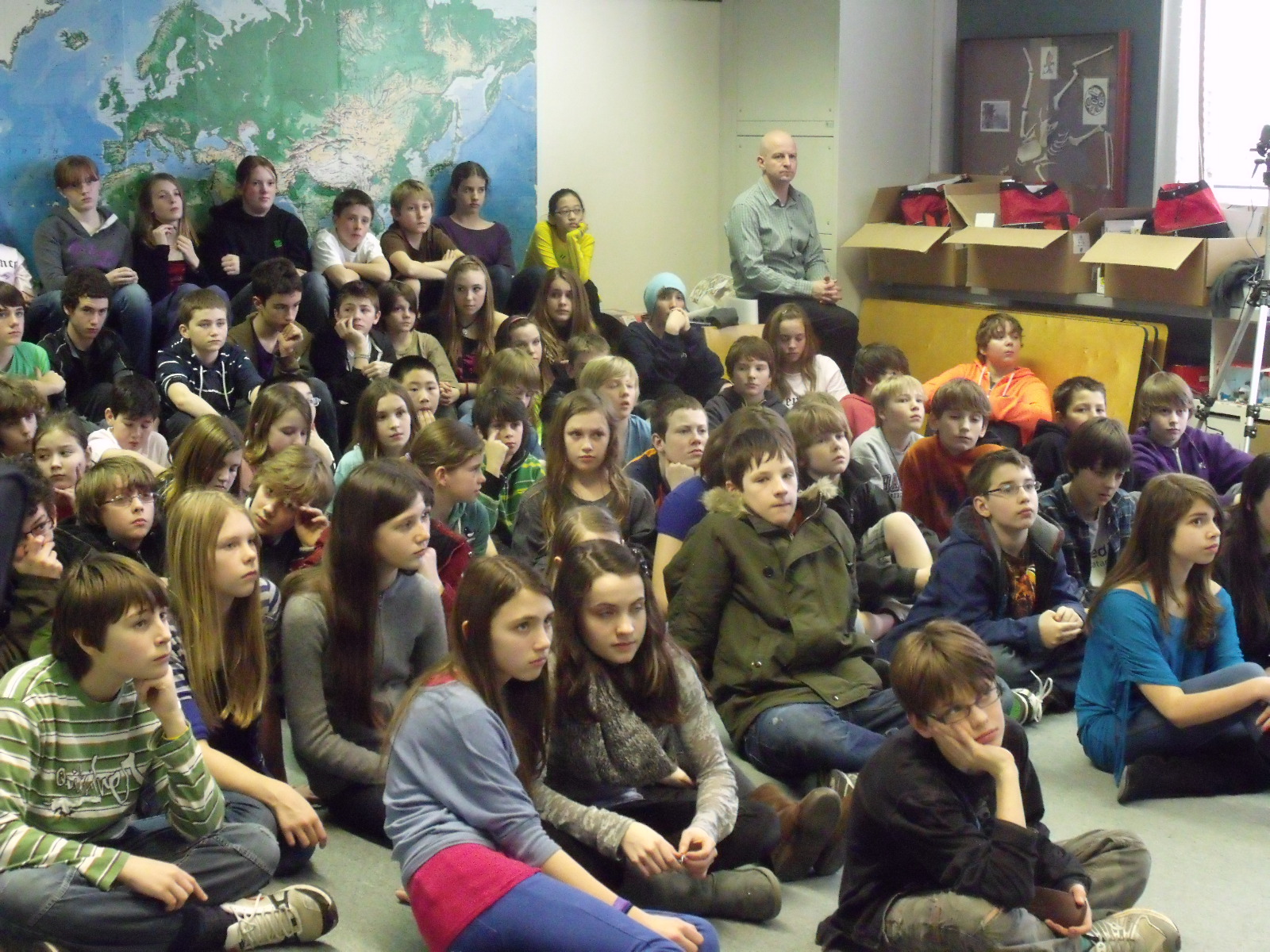
Trying  to do something new or different can be a real challenge sometimes.  Last week I had the opportunity to teach a class to students at Gleneagles Elementary School and West Bay Elementary School, and to share my story about how I started blogging. I also had the opportunity to learn about their work and their own digital writing.  The work at Gleneagles is part of a teacher inquiry project that focussed on the following question:

Will students include more meaningful detail and perspective in their weBlogs by focusing on social issues as their ‘purpose for writing’ and will continuous feedback, in the form of threads, lead to deeper understanding of a given issue?

The classroom was both face-to-face and virtual, and teaching students I couldn’t see was new and challenging.  Teachers are accustomed to reading a student’s body language, and receiving cues from the class.  Half of the students were in front of me at Gleneagles, but the other half were viewing the class on-screen at West Bay via Lync, and it was a one-way video.  The students could ask questions, but I didn’t feel the same connection as when they are in front of me, in a room, or at least when I can see them on video.

Of course, the whole topic was quite new for the students as well.  We all agreed that even two years ago, there would have been no way we would be having a conversation about digital writing and blogs; what it meant to have a personal brand, and what kind of topics we would write about if we were going to share our ideas with classmates, or the world.  Out of the presentation came a number of excellent questions:

  • Why do you blog versus using an alternative platform to share your message/knowledge?
  • Where do you get your ideas/inspiration for your many blogs?
  • How do you create an effective blog?
  • Where/how do you find the time to blog so frequently?
  • When you started blogging, were you inspired by anyone/anything in particular?  Do they continue to influence your thinking?  If so, by what/whom?
  • Do you follow other bloggers and use their techniques/messages as a model for your own?
  • How do you decide on the graphics, pictures, and links you embed when there seems to be so many to choose from?
  • How often do you post?  Why?
  • Do you believe the good connection with your readers is because of your transparency as a writer?

It is a different way to think about writing, and I often say that I think in blog posts.  When I sit in a meeting, I write my notes around themes that may later become posts; I can think of the visuals that might go with the words, and this is so different from only a few years ago.  I have started dozens of posts, which may or may not become a blog at some point, but they have helped me organize my thinking.  While I write about one post a week, I think about hundreds. It was great to hear students discussing the stories they would like to tell, because we all have stories; we all have our own powerful narratives to share.

Toward the end of the session, one of the excellent discussions was about commenting. I offered that when I comment on other blogs I try to expand on an idea raised by the writer, perhaps give a different point-of-view, or add additional information the writer, or other readers, may find interesting or valuable.  I am hopeful some of the students who participated in our session last week will do just that with this post — extend and reach out with all of your learning.  So, what did you find interesting/valuable? What are you going to do next?  What questions do you still have?

Thanks again to the students of Gleneagles and West Bay for your engagement.

Thanks also to Colleen Denman for session photos, and all of the teachers and administrators who were involved in organizing and setting up the session.

Read Full Post »

« Newer Posts - Older Posts »