Feeds:
Posts
Comments

Posts Tagged ‘Dean Shareski’

You can’t watch sports these days without being hit by gambling ads. They are everywhere, plastered across hockey broadcasts, embedded in pre-game shows, sliding into social media feeds. And they’re not just ads; they are slick, fun and social, often fronted by relatable celebrities touting the thrill of gambling. It’s hard not to be reminded of those old Camel cigarette campaigns: technically “for adults only,” but with a wink and a smile, kids got the message all the same.

This past week, the McCreary Centre Society released From Loot Boxes to Lottery Tickets: Gaming & Gambling among BC Youth aged 12–18. The report draws on surveys from more than 38,000 students across the province, and the findings are striking. One in five youth reported gambling for money in the past year, up from 18% in 2018. Online sports betting, while still less common overall, has doubled since 2018 (4% compared to 2%) and is now the gambling activity young people are most likely to engage in regularly. The most popular monetized activity, however, wasn’t betting at all but buying in-game items like loot boxes, something 20% of youth had done. And 12% of youth said their gaming had reached a point where they needed help. For gambling, that number was 1%, with another 1% saying both had become problematic.

In the United States, the story is similar but amplified: studies suggest that up to 60–80% of high school students have gambled in the past year, with problem gambling rates among young men and college students significantly higher than the general population.

What is striking is how these activities overlap and reinforce each other. While the survey doesn’t track individuals across categories, the fact that both loot boxes and gambling each draw in 20% of youth suggests a generation being gradually acclimated to risk-based spending, first through the games they play, and then through the sports they watch.

The report also highlights the ripple effects: poorer sleep, disrupted eating and reduced school attendance. The risk factors look familiar, poverty, loneliness, bullying and a lack of close in-person friendships. The protective factors do too: adult support, healthy boundaries around screen use and strong connections to school and community.

Earlier this year, my colleague and friend Dean Shareski asked in his blog, When Will We Talk About Sports Gambling in Schools? He pointed out what feels obvious once you see it: gambling is no longer tucked away in casinos or shady corners of the internet. It has been woven directly into the sports culture that so many young people love. The Vancouver Sun recently echoed the same concern, noting that online betting is driving a new wave of youth addiction risk.

Educators don’t need another health and well-being issue to worry about. But this one is particularly tricky. Gambling doesn’t leave bottles in lockers or the smell of smoke on clothes. It is silent, digital and invisible, until it is not.

We can’t solve this alone, but we can’t ignore it either. If preparing students for the world they are growing up in means anything, it means naming the risks hiding in plain sight. Gambling isn’t just an “adult issue.” It is already in kids’ worlds, delivered through the games they play, the sports they watch, and the phones in their pockets.

The question is not if we should talk about it. The question is when. And perhaps the answer is sooner than we think, not as a crisis intervention, but as part of the conversations we are already having about digital citizenship, media literacy, and making informed choices in an increasingly complex world.

The image at the top of this post was generated through AI.  Various AI tools were used as feedback helpers (for our students this post would be a Yellow assignment – see link to explanation chart) as I edited and refined my thinking.

Read Full Post »

Staying relevant is an ongoing journey.

This is ground I have in part, covered before. In 2018, relevance was actually my word for the year. As said in that post in January of 2018, “I am desperate to be relevant.” And this still holds true and is even maybe truer. The deeper I have got in my career, the more I have wondered if my thinking is still current. With AI dominating current education conversations, I feel an even greater need to stay relevant—not just as a leader but as someone who has always valued the balance between tradition and innovation.

Staying relevant is about balancing future demands while staying rooted in core values—a balance that has felt increasingly challenging lately. My recent writings on AI are part of this journey, reflecting my effort to understand how these technologies fit into our educational landscape. I want to be in the mix with important conversations for our profession. Whether navigating AI’s rise in classrooms or leading a school district, relevance means more than keeping up with trends—it’s knowing which to embrace and which to let pass by.


Rooted in Values, Evolving with Purpose
No matter the speed of change, certain principles—trust, empathy, and consistency—act as anchors. In education, our work isn’t just to adopt new practices whether it is literacy teachings or physical activity practices, it’s to assess how they enhance the learning experience while holding fast to the human connection that students need. Having worked in West Vancouver for 18 years now, for better or worse, my values and principles are very clear and public. And during this time, I have seen education become far more student-centric and personalized.


Adapting, Not Just Adopting
The key to relevance is thoughtful adaptation. Take AI, for instance: it can enhance lesson planning and save time, but how do we ensure it aligns with our broader goals? I’ve learned in both the classroom and through sports that not every innovation will fit, and it’s okay to be selective. Relevance comes from refining the tools that genuinely serve our values.


Consistency as the Foundation for Innovation
Consistency often gets a bad reputation in fast-moving industries. However, it’s precisely this stability that enables innovation. By creating an environment where trust thrives—whether in the classroom or on the court—we allow space for risks and experimentation. In my recent post Consistency is Often a Key to Positive Change I wrote about how our long-term relationship with Dean Shareski had been instrumental in some of the key innovations in our district.


Learning Across Contexts
One of the most powerful lessons in staying relevant is recognizing how different areas of life intersect. My experiences in education continually inform my approach to coaching, and vice versa. Whether it’s understanding how to motivate a student or an athlete, the principles remain: build trust, stay consistent, and be open to learning. Relevance is about seeing these connections and applying them across all aspects of our work.


Practical Tips for Staying Relevant

Learn Something New Every Year: Challenge yourself to master one new idea each year.

Stay Engaged with the Next Generation: Relevance is often about understanding younger voices and perspectives. Having younger leaders in key positions in our district has been healthy for everyone.

Adapt with Purpose: Don’t chase every trend; stay true to what works, and thoughtfully integrate what aligns with your core mission.  I have often said, “If you think everything in schools is important you really think nothing is important.”

Ultimately, relevance isn’t just about surviving change—it’s about thriving in it. When I wrote in 2018 and said, “It is easy to do this year just like last year.  I know that in the long run, that will not work.”  This sentiment sure hits home and even with more urgency knowing that the number of years I have to contribute and make a difference is shrinking (and seemingly faster than ever). By staying grounded in our values and embracing purposeful adaptation, we remain relevant in education and life.

How are others trying to stay relevant with how quickly things are moving in education?

The image at the top of this post was produced through Chat GPT 4.

Read Full Post »

Is anyone else feeling overwhelmed by how fast AI is evolving?

It is a sentiment I hear from a lot of school superintendents. The conversation about how fast things are moving and a resignation that it is impossible to keep up are commonplace.

We definitely have some of those same feelings in West Vancouver—whether it’s choosing the right tools or simply keeping up with the pace of change. We are trying to do some specific things to stay in the game, be AI relevant and not be so anxious.  What we have done and continue to do include:

Make leading AI part of people’s jobs – While declaring anyone ‘AI experts’ is silly, assigning someone AI leadership signals its importance and provides a go-to person for questions and coordination.

Build a cross-functional team – And the team looks different than with a curriculum implementation for example.  We have school and district administrators as well as IT personnel part of our core team around AI integration.

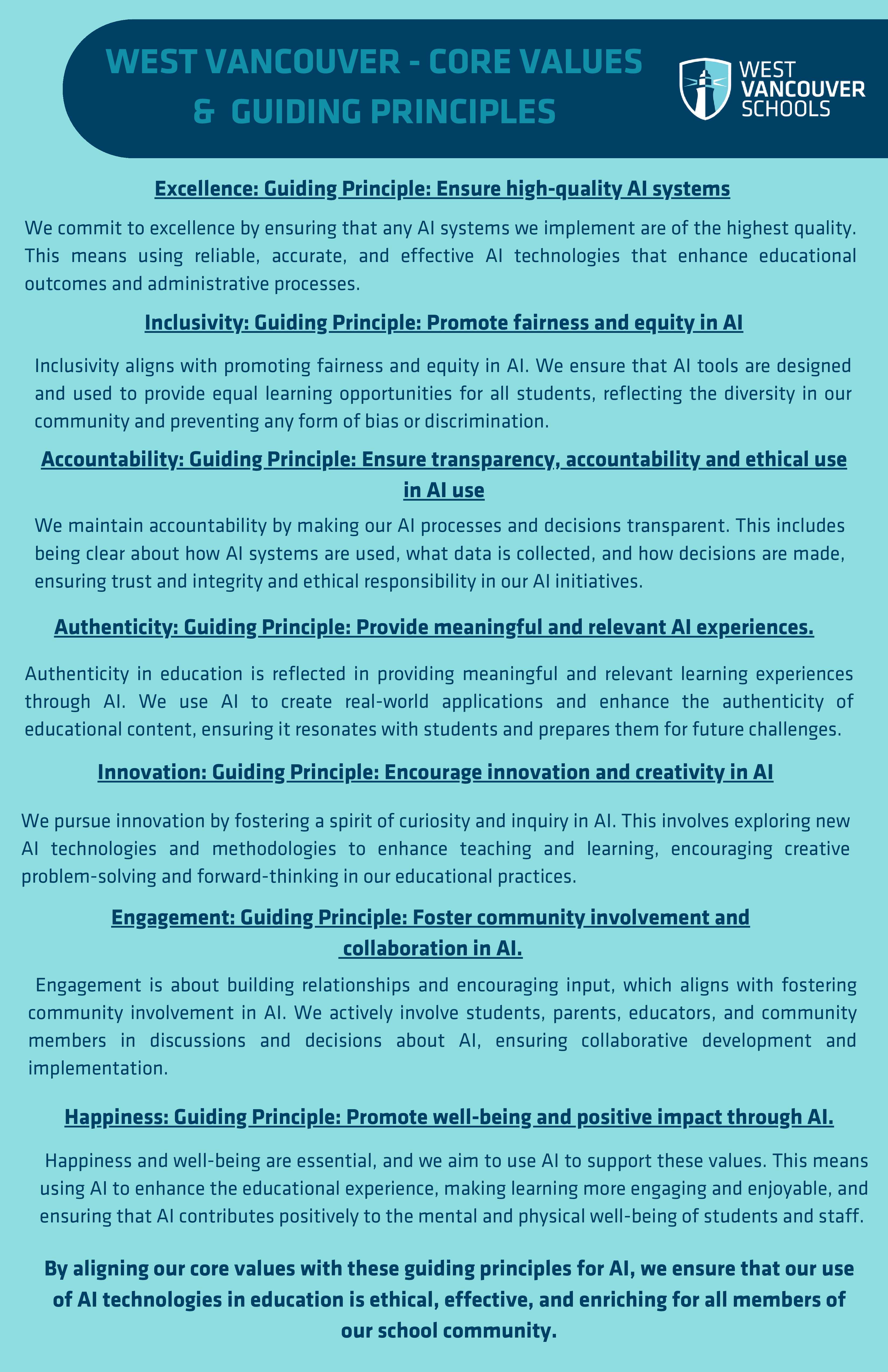
Creating and Revising Documentation – Setting clear guidelines and documentation ensures that everyone is on the same page as AI becomes more integrated into our work.  We started with our Core Values and Guiding Principles (HERE), Guidelines for the Use of AI (HERE) and When Do I Use AI visual (HERE). We also revised existing technology policies to ensure they were inclusive of AI.  

Focus on a few key AI apps – There are thousands of AI tools out there.  And it is easy to just talk about and debate which tools to use rather that just identifying a small number, supporting their use and getting on with better conversations around how AI can positively impact teaching and learning.  For us, Magic School has become a go-to tool for its ease of use and versatility in the classroom, helping both teachers and students adapt to AI technology

Engage the entire community – Often with new ideas or initiatives they apply unevenly to a school district.  One of the best things about AI is that it has uses throughout the system.  As I wrote recently there are great ways for trustees or senior leaders (HERE), or sports coaches (HERE), or parents (HERE), to use the tools to support their work and the work with students.  We have also leaned in to district-wide and school specific sessions specifically for parents.

Model AI in Action – Have you noticed this is the 5th AI related blog I have written in the last 2 months?  That is not coincidence.  My colleague Cari Wilson is also regularly blogging about it. And I have committed myself to spending a couple minutes at all meetings this year showing my learning with AI.  Over the last two weeks this has included meetings with Trustees, parents, principals, office staff and others.  

Leverage external experts – We have engaged with Alec Couros who worked with all district staff and then smaller groups in our district, and will be back this month to work with parents.  We have also spent five days with Dean Shareski and Adam Garry and are planning three more for the new year.  It is always a balance of using internal champions and outside experts. 

Join local and global AI networks – Locally we are working to network teachers inside our district and then network our schools around their AI work.  And then we have built a network of about 12 districts in Metro Vancouver that are working and sharing resources around AI. This is work that Shareski, Garry and ALP Learning are supporting.  We are also part of a network with Michael and Bailey Fullan and districts from across Canada and a network in partnership with C21 Canada, Mindshare Learning and Dell that is looking at AI practices across the country.

It is not fluke when you see things are moving fast, and you want to get out front what you need to do.  And it is never just one thing.  I am definitely bullish around the impact AI is going to have on schooling and want us to lead and guide what happens.  So we need to be doing things to look around the corner to what is coming next.

The speed of AI is exhilarating, and with so much possibility ahead, I’m excited to see where we can take it together.

The original blog post was posted into Chat GPT with the following prompt “Be a critic of this blog, what could be improved or clarified to make it more readable for the audience.” Feedback was incorporated into the final copy.  The image at the top was generated through the enterprise version of Magic School.  

Read Full Post »

Dean Shareski’s recent blog post about his time working with West Vancouver Schools (HERE) got me thinking. He is good at that.  His blog has been pushing my thinking for 20 years.

His recent blog post on his work with our district captures so much of what makes our partnership valuable. In his post, he is generous about the people and schools in our community and the exciting current work around generative AI. But what stands out to me isn’t just the highlights of the week—it’s the consistency of our work together over the years and how that consistency has fostered trust, which has become the foundation for innovation in our district.

 Trust Through Consistency

One of the most underrated factors in educational progress is the value of steady, consistent leadership and support. Dean isn’t just a consultant who drops in and out; he’s become a trusted partner who fully understands our vision and works with us to help move it forward. His ongoing presence has allowed us to build a relationship rooted in trust, which, in turn, has given us the confidence to take risks and innovate in meaningful ways. We have done this with others as well.  You can bring in someone for an hour or a day and you will get some initial enthusiasm – but it is the ongoing connections that move the work.

When you think about innovation, it’s easy to assume that change is the driving force. In reality, constant change without a strong foundation can lead to instability and confusion. What we’ve found in our district is that consistency—having the same voices, the same leaders, and the same trusted advisors—creates the conditions for genuine, thoughtful change. Of course, as a superintendent about to hit 15 years in the position, I am biased towards consistency.  When our team knows that the support they’ve relied on is there year after year, they can focus on pushing boundaries and exploring new ideas, knowing that their foundation is secure.  

In our classrooms, this foundation of trust and consistency has allowed our teachers to embrace innovative practices confidently. For example, our recent work around generative AI is not just a theoretical exercise but one that is being thoughtfully integrated into learning experiences. Teachers, secure in the knowledge that they have ongoing support and guidance, will be able to experiment and refine new methods in a way that directly benefits students. This steady approach ensures that our educators aren’t overwhelmed by constant change but can focus on delivering powerful, meaningful lessons.

This emphasizes the direct impact of innovation and leadership on daily teaching and learning, aligning the broader themes of trust and consistency with the tangible outcomes in the classroom.

Innovation Through Stability

Dean’s work with us around generative AI is a perfect example of how innovation flourishes in stable environments. We didn’t jump into AI because it was the trendy thing to do. Instead, we are laying the groundwork, with thoughtful conversations, professional development, and collaboration. This steady, deliberate approach is what allows us to dive deeper into AI in a way that feels sustainable and aligned with our broader educational goals.  In the end our goal isn’t AI, it is the creation of powerful learning experiences.  

When leadership and external partnerships are constantly shifting, it can be hard to build momentum. But in West Vancouver, we’ve been fortunate to have consistency in our leadership and in those who support us. This has allowed us to move forward faster and more effectively than if we were constantly changing course. With Dean’s ongoing guidance, we are able to focus on refining our work with AI, rather than starting from scratch each time we introduce a new initiative.  

Moving Forward With Confidence

There’s a lesson here about the power of consistency in all aspects of education. While we often hear that change is necessary for growth—and it is—it’s also true that change for the sake of change can slow progress. The real magic happens when consistent leadership and support create an environment where trust thrives and innovation can happen organically.

As we continue our work with AI and other innovative practices, I am grateful for the steady partnership we’ve built with Dean Shareski and others like him. It’s this consistency that has allowed us to push the boundaries of what’s possible in our classrooms while maintaining a clear sense of direction and purpose.

In West Vancouver, we are committed to continuing this approach: building on the foundations we’ve set, nurturing the trust we’ve established, and embracing innovation at a pace that feels both exciting and sustainable.

Thank you, Dean, for your ongoing support and for helping us model a culture of yes—one that is widely shared in its commitment to trust, consistency, and  moving forward together.


Read Full Post »

The tradition continues!  Like Darlene Love performing on David Letterman, or gathering the family around the TV to watch Elf and Christmas Vacation – it is year 14 for the annual year-end post at the Culture of Yes.  If this post is your first “Top 3” List – you get a mash-up of your aunt’s family Christmas letter and one of those countdown lists that everyone has to finish the year.  Thanks for once again being a part of this community in 2023.   

If you are wondering what you might have missed, here are the previous years Top 3 lists:  2022 (here) 2021 (here) 2020 (here) 2019 (here) 2018 (here) 2017 (here) 2016 (here) 2015 (here) 2014 (here) 2013 (here) 2012 (here), 2011 (here) and 2010 (here).

Now, on with this year’s results:

Top 3 “Culture of Yes” Blog Posts which have generated the most traffic this year:

  1.  The Most Important Game of My Life
  2. 27 Ways Schools are Better
  3.  The Last 1000 Days

Interesting to see that the three most personal pieces I wrote this year were the most read.  I made a commitment this year to trying to write some longer stories, and the first one I did, The Most Important Game of My Life, has already become one of my most read posts ever.  I will try to tell more stories again in 2024.  Also, interesting is to see how people land on my blog.  I have had a steady flow of about 1000 people opening it via email for the last decade.  And in the past, most of those who found specific posts, reached the blog via Twitter (X) or Facebook.  Both of these have declined, and LinkedIn is becoming a more popular referrer to the CofY.  It is interesting to see what happens as the traditional social media spaces all seem to be having their challenges so where will people go to share and connect?   And what was the least read post of the year?  Leaders lending their calm.  Having done this for a while – I can usually predict which posts will resonate more widely – based on the topic and timing of publication.  Of course, as I have often written, the blog is not just about clicks (Though, I do like my metrics).  

Top 3 Shifts in BC Education in 2023:

  1. Updates to the Student Reporting Order – a number of modernizations but most attention around no letter grades at grades 8 and 9
  2. Bill 40 – acknowledge the crucial importance of First Nations involvement in the education of Indigenous students
  3.  AI – probably on every list like this, not only in education but in every industry

Top 3 Local Education Stories from 2023 that will still be hot in 2024:

  1. Teacher Recruit and Retention 
  2. More students
  3.  A focus on literacy and numeracy

The first two of these are really related.  As we see more students, there will be even more pressure for more teachers.  The teacher recruitment and retention trend is not a local issue, but a global issue.  The current North American strategy seems to be to take teachers from other places.  Of course, this short-term fix does not really address the problem.  We need more people wanting to become teachers and new pathways for them to become qualified.  Canada’s huge population increases are being felt in schools, and this too seems to be continuing into 2024.  One of my last post this year (HERE) focused on the latest round of PISA results helped to focus attention on literacy and numeracy.  Again, it is not only British Columbia, but more broadly across Canada, there is going to be attention on the traditional core learning skills. 

Top 3 Predictions for other edu-trends in 2024:

  1.  More computers but fewer phones in schools
  2. Focus on supporting leaders and leadership
  3. Efforts to see longer term impacts of COVID on education

We are allowed to let our thinking evolve over time, and I am less bullish on my views of cell phones in schools than I was a decade ago.  10 years ago, I saw cell phones as a way to bring the internet to all students.  As more students brought a larger internet device (table, laptop, etc.) the cell phones purpose for this diminished.  I most recently wrote about phones in school in 2019 when I suggested we ban parents from using them (I still hold to this view!).  I would suspect more discussions like those now in Ontario, that place more limits on phones in schools.  In the previous topic, I wrote about the broad need for more teachers.  There is also a need to support those in and aspiring to school and district leadership.  We are seeing fewer people looking towards these positions, and this reality is something I hear from many of my superintendent colleagues. As Mark Perna wrote in Forbes this past summer, “The looming shortage of quality school leaders is everyone’s problem.”   Finally with the long term impacts of COVID – there is more data being released that shows shifts in mental health and learning levels post-COVID compared to pre-COVID.  There is a lot to unpack here, and need to understand what we need to do differently going forward if our student population is simply different than it was before.

Top 3 Free AI Tools for education I have used (not counting ChatGPT):

  1. summarizetech
  2. AudioPen
  3.  Fathom

I will be clear I am a novice hear, and likely use far fewer tools than many of you reading this post.  While ChatGPT got all the attention, there are many other AI tools being integrated into schools. 

I get sent a lot of videos and sometimes you just want a quick summary – that is where summarizetech comes in.  You add the YouTube link and it gives you an AI generated summary of the video.

I have used AudioPen to help get me started on emails and blog posts.  You speak into the microphone (you can even ramble) and it converts to text and then cleans it up.

Fathom is one of a few meeting summary tools I have tried.  While I am not on Zoom as much as I was a couple years ago, these tools use AI to summarize meetings and dispense of the need for a notetaker.  

And I also need to mention that before using any of these tools with students, one needs to be careful of privacy and security issues that must be considered.

Top 3 artists for me according to Spotify this year:

  1.  Paul Simon
  2.  Simon and Garfunkel
  3.  James Taylor

Just what year was this for?  My music tastes are pretty stable. My only “new” artist in the Top 10 was Ocie Elliot – a folk duo out of Victoria.  As much as I champion change if the music came out after the start of this century, it is very difficult to convert me into a fan.

Top 3 new (at least to me) podcasts I began to listen to in 2023:

  1. Good Sport
  2.  The Economics of Everyday Things
  3. The Redemption of Jar Jar Binks

Good Sport from TED is hosted by Jody Avirgan.  This show is not your regular sports podcast – Jody shares stories you are not hearing elsewhere.  If you are looking for an episode to start with, I would try: From F1 to Banana Ball: How to Make a Fan.  The Economics of Everyday Things is a quick weekly podcast – usually just about 15 minutes.  Zachary Crockett is also a great storyteller.  A first one I would recommend is his episode on the economics of Girl Guide Cookies.  Finally, the Jar Jar podcast is a quirky six-episode series on one of the most hated movie characters of all-time.  I remember the controversy when the film came out, and it was interesting to revisit it, also see it in the context of information spread during the early internet.

Top 3 people keeping Canadian educators connected:

  1. Dean Shareski
  2. Robert Martellacci
  3. Karen Yamada

Dean Shareski has appeared on this year-end blog in other categories before, but this year it is for some new work he has taken on.  He has started a regular podcast where he interviews educational leaders across the country. The CanadianED Leadership Show is a great listen for everyone who is interested in education.  His interview with John Malloy was my favourite of 2023.   Nobody is better at making connections in Canadian education that Robert Martellacci.  His Mindshare Learning has been the go-to spot for innovation in Canadian education for 20 years.  Robert knows everyone and is one of the most positive and curious people I have met.   I have known Karen for more than a decade.  She has helped steer the C21 Superintendent Network over this time.  Karen brings people together around big ideas and finds connections across Canada.  With little federal involvement in education in Canada, we are fortunate to have Dean, Robert and Karen keeping the country linked together. 

Top 3 edu-related TED Talks I watched this year:

  1. The rise of the “trauma essay” in college applications

 2.  How to make learning as addictive as social media

                  3. How AI could save (not destroy) education

Top daily 3 streaks I still have going:

  1. 10,000 Steps
  2. Running 5 km a day
  3. Photo posting to Instagram

Hey – aren’t those the same from last year?  Why yes, they are – but that is a sign they are good streaks.  The steps streak in now at every day for 10 years.  I wrote about the running streak HERE when I crossed the 1000 day mark, and I continue to post a photo every day – something that is now at 9 years and counting.  

Top  3 photos from this past year that make me smile:


I have such a great job connecting with students. Elementary students telling me about their learning is so awesome!

University limits the days everyone is together in our house – but they will still find a way to go strawberry picking on Father’s Day!

One of my summer joys is I get to travel around North America coaching basketball. And this past summer look who I ran into in Chicago!

As I have noted above, I still post a photo a day – well over 3,000 straight days of this.  And I save them to my Archive in Instagram.  And scrolling through them always brings me joy.  I shared the 3 above – but I could have picked dozens of them – each one with a story. 

Final Thoughts

The Culture of Yes continues to roll on.  I have always written about doing it for myself, but it still feels good when someone references something I wrote – event sometimes a decade ago that made them think or act differently.   

It will be interesting to see how AI impacts blogging going forward.   I have begun to use Chat GPT in my writing process quite regularly, but in a supporting role to my creative thought.  

As our traditional media has contracted even more in recent times, I feel more determined than ever to write regularly and help influence conversations around education.  This space continues to be my favourite for thinking about, and working through ideas around education as it is and how it could be.

To all my friends and colleagues in West Vancouver and beyond still reading, hopefully you have a great year to reflect on.  

All the best for a wonderful 2024.

Read Full Post »

I love this notion that a leader can lend their calm.

I was recently listening to The Canadian-Ed Leadership Show hosted by Dean Shareski and his interview with the former  Director General of the Lester B School Board in Montreal, Michael Chechile.  He was relaying a story from Michael Fullan.  Chechile, quoting Fullan, said, “you don’t only show your calm as a leader but you lend your calm.”  This is such a wonderful extension to what we often say about modeling the calm we want in others.

Calmness is such an important quality in school leadership. As Chechile describes, it is one of the soft skills that you need to be a team player.   This notion of lending your calm is also referenced in the work of Stuart Shanker, someone who has greatly impacted my thinking – when their storm meets your calm, co-regulation occurs.  While it can be great in the classroom with students, the same principles apply in the interactions school and district leaders have with other adults in our work.

I really like this simple idea of lending your calm to someone else. It can mean offering a sense of tranquility, reassurance, or stability to another person during a stressful or challenging situation. It involves sharing a peaceful and composed presence to help someone feel more at ease or supported.   I am sure it is true in many professions, but I can speak with most authority in the school setting, that calmness from school and district leaders can be one of the most important qualities in times of heightened emotions.  

This idea of extending emotional support and helping others navigate difficult moments by sharing your own inner sense of peace or calmness is very powerful. This act can be particularly valuable in situations where someone is feeling overwhelmed, anxious, or stressed, as your quiet presence can have a calming effect on them.

When I think to the specific work of school and district leaders, lending our calm can:

  • exhibit leadership presence
  • manage a crisis
  • help in decision making
  • assist in communication
  • build support and confidence
  • model resilience
  • promote wellness

School and districts leaders seem to be faced with increased situations of heightened emotions.  This simple idea of lending one’s calm, can help reframe these situations, and help us slow down and react more thoughtfully.

Thanks Dean, Michael, Michael and Stuart for sharing this thinking.

Read Full Post »

I have been thinking about those educators who have influenced me.  And I started making a list. I didn’t want to just do my “favourite” teachers or colleagues but wanted to take a mix of some of the very best I have ever had as a teacher, or worked with, and try to articulate a simple lesson from them that I have tried to apply to my work.

I had about 70 people on my list, but decided to limit this post  to 26 teachers as I finish my 26th year in education.  And then focus on 26 simple lessons from the people I knew as an elementary and high school student, and it my professional stops in Richmond, Coquitlam and West Vancouver.

Here are some ideas I try to take and apply:

Rod Allen – If there is one person most responsible for the progressive curriculum and assessment in British Columbia it is Rod.  I got to know Rod when he worked at the Ministry of Education and learned from him as he would balance the demands of government and the goals of education.  Lesson – No matter the audience, hold to what you believe and people will respect you.

Carol Bourne – Carol was my grade 8 and 10 English teacher.  She got me to read fiction which was not something I had really done before and she had high expectations.  Lesson – A wry sense of humour can go a long way in a high school English classroom.

Pat Brown – Pat was my Socials 11, Western Civilization 12, and Literature 12 teacher.  He built relationships with his students that went beyond the classroom.  I remember sushi dinners and movie nights as a class.   Lesson – You can be completely prepared for a government final exam without ever practicing a government final exam.

Ann Caffrey – I have written before about Mrs. Caffrey (here).  She is a reminder of what a difference a teacher can have on a student’s trajectory.  Lesson – Using a grade 2 boy’s first AND middle name will really get their attention.

Alex Campbell – When Alex became the principal of my junior high in grade 10, it was a completely different school in 3 months.  He and the vice-principals changed the culture and tone almost immediately.  I would always remember this lesson of the impact of leadership. And how blessed I was that Alex came to work with me in West Vancouver for 3 years as Director of Instruction and Assistant Superintendent. Lesson – Principals have a huge impact on school culture.

George Couros – George is a bit of an edu-celebrity.  I like to think I knew him before he was such a star.  George’s first book The Innovators Mindset did a great job of taking all the little changes that we see happening in education and weave them together as part of a big change narrative.  His regular blogging is admirable and he is one of those people I will always read.  Lesson – Education needs storytellers.

Judy Duncan – Judy retired a year ago as the Principal at Rockridge Secondary.  Like at West Bay Elementary and many other stops before, she was loved.  She had that “it” that is hard to explain – a mix of grace, humour and relentlessness.  Lesson – Everyone wants to be part of a winning team.

Paul Eberhardt – I first met Paul about 30 years ago.  At the time Paul was already a well established basketball coach.  We ran programs at neighbouring schools.  He could have tried to recruit all our players to make his team better, but he took the view with me and others that if we all grow strong programs it is good for all of us.  And he was right! Lesson – A model of abundance is better than one of scarcity.

Dave Eberwein – The first person I hired as Superintendent was Dave.  He started as Assistant Superintendent on the same day I started as Superintendent.  Dave and I would challenge each other’s thinking, and we would always land in a better spot.  Having team members with complimentary skills is so important – a real reason why Dave and I worked so well together.  Now Superintendent in Saanich, Dave has a great blog worth following.  Lesson – When hard things are the right things to do you need to do them.

Michael Grice – Michael was appointed vice-principal at Riverside the day I was appointed principal.  He was a master of the timetable, and always took on hard tasks that were the right thing to do.  With his background as a music teacher, and his daily bow-ties, in some ways we couldn’t have been more different – but we just clicked.  Lesson: Sometimes the stars in the school don’t need to be in the limelight.  

Fred Harwood – Fred taught math at McRoberts during my time at the school as a teacher.  He was already well established.  The gesture I will always remember was that he traded courses with me in my first year, to give me a lower level math course to teach – giving me one less prep and him one more.  Few people would have done that.  Lesson:  Teachers are always learners.

Geoff Jopson – Geoff was superintendent just prior to me in West Vancouver.  We actually worked together for 14 months where it was known I would be assuming the role.  Since then, Geoff has continued to be involved in the community and a huge supporter of public education.  Lesson:  Always be advocating for a strong public education system.

Gary Kern – I first worked with Gary in Coquitlam when we were both administrators and then later in West Vancouver on the district leadership team.  Gary moved from public system, to private sector, back to public education and then to independent schools.   Most of us in education are averse to moving around, but it has given Gary such a more broad perspective on issues.  Lesson:  Career movement in education is healthy.

George Nakanishi – George was my grade 5 teacher at Woodward Elementary School.  And the teacher who introduced me to basketball.  His class was also a lot of fun.  Still today, I remember specifics of assignments we did in his class.  I loved getting to design my own island.  Lesson:  Let students bring their passions into their learning and give them choice.

Trish Nicholson – Trish is one of the best coaches I have known.  She has been recognized for her basketball and volleyball coaching and also been to multiple world championships and Paralympic games as a coach.  She is also always finding ways to get better as a coach.   Lesson:  Prepare for working with grade 8’s like you do when you work with Olympians.  

Mary O’Neill – Mary is another vice-principal I worked with at Riverside Secondary and she was later a principal at Charles Best. She put more hours into the work than anyone I have ever known.  I couldn’t believe how she had so much energy.  We were a good team, as she invested in situations that I didn’t have the patience for.    Lesson:  Kids need adults on their side.  

Doug Player – Doug was the long-time superintendent in West Vancouver, but I first met him as a student of his in the San Diego State University Master’s Program.  Doug always brought a different perspective to an issue than what was the common refrain.  Lesson:  Even high performing jurisdictions need to be looking for what is next.  

Rob Pope – Rob was an English teacher at Riverside Secondary, and teacher lead of the school newspaper The Eddy.  He also enjoyed the music of the 1960s which went a long way with me.   Lesson:  We need to give students voice, even if we don’t always agree with that they say.

Stuart Shanker – Stuart is one of Canada’s leading voices around self-regulation.  We have had the pleasure of having him in West Vancouver several times to work with our staff and parents.  My first post about Stuart from 2010 is one of the most read ever on my blog.  Lesson:  There is no such thing as bad kids.  

Dean Shareski – Dean has always been on the leading edge of technology in schools.  But what stands out is his commitment to humanize the work and be serious without being too serious.  Lesson:  More Joy.  

Doug Sheppard – Doug gave me “Satisfactory” in my teacher evaluation in 1996 (so now you know who to blame!).  I followed him to Coquitlam and now he is the Superintendent of Schools in Delta.  My clearest memories of Doug are as a phenomenal teacher that so many of us aspired to be.   Lesson:  A final exam does not need to be a traditional test.

Sue Simpson – Sue was the counselling department head at Riverside Secondary when I was there as  vice-principal and later principal. She was a keeper of the school’s history and kept many of us inline.   Lesson:  In the best schools the administrators and counsellors work as a tight team.  

Gail Sumanik – Gail was the first principal I worked with as a teacher at McRoberts.  She was a wonderfully caring principal and a great mentor.  From Barrie Bennett to Rick DuFour, she introduced me to learning outside my classroom.   Lesson:  Adult study groups build community.  

Don Taylor – Don was my grade 7 teacher and we then later we coached elementary basketball together. He spent much of his career as an elementary school principal keeping school fun.  He was awesome at hosting events – as a teacher and in the years since.  Lesson:  Keeping schools and communities connected is vitally important.

Ken Whitehead – Ken was my grade 6 teacher.  The truth is what I remember most was that he was an Olympic soccer player and loved Bruce Springsteen.  Well, that and he made learning fun.  It seems like such a small thing, but he got me to see a speech language pathologist for a lisp and I am forever grateful.  Lesson:  Look to make a difference for each child.  

Yong ZhaoYong is a leading voice education across North America.  I have had the chance to work with him on various occasions over the last decade including having him as my doctoral advisor at the University of Kansas.   Lesson:  We need to take more chances in education and challenge the current model.

Happy Summer everyone!  Congratulations to all those involved in education – staff, students and parents for all that we have accomplished this year.

The Culture of Yes will slow down over the summer – maybe one or two posts but will be back strong in the fall as launch the 2022-23 school year.

Read Full Post »

When it comes to schooling everything is essential.  At least that is what we are made to believe.  While I often hear about what should be added to schools, I never hear any arguments about what should be removed to make space for new content.   One of the most prolific of these debate is handwriting – which I waded into a decade ago (and won’t again here).  One lesson from the handwriting debate is as much as we want schools to be doing more and different things, we are pained to think that our kids could miss out by not having everything required in school that we had mandated for us.  We generally seem to wish our kids to have all the same experiences we had, just more and better.

COVID has really forced us to have these conversation around what is essential, in ways that we were unable or unwilling to do outside of a pandemic.   No longer could we keep doing things because we had always done it, or everyone else was doing it in their classes.   We have had to truly adopt the Marcus Aurelius quote, “Ask yourself at every moment, is this necessary.”

I have written before about the particular impact of COVID on high schools.  HERE is a recent post on COVID edu-trends that will stick and HERE is a link to a recent white paper that Dean Shareski produced working with over 200 educators from our region examining scheduling, blended learning, assessment and wellness in our secondary schools in COVID and beyond.  

More than anything else, COVID has really made us rethink the use of time in schools.  In the pre-COVID era, we had neatly organized blocks, all of the same length, with each course the same number of blocks over the year.  Some teachers had this planned down to the minute.  While jurisdictions across North America have faced different realities, the last year has seen shifts from “regular” blocks, to virtual, to hybrid to new models.  In our district, there is now more flexible time for students, and blocks are of different lengths on different days.  The traditional block model has been disrupted.  And while we can’t ignore that these efforts are occurring in a pandemic – the new models are working for many students.  

This year has been both utterly exhausting and invigorating for many colleagues.  They have had to reinvent their courses from the ground-up.  And in doing so they have cut out a bunch of stuff that now no longer is as necessary as it seemed, but they have also been able to give renewed energy to other materials – content and competencies that are truly essential and ones which bring out the passion of the students and teachers.

Asking ourselves, Is this essential?  is always a good question to ask.  But of course, we often don’t – not just in schools, but in many parts of our lives and society.  COVID is making us take a hard look at content and competencies and the results are showing that we are building back a schooling system that is different than the one we had just a couple of years ago.  

Read Full Post »

The Culture of Yes turns 10 this month. 364 posts later, and here we are.

Starting this blog seemed like a natural fit.   In an earlier time I had been a newspaper columnist so was pretty familiar with organizing thoughts into 550 words at a time.   And in 2010 I was just officially starting as Superintendent so I was looking to differentiate myself and find a way to have a voice in a way that was authentic and made sense for me.  At the time I had a blogroll that was inspiring.  I would read Dean Shareski, or Will Richardson, or David Warlick and be excited.  The world of web 2.0 was booming and each post I read was opening me up to new ideas and a new world I was trying to understand.

The world of education blogs has really felt like it has had a boom and bust era.  My 2010 entry was just before the boom.  We had a community in BC of edu-bloggers including Chris Wejr, Elisa Carlson, Cale Birks, Dave Truss, Brian Kuhn and others.  It was just as the way we get education news was shifting.  Blogs were opening up classrooms, schools and districts to the community.  It was interesting to see what was being written in local blogs driving conversations in school and in the media.  What I saw in a blog post Monday, I would read in a Janet Steffenhagen story on Thursday in the Vancouver Sun.  The modern network was truly coming alive.  I also loved how blogging came alive in our schools.  We still have a number of staff blogging – including Cari Wilson who is still so great at posting every week!

And yet within 4 or 5 years the internet was littered with well intentioned but discarded educational blogs.   It is not as bad as it sounds.  Like with any trend or fad you get this huge growth, and then some people decided it wasn’t for them, and moved on.  We began to consume more through social media – twitter posts were far easier than 500 word blog posts. And as I wrote, the comments really slowed down (ironically that post about the lack of commenting has 86 comments). And the comments that came were not on the post but on Facebook or Twitter.  The conversation actually happened in multiple places which was not really a good thing – I would often think of a conversation of a post on Twitter, that these people should meet the people talking about it on Facebook, they would really learn from each other.  That said, my thanks to the close to 4,000 comments that have been shared directly on the site – they have challenged me, taught me and encouraged me.  I looked back at my first post – thanks to Brian Kuhn for being the first person to leave a comment.

In my first post I wrote:

It is an exciting time in education.  I feel like we are in the middle of a dramatic shift in what “school” looks like.  We will look back on this time as a pivotal point of change.  I look forward to sharing ideas, and connecting with those inside and outside our system as we work our way through it. 

And it was an exciting time, and is an exciting time in education.  This blog has really been career defining for me.  I love to look back at what I used to think and write about, how I believe some things more strongly now than when I wrote them and on other topics my views have changed – that is what is great about learning in public – I can share this.  And if nobody else even reads it, the act of writing down ideas and taking a position has been exceptionally powerful for me.

When I was asked to describe my blog goal, I have said, I know I am not the New York Times or Wall Street Journal of education blogs.  I am more USA Today.  And while we need the more formal writers, we also need those who are trying to be accessible to those not in education.   I have tried to be a serious thinker who doesn’t take himself too seriously.

Today, I love following other superintendent bloggers.  In BC I read everything that Dave Eberwein, Kevin Godden and Jordan Tinney write.  I just wish more of my colleagues would blog.  As my regular readers know, my doctoral research is around the role of the superintendency and I am fascinated by the role and the work.   I also really appreciate how supportive Jay Goldman and the AASA (School Superintendent’s Association) has been to regularly highlight superintendent blogs in their magazine and to take several of my pieces and work with me to convert them into magazine columns and articles. 

As to my posts – if I want to chase clicks, I find if I write about parenting and sports those fuel interest.  I really enjoy writing about both topics so it is fun to stir debate around them.  They are actually the easier posts to write.    My most-read post to date comes from November of 2010 on Stuart Shanker and Self-Regulation.  I have written about Stuart’s work a number of times, and it is an example of thinking that has really changed my view of education in the last decade.  More personally, my post Teacher during the 2014 teacher’s strike about my dad really sticks with me.  

And yes, every-time I still hit publish I feel anxiety.  I think my high school English teacher is out they’re noticing grammar errors (that was intentional).  And I worry (it has only happened a handful of times) someone will splice a  part of my text and re-post it social media to try to embarrass me or make a political point.  But my blog has changed me.   It has opened doors for me for work, it has introduced me to many new people and given me a platform to share.  Most importantly, it has given me voice and confidence.   I am still a proponent of having everyone write for the world, as we all have stories to tell and we want our children to feel this comfort from a young age.

So, to all who have read and engaged with me over the last 10 years – thank you.   Hopefully I have helped assure you that superintendents are actually human being and not just “those guys” in the board office.  I love our community and my head is full of ideas I want to write and think through with you in this space in the months and years ahead.

I look forward to the next 10!

Read Full Post »

My One Word (2018)


This is the 3rd year of my “One Word” Tradition.  In 2016 I wrote about Hungry and in 2017 my first post of the year was dedicated to Hope.  I feel both words were ones that were good ones for the times they were written.  In looking at 2017, it was a year of hope with shifts in education and a new provincial government.  When it came to the world of teaching and learning, it was hope realized.

So what about 2018?

This year my word is Relevance.  It is interesting to see the social media posts as others post words for the year.  I see words like love, gratitude, empathy and others.  And when I test them out for me – they do not work.   My digital colleague, Dean Shareski suggested my word should be “Lucky” and he actually had a good point.  But, I landed on relevance.

I am desperate to be relevant.  It is part of why I blog.  Blogging forces me to make my thinking public.  It is easy to shy-away from the big conversations, but I want to be in the middle of them.  I want to continue to think about education in ways that helps shape the narrative about our future.  I do not fear disagreement, but I do worry that I get to a point where my thoughts and ideas are just ignored.  That would be way worse.  I want to be part of the dialogue.  And relevance is largely up to me in this regard.  I need to continue to read, question, explore and get out and see what others are doing.  I work in a very high performing school district, which has a great reputation for innovation.  But we always need to be looking beyond where we are.  Our job is to be looking around the corner, to help people see what is next.

It is not just my own need to stay relevant to the educational world, and ensure our district stays relevant.  Relevance speaks to what we need to have happening every day with students in our schools.  From the “what” we teach to the “how” we teach it, we need to ensure we do it in ways to meet the needs of the modern student.  Just before Christmas our Board approved new programs that will create specialty programs for high school students in areas including:  table tennis, environmental sciences, engineering, computer animation and volleyball.  These add to the choice program opportunities that include options from robotics, to rugby to honour choir classes at night and basketball academy classes on the weekend.  Everything we hear about public education being the key to a democratic society is very true.  And it is true that public education is about the ongoing growth of our communities.  And it will stay that way if our system continues to be relevant for our students in this changing world.

So, as someone finishing their 11th year in this district, and 8th year as Superintendent, I know relevance could be a blind spot for me.  It is easy to do this year just like last year.  I know that in the long run, that will not work.  So here is to a 2018 of doing things everyday that add to the conversation, push the work forward and keep me, my thinking, our district, our students’ experiences and public education relevant.

Read Full Post »

Older Posts »